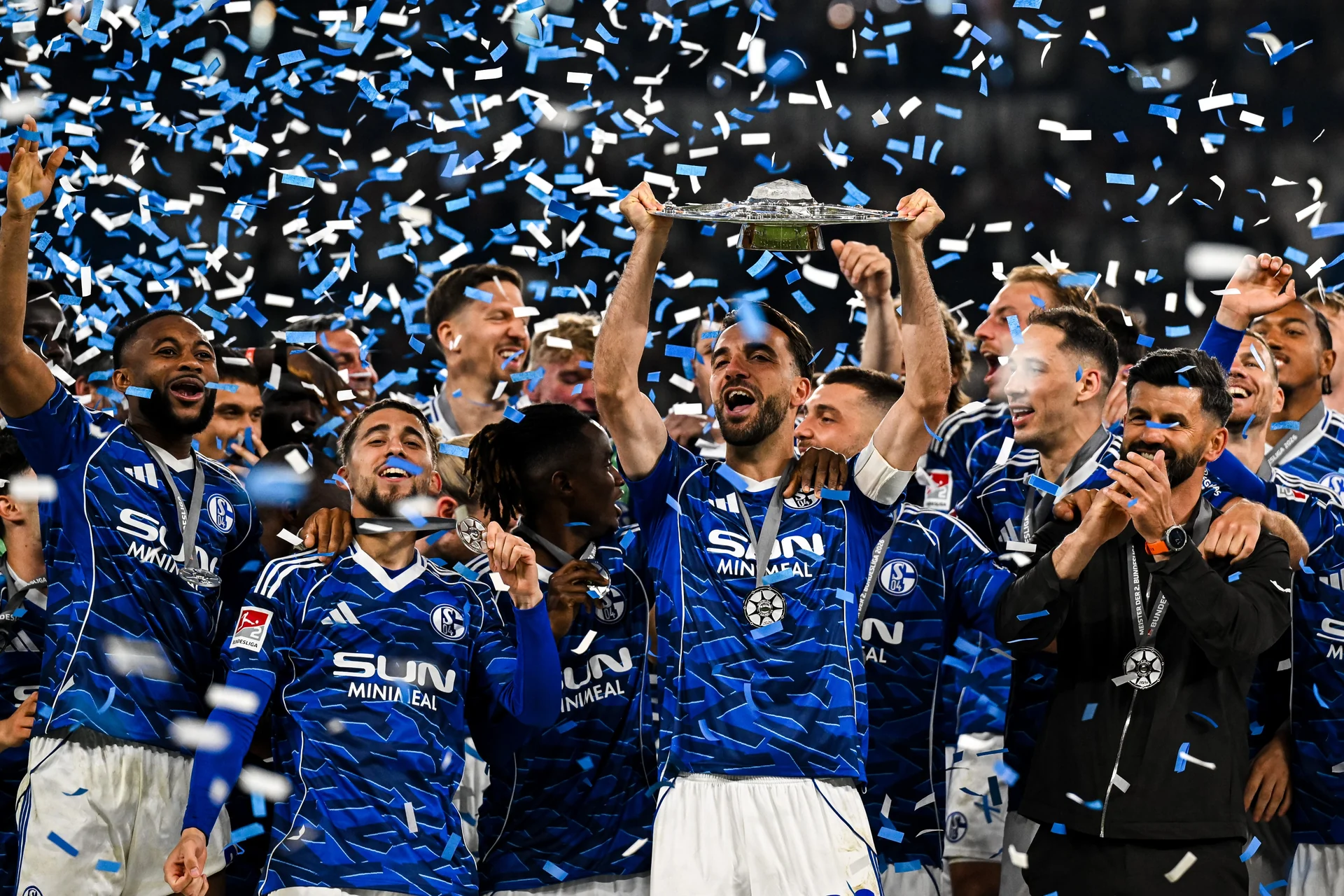
Final answer: Schalke 04 won the 2025/26 2. Bundesliga with 70 points. SV Elversberg finished second and went up automatically. SC Paderborn ended third, then won the promotion play-off to join them in the 2026/27 Bundesliga. At the bottom, Fortuna Düsseldorf and Preußen Münster went down; Greuther Fürth stayed in the second tier after winning its play-off. The complete 18-club table and the results behind those outcomes follow.
The complete 2025/26 Bundesliga 2 final table
Schalke 04 finished the 2025/26 Bundesliga 2 season first with 70 points. SV Elversberg and SC Paderborn both collected 62, but Elversberg's superior goal difference gave it the second automatic promotion place. Paderborn took third and the promotion play-off berth; Hannover 96 finished fourth on 60. At the other end, three clubs ended on 37 points, yet their different goal differences placed them on three different sides of the survival line. The standings below are the final league table after Matchday 34 on 17 May 2026, before any play-off matches were played.
| Pos. | Club | P | W | D | L | GF | GA | GD | Pts |
|---|---|---|---|---|---|---|---|---|---|
| 1 | Schalke 04 | 34 | 21 | 7 | 6 | 50 | 31 | +19 | 70 |
| 2 | SV Elversberg | 34 | 18 | 8 | 8 | 64 | 39 | +25 | 62 |
| 3 | SC Paderborn 07 | 34 | 18 | 8 | 8 | 59 | 45 | +14 | 62 |
| 4 | Hannover 96 | 34 | 16 | 12 | 6 | 60 | 44 | +16 | 60 |
| 5 | Darmstadt 98 | 34 | 13 | 13 | 8 | 57 | 45 | +12 | 52 |
| 6 | 1. FC Kaiserslautern | 34 | 16 | 4 | 14 | 52 | 47 | +5 | 52 |
| 7 | Hertha BSC | 34 | 14 | 9 | 11 | 47 | 44 | +3 | 51 |
| 8 | 1. FC Nürnberg | 34 | 12 | 10 | 12 | 47 | 45 | +2 | 46 |
| 9 | VfL Bochum | 34 | 11 | 11 | 12 | 49 | 47 | +2 | 44 |
| 10 | Karlsruher SC | 34 | 12 | 8 | 14 | 53 | 64 | −11 | 44 |
| 11 | Dynamo Dresden | 34 | 11 | 8 | 15 | 54 | 53 | +1 | 41 |
| 12 | Holstein Kiel | 34 | 11 | 8 | 15 | 44 | 48 | −4 | 41 |
| 13 | Arminia Bielefeld | 34 | 10 | 9 | 15 | 53 | 51 | +2 | 39 |
| 14 | 1. FC Magdeburg | 34 | 12 | 3 | 19 | 52 | 58 | −6 | 39 |
| 15 | Eintracht Braunschweig | 34 | 10 | 7 | 17 | 36 | 54 | −18 | 37 |
| 16 | Greuther Fürth | 34 | 10 | 7 | 17 | 49 | 68 | −19 | 37 |
| 17 | Fortuna Düsseldorf | 34 | 11 | 4 | 19 | 33 | 53 | −20 | 37 |
| 18 | Preußen Münster | 34 | 6 | 12 | 16 | 38 | 61 | −23 | 30 |
Green indicates automatic promotion, amber indicates a promotion or relegation play-off place, and red indicates direct relegation. P is played, W wins, D draws, L losses, GF goals scored, GA goals conceded and GD goal difference. The league table records where teams finished; it does not change when a club later wins its play-off.
Several margins make this table more revealing than a simple list of names. Schalke finished eight points clear of both Elversberg and Paderborn, but the clubs in second and third had identical win-draw-loss records. Elversberg's 64 goals were also the highest total in this final table, five more than Paderborn's; its 25-goal difference was 11 better. Hannover, meanwhile, scored 60 goals and lost only six matches, fewer defeats than any other side, yet 12 draws left it two points behind third. A high position was not enough by itself: the precise line between second and third decided whether the summer began with celebration or two more decisive matches.
This is a snapshot of a completed historical season. Fans looking for the current German top-flight standings should use the site's 2026/27 Bundesliga table. The seasons and divisions are different; mixing their rankings would misidentify both the promoted clubs and the current relegation places.
How Schalke and Elversberg secured automatic promotion
The first two places carried direct entry to the 2026/27 Bundesliga, but the clubs reached that destination on very different schedules. Schalke had already guaranteed promotion with two matchdays to spare and eventually finished eight points ahead of the field. Elversberg entered the final Sunday still competing with Paderborn and Hannover for the one remaining automatic place. Reading only the final points column hides that contrast: one club could plan its return early, while the other needed an emphatic last-day win.
Schalke turned first place into a 70-point title
Schalke won 21 of 34 league matches, drew seven and lost six. Its 50 goals were not the division's highest attacking total; Elversberg scored 64. The title run was anchored by a defense that allowed only 31 goals, the lowest figure in the final table. That balance matters to anyone trying to understand why the Royal Blues could settle the promotion question earlier than the more explosive sides behind them. Consistent points collection created room for a difficult weekend without surrendering first place.
The decisive promotion result came on Matchday 32, when Schalke beat Fortuna Düsseldorf 1-0 at the Veltins-Arena. It was Miron Muslić's first season in charge, and the win ensured Schalke would return to the top flight after three seasons in Bundesliga 2. The championship itself was confirmed the following day when Paderborn failed to beat Elversberg. Those are two distinct milestones: the Düsseldorf result secured an automatic place; the later result mathematically secured first place. Schalke still finished its own season with a 1-0 win over Eintracht Braunschweig on Matchday 34, reaching 70 points rather than merely coasting across the line.
The eight-point gap from first to second is large in the context of the much tighter scramble below. It means Schalke's promotion cannot be reduced to a favorable tie-break or one final-day swing. The club controlled the top of the standings over the closing rounds, while three challengers approached the last matchday on the same points total. For supporters following the 2026/27 Bundesliga, Schalke arrived as a second-tier champion with a clear defensive record, not as a play-off survivor.
Elversberg won the last-day race for second
Elversberg's route was more precarious. A 5-1 win over Paderborn helped put the club in the automatic-promotion position, but a 3-1 defeat at Fortuna Düsseldorf on Matchday 33 prevented an early celebration. Elversberg, Paderborn and Hannover entered the final round level on 59 points. To keep control of its own route, Elversberg had to finish the job against an already relegated Preußen Münster side rather than assume its rivals would stumble.
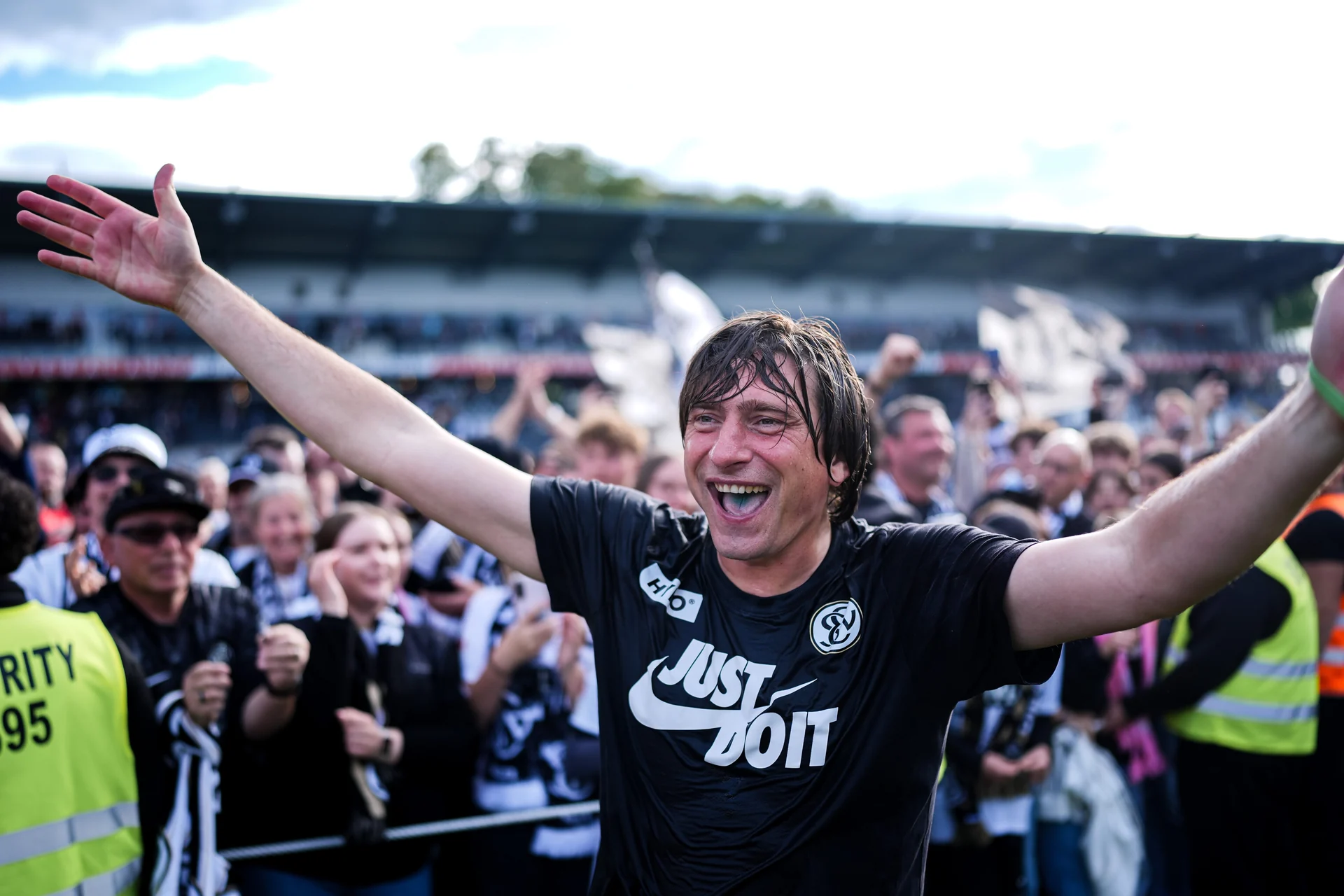
It did so quickly on 17 May 2026. Bambasé Conté scored in the 10th minute, and David Mokwa added a second five minutes later. Mokwa's second goal in the 66th minute made the final score 3-0 and closed off the immediate uncertainty around second place. Elversberg ended with 62 points, 64 goals scored and a +25 goal difference. Paderborn also reached 62 points, but its +14 goal difference left it third. The distinction was consequential: Elversberg moved directly into the Bundesliga for the first time, while Paderborn faced a two-leg play-off.
For fans, the last matchday shows why a final table is both an answer and a condensed story. Elversberg's superior season-long goal difference ultimately separated two equal-point clubs, yet the final-day win was still essential to reach those 62 points. The 2026/27 Bundesliga teams page now includes both promoted clubs; this table explains the different routes that put them there.
Why Paderborn finished third and Hannover fourth
Paderborn earned the league's promotion play-off berth by winning 2-0 at Darmstadt on the final day, while Hannover's 3-3 home draw with Nürnberg left it two points short. The two clubs began Matchday 34 level with Elversberg on 59 points. By full time, Elversberg and Paderborn had each reached 62 and Hannover had reached 60. The outcome was stark: Paderborn would play a Bundesliga club for promotion, and Hannover's season ended immediately.
| Club | Matchday 34 result | Final points | League outcome |
|---|---|---|---|
| Elversberg | 3-0 vs Münster | 62 | Second; automatic promotion |
| Paderborn | 2-0 at Darmstadt | 62 | Third; promotion play-off |
| Hannover | 3-3 vs Nürnberg | 60 | Fourth; no play-off |
Paderborn's match in Darmstadt showed both urgency and risk. Stefano Marino put the visitors ahead in the sixth minute after being played in by Mattes Hansen. Darmstadt had struck the post before that opening goal and kept pressing, while Paderborn goalkeeper Dennis Seimen had to protect the narrow lead. Filip Bilbija later hit the crossbar with a penalty, so the result was still exposed to one equaliser deep into the match. Sven Michel scored in the 89th minute to make it 2-0. That second goal turned a nervous afternoon into a confirmed third-place finish once Hannover's result was known.
Hannover's own match was far less settled. Nürnberg went ahead, Hannover responded, and Hannover led twice before Luka Lochoshvili made it 3-3 in the 83rd minute. The draw was damaging because Paderborn had won: Hannover could not make up the three-point swing with a single point at home. There had been warning signs in the preceding rounds, including a 3-3 draw with bottom club Münster on Matchday 32 and a 1-1 draw at Bochum on Matchday 33. None alone decided the season, but together they explain why a side with only six defeats still finished fourth. Hannover's 12 draws were the highest total among the top four.
Goal difference mattered to the second-versus-third ranking, because Elversberg and Paderborn finished level on points. It did not decide third versus fourth: Paderborn simply had two more points than Hannover. That distinction prevents a common misreading of the standings. The play-off berth came from the final table; whether Paderborn actually went up depended on the separate two-leg tie played afterward.
How a three-way 37-point tie decided survival
Eintracht Braunschweig, Greuther Fürth and Fortuna Düsseldorf all finished with 37 points, but they did not share the same fate. Braunschweig took 15th and stayed in Bundesliga 2 outright; Fürth took 16th and had to play a relegation tie; Düsseldorf took 17th and went down directly. Their goal differences were −18, −19 and −20 respectively. That one-goal step between each club is the simplest way to read the final table's most consequential tie.
The outcome was especially brutal because Fürth and Düsseldorf met in the final round. Fürth entered the game needing a win by at least three goals to overtake Fortuna. Felix Klaus scored in the third minute, an Elias Egouli own goal doubled the lead, and Noel Futkeu struck before half-time to make it 3-0. Futkeu's goal was his 19th of the Bundesliga 2 season. The final whistle delivered exactly the margin Fürth needed to escape automatic relegation. It also sent the losing side below Fürth on goal difference, even though Düsseldorf had 11 wins to Fürth's 10.
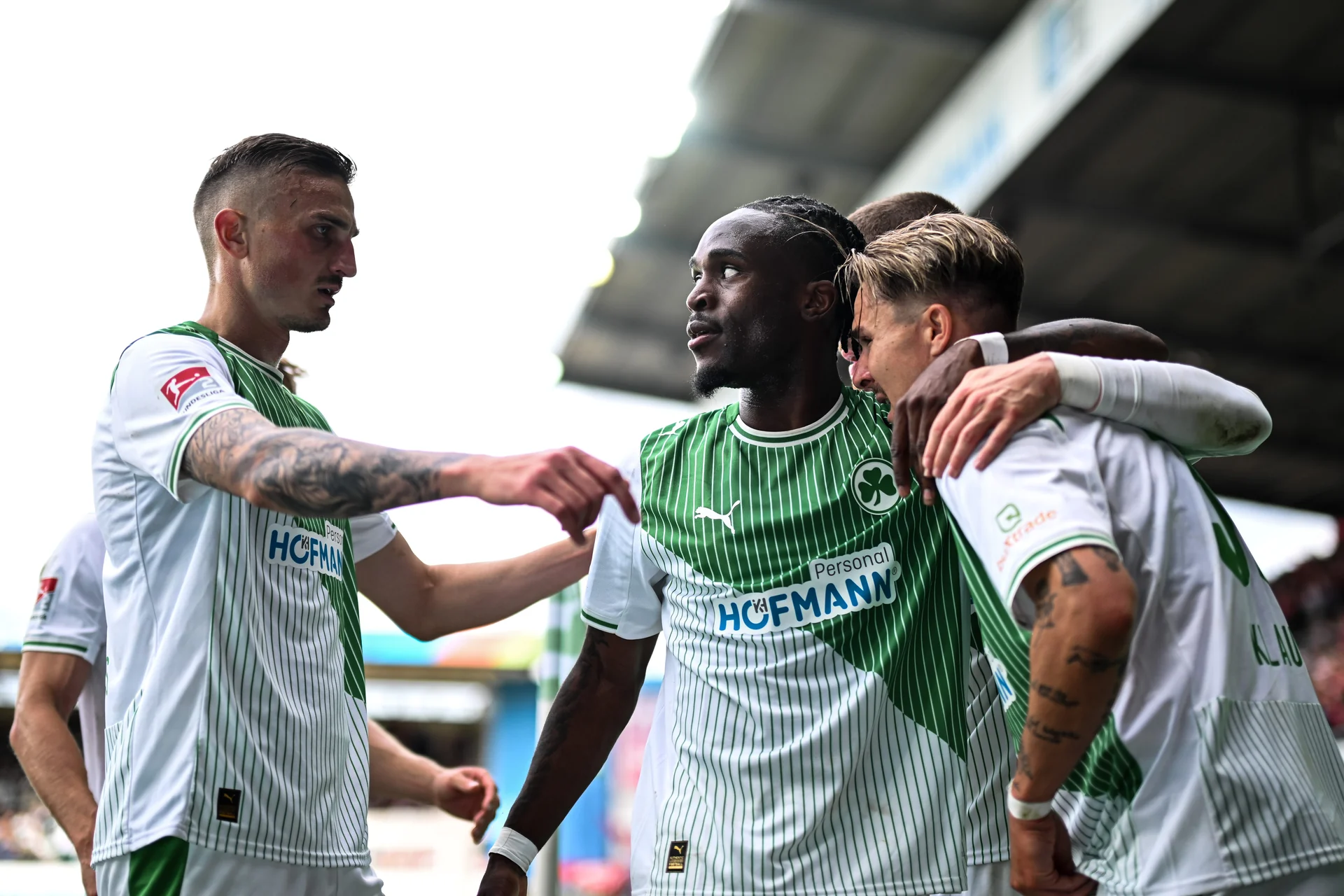
Those win totals are not a contradiction. A league table awards three points per win and one per draw; Düsseldorf had four draws, Fürth seven, so both finished on 37 points. When clubs are level, goal difference separates them before goals scored. A 3-0 result changes the two clubs' goal differences in opposite directions by three each, a six-goal swing across the head-to-head pair. That makes the final-day score more significant than an ordinary three-point result. Fürth ended at −19 and Düsseldorf at −20; anything less than the required margin would have left the clubs on the wrong sides of the cut line.
Braunschweig illustrates a second point. It lost 1-0 away to already crowned champion Schalke on Matchday 34, yet still finished 15th with a −18 goal difference. A club can lose its own final game and survive if the parallel results leave its points and tie-break position intact. Arminia Bielefeld, by contrast, escaped the threatened zone emphatically with a 6-1 victory over Hertha Berlin and finished 13th on 39 points. The tension at the bottom was thus not a single match in isolation; it was a changing set of positions across several grounds.
Preußen Münster occupied the final place on 30 points. Its relegation had been confirmed a week before the closing round after a 1-1 draw with Darmstadt and Düsseldorf's win over Elversberg. Münster's 3-0 defeat at Elversberg on Matchday 34 did not newly send it down; it concluded a season whose last available escape route had already closed. The distinction matters when looking back at the standings: Düsseldorf's fall and Fürth's reprieve happened on the final day, while Münster's fate was settled earlier.
What the play-offs changed after the table was final
The league table was final on 17 May 2026, but two places in the following season's divisions were still unresolved. Third-placed Paderborn played 16th-placed Bundesliga club Wolfsburg for a top-flight berth. Sixteenth-placed Fürth played third-placed 3. Liga club Rot-Weiss Essen for a Bundesliga 2 berth. Both second-tier clubs won their ties. That does not move Paderborn above Elversberg in the 2025/26 table or move Fürth above Braunschweig. It tells us where the clubs played after their league seasons ended.
Paderborn converted third place into Bundesliga promotion
Paderborn's reward for third place was a second route upward, not automatic promotion. The first leg at Wolfsburg ended 0-0, making the return match decisive. Wolfsburg took an early lead through Dženan Pejčinović, but Joakim Mæhle's dismissal after a second yellow card in the 14th minute changed the balance. Filip Bilbija equalised for Paderborn before half-time. With the tie still level after 90 minutes, Laurin Curda struck in extra time. Paderborn won the match 2-1 and the two-leg contest 2-1 on aggregate, sending Wolfsburg down to Bundesliga 2.
The sequence is important for reading any historical table. At the moment Matchday 34 ended, Paderborn had 62 points, a +14 goal difference and a play-off opportunity. It did not yet have a confirmed 2026/27 Bundesliga place. The scoreless first leg left everything open; the extra-time winner made the change of divisions real. In a season archive, label Paderborn as third in the final league standings and, separately, as promoted through the play-off. Combining those labels is accurate. Treating the play-off as three more league points is not.
Fürth kept its Bundesliga 2 place
Fürth had the reverse problem. Its 37 points and −19 goal difference rescued it from 17th on the last league day, but 16th did not guarantee safety. Rot-Weiss Essen, third in the 3. Liga, won the first leg 1-0 through Torben Müsel's free-kick. That left Fürth needing to overturn a one-goal deficit at home. Noel Futkeu scored in the 29th minute of the return, bringing the aggregate scores level; Branimir Hrgota struck two minutes after the restart to give Fürth a 2-0 win on the night and a 2-1 aggregate victory.
Fürth therefore stayed in Bundesliga 2 for 2026/27, while Essen remained in the third tier. The club needed two separate escapes: the final-day 3-0 victory over Düsseldorf to reach the play-off place, then the comeback against Essen to keep its division. Fans who see a 16th-place label beside Fürth and wonder why it was not relegated are seeing the difference between a league finish and a completed play-off. For this table, neither of those post-season results changes the 37-point total or its rank.
What this final table means for 2026/27
The 2025/26 final table explains why three clubs that were in Bundesliga 2 appear in the 2026/27 Bundesliga. Schalke won the division, Elversberg took the second automatic place, and Paderborn won promotion after finishing third and beating Wolfsburg in the play-off. They arrived by three different routes that can be traced to the first three rows of the table and the post-season result. Those rows are historical finishes, not current Bundesliga positions. For live records in the new top-flight campaign, use the site's 2026/27 Bundesliga table.
The movement in the other direction also makes sense only when the play-offs are included. Wolfsburg went down to Bundesliga 2 after losing to Paderborn. St. Pauli and Heidenheim had already fallen from the top flight through their Bundesliga league finishes. Their presence in the 2026/27 second division therefore tells the reverse side of the promotion story. A reader scanning the old table will not find those three clubs there, because they spent 2025/26 one level higher. This is why a season label belongs beside every league table, particularly when promoted and relegated teams change the lineup every summer.
At the bottom of the 2025/26 Bundesliga 2 table, Düsseldorf and Münster exited for the 3. Liga. Fürth stayed after winning its play-off with Rot-Weiss Essen. Coming up from the third tier, VfL Osnabrück returned as champions and Energie Cottbus took another automatic place. Those moves are enough to show why a 2026/27 Bundesliga 2 table cannot simply be a revised version of this one with fresh points: its membership changed. Hannover, despite finishing fourth in 2025/26, remained in the second tier and began a new campaign rather than carrying its 60 points forward.
For supporters of the three promoted sides, the old standings also offer a useful baseline without pretending to predict the next season. Schalke's 70 points and 31 goals conceded describe a title-winning second-tier campaign. Elversberg's 64 goals and +25 goal difference describe an attack that won the tie for second. Paderborn's 62 points and eventual play-off victory describe resilience across a longer finish. None of those numbers guarantees how the clubs will perform against Bundesliga opposition, whose strength and match schedule are different. They do, however, explain what each club had proved before taking its place in the 2026/27 top-flight club list.
If the question is simply “Who won Bundesliga 2 in 2025/26?”, the answer is Schalke. If it is “Who went up?”, the complete answer is Schalke and Elversberg directly, plus Paderborn through the play-off. If it is “Who went down from Bundesliga 2?”, the answer is Düsseldorf and Münster, while Fürth survived its play-off. Keeping those three questions separate makes the final table much easier to read and avoids assigning a post-season outcome to a league position it never changed.
JOIN THE DISCUSSION
Comments
Sign in with Google to comment. Keep the discussion focused on Bundesliga football and respectful to other supporters. New comments are reviewed before publication.
Loading comments…