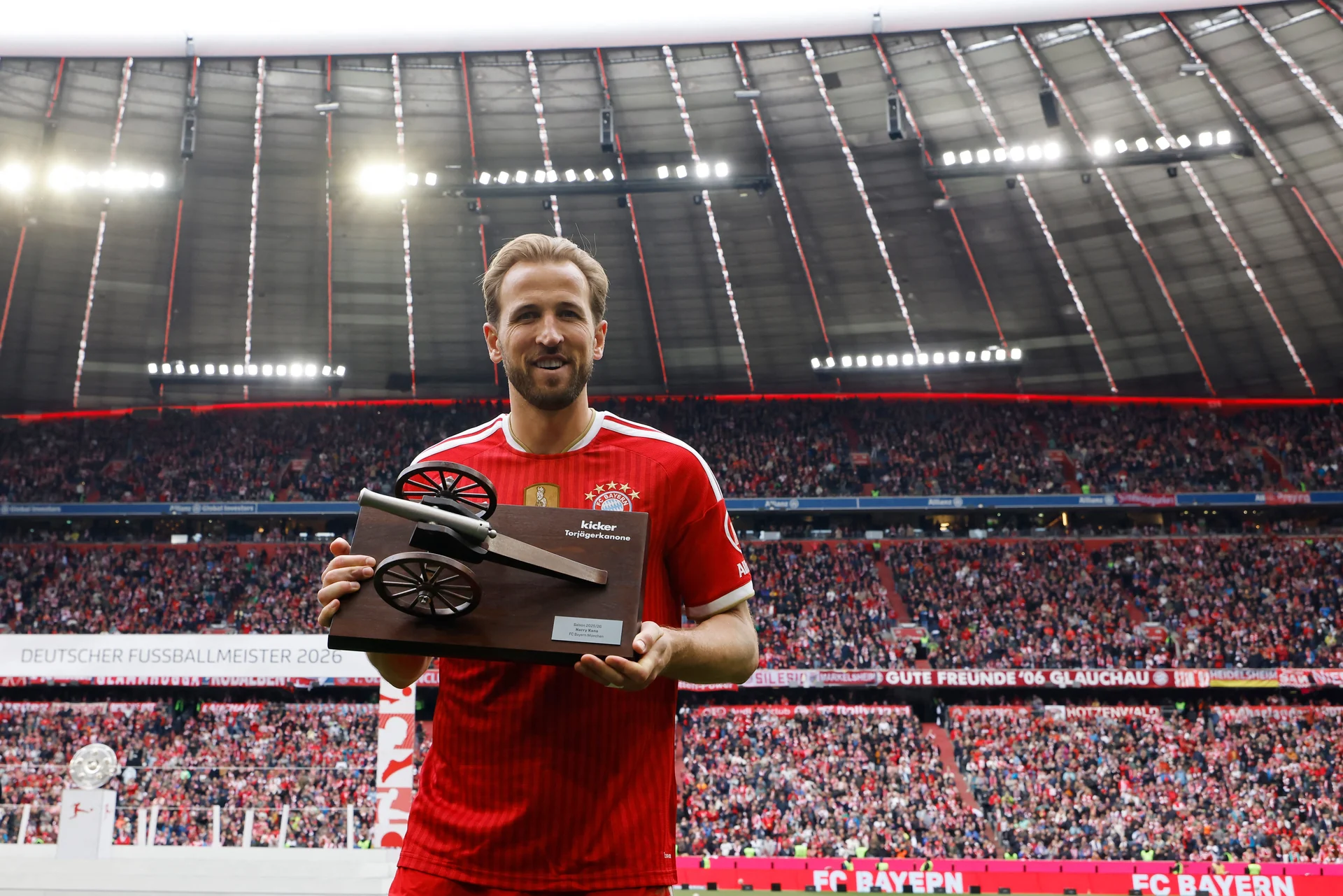
Harry Kane finished as the Bundesliga's 2025/26 top scorer with 36 goals, winning the Torjägerkanone for a third consecutive season. Deniz Undav was the nearest challenger with 19, followed by Serhou Guirassy on 17. The ranking below is a completed-season archive for players with at least five league goals, followed by the match context and statistical distinctions that explain what the numbers mean.
The final Bundesliga 2025/26 goalscorer rankings
Kane's 36 goals put him clearly ahead of the field in the completed 2025/26 Bundesliga campaign. Undav finished second on 19, Guirassy third on 17 and Patrik Schick fourth on 16. Luis Díaz and Michael Olise shared the next position with 15 each. The clubs shown here are the players' 2025/26 teams, so a later transfer should not change the identity attached to a historical total.
This table includes the players who reached at least five Bundesliga goals. It does not claim to list every one-goal scorer. Cup games, European matches, internationals and the relegation play-off are outside its league-season scope. Those boundaries matter because the same player's all-competition record can be much larger without contradicting this chart.
How shared ranks and penalty goals are shown
Equal goal totals share a rank. The two players on 15 are both fifth, and the next position is seventh. Names within a shared rank are arranged alphabetically for readability; that order is not a sporting tie-break. A penalty goal counts towards the ordinary goal total, while an assist does not. The table keeps the main ranking to goals rather than combining measures that answer different questions.
For Undav, Stuttgart's historical player profile and the league's final records both give 19. That is the figure used here. Checking the season label is essential even on a reputable statistics page: a current campaign selector, an intermediate update or a differing entry can otherwise make a historical comparison look more settled than it is.
| Rank | Player | 2025/26 club | Goals |
|---|---|---|---|
| 1 | Harry Kane | FC Bayern München | 36 |
| 2 | Deniz Undav | VfB Stuttgart | 19 |
| 3 | Serhou Guirassy | Borussia Dortmund | 17 |
| 4 | Patrik Schick | Bayer Leverkusen | 16 |
| 5 | Luis Diaz | FC Bayern München | 15 |
| 5 | Michael Olise | FC Bayern München | 15 |
| 7 | Andrej Kramarić | TSG Hoffenheim | 14 |
| 8 | Christoph Baumgartner | RB Leipzig | 13 |
| 8 | Ermedin Demirovic | VfB Stuttgart | 13 |
| 8 | Haris Tabakovic | Borussia Mönchengladbach | 13 |
| 8 | Jonathan Burkardt | Eintracht Frankfurt | 13 |
| 8 | Said El Mala | 1. FC Köln | 13 |
| 13 | Nadiem Amiri | 1. FSV Mainz 05 | 12 |
| 13 | Yan Diomande | RB Leipzig | 12 |
| 15 | Igor Matanovic | SC Freiburg | 11 |
| 16 | Fisnik Asllani | TSG Hoffenheim | 10 |
| 16 | Jens Stage | Werder Bremen | 10 |
| 18 | Maximilian Beier | Borussia Dortmund | 9 |
| 18 | Rômulo da Cruz | RB Leipzig | 9 |
| 20 | Alejandro Grimaldo | Bayer Leverkusen | 8 |
| 20 | Can Uzun | Eintracht Frankfurt | 8 |
| 20 | Dženan Pejčinović | VfL Wolfsburg | 8 |
| 20 | Mohamed Amoura | VfL Wolfsburg | 8 |
| 20 | Nicolas Jackson | FC Bayern München | 8 |
| 20 | Serge Gnabry | FC Bayern München | 8 |
| 20 | Tim Lemperle | TSG Hoffenheim | 8 |
| 27 | Chris Führich | VfB Stuttgart | 7 |
| 27 | Fábio Vieira | Hamburger SV | 7 |
| 27 | Grischa Prömel | TSG Hoffenheim | 7 |
| 27 | Jakub Kaminski | 1. FC Köln | 7 |
| 27 | Jamie Leweling | VfB Stuttgart | 7 |
| 27 | Julian Brandt | Borussia Dortmund | 7 |
| 27 | Karim Adeyemi | Borussia Dortmund | 7 |
| 27 | Maximilian Mittelstädt | VfB Stuttgart | 7 |
| 27 | Ragnar Ache | 1. FC Köln | 7 |
| 27 | Vincenzo Grifo | SC Freiburg | 7 |
| 37 | Anton Kade | FC Augsburg | 6 |
| 37 | Arnaud Kalimuendo Muinga | Eintracht Frankfurt | 6 |
| 37 | Budu Zivzivadze | 1. FC Heidenheim | 6 |
| 37 | Fabian Rieder | FC Augsburg | 6 |
| 37 | Luka Vuskovic | Hamburger SV | 6 |
| 37 | Malik Tillman | Bayer Leverkusen | 6 |
| 37 | Michael Gregoritsch | FC Augsburg | 6 |
| 37 | Oliver Burke | 1. FC Union Berlin | 6 |
| 37 | Phillip Tietz | 1. FSV Mainz 05 | 6 |
| 46 | Albert Sambi Lokonga | Hamburger SV | 5 |
| 46 | Alexis Claude-Maurice | FC Augsburg | 5 |
| 46 | Andrej Ilic | 1. FC Union Berlin | 5 |
| 46 | Christian Kofane | Bayer Leverkusen | 5 |
| 46 | Danel Sinani | FC St. Pauli | 5 |
| 46 | Danilho Doekhi | 1. FC Union Berlin | 5 |
| 46 | Derry Scherhant | SC Freiburg | 5 |
| 46 | Edmond Tapsoba | Bayer Leverkusen | 5 |
| 46 | Ilyas Ansah | 1. FC Union Berlin | 5 |
| 46 | Johan Manzambi | SC Freiburg | 5 |
| 46 | Justin Njinmah | Werder Bremen | 5 |
| 46 | Kevin Diks | Borussia Mönchengladbach | 5 |
| 46 | Lennart Karl | FC Bayern München | 5 |
| 46 | Leon Goretzka | FC Bayern München | 5 |
| 46 | Luca Waldschmidt | 1. FC Köln | 5 |
| 46 | Marius Bülter | 1. FC Köln | 5 |
| 46 | Nico Schlotterbeck | Borussia Dortmund | 5 |
| 46 | Paul Nebel | 1. FSV Mainz 05 | 5 |
| 46 | Ramy Bensebaini | Borussia Dortmund | 5 |
| 46 | Rani Khedira | 1. FC Union Berlin | 5 |
| 46 | Ransford Königsdörffer | Hamburger SV | 5 |
| 46 | Raphaël Guerreiro | FC Bayern München | 5 |
| 46 | Ritsu Doan | Eintracht Frankfurt | 5 |
| 46 | Stefan Schimmer | 1. FC Heidenheim | 5 |
| 46 | Tiago Tomás | VfB Stuttgart | 5 |
The cutoff still captures a wide range of roles. Central forwards naturally feature, but attacking midfielders, wide players and defenders can contribute substantial totals through different routes. A shared rank means the same number of goals, not identical opportunities, minutes or responsibilities. The sections that follow explain why the leading totals deserve context rather than a quick assumption that every player reached them in the same way.
How Harry Kane won a third consecutive scoring crown
Kane won the league's scoring award for a third consecutive season, and the margin was substantial. His 36 goals exceeded Undav's 19 by 17. That difference is larger than the entire final tally of the third-placed player, Guirassy. The comparison illustrates the scale of the lead without needing to mix in any of Kane's European or international goals.
The final-day hat-trick took him to 36
Bayern finished the league campaign with a 5-1 home win over Cologne on 16 May 2026. Kane scored a hat-trick, moving from 33 to 36 on Matchday 34. The title had already been secured, but the final round still changed the striker's season total. A historical ranking should therefore use the completed figure rather than a number retained from the run-in.
The finish also shows why a season can contain different kinds of importance. Some goals change the direction of a title race; others extend a settled lead or complete a personal milestone. They all count in the scorer chart, while their match context differs. The final-day hat-trick belongs in the explanation because it accounts for the last three goals, not because those goals were required to win the scoring award.
Penalties were part of the total, not the whole story
The official season statistics list ten successful Kane penalties from eleven attempts. Subtracting those ten from the total leaves 26 non-penalty goals. That arithmetic helps readers understand the composition of the haul, while preserving the ordinary ranking: a penalty goal counts just as a non-penalty goal does in the Torjägerkanone race.
Non-penalty is not identical to open play. A goal from a corner, free-kick delivery or other set-piece situation can belong to the non-penalty total. The distinction matters when a comparison uses technical labels. Saying that Kane scored 26 non-penalty goals is supported by the subtraction; claiming that all 26 came from open play would require separate evidence about each scoring action.
The broader explanation combines repetition and supply. Bayern created many attacking situations, and Kane repeatedly converted his opportunities. His teammates' movement and deliveries helped produce those chances, while his positioning made the service useful. The final count recognises the finish; watching the goals reveals how the team and striker reached that point together.
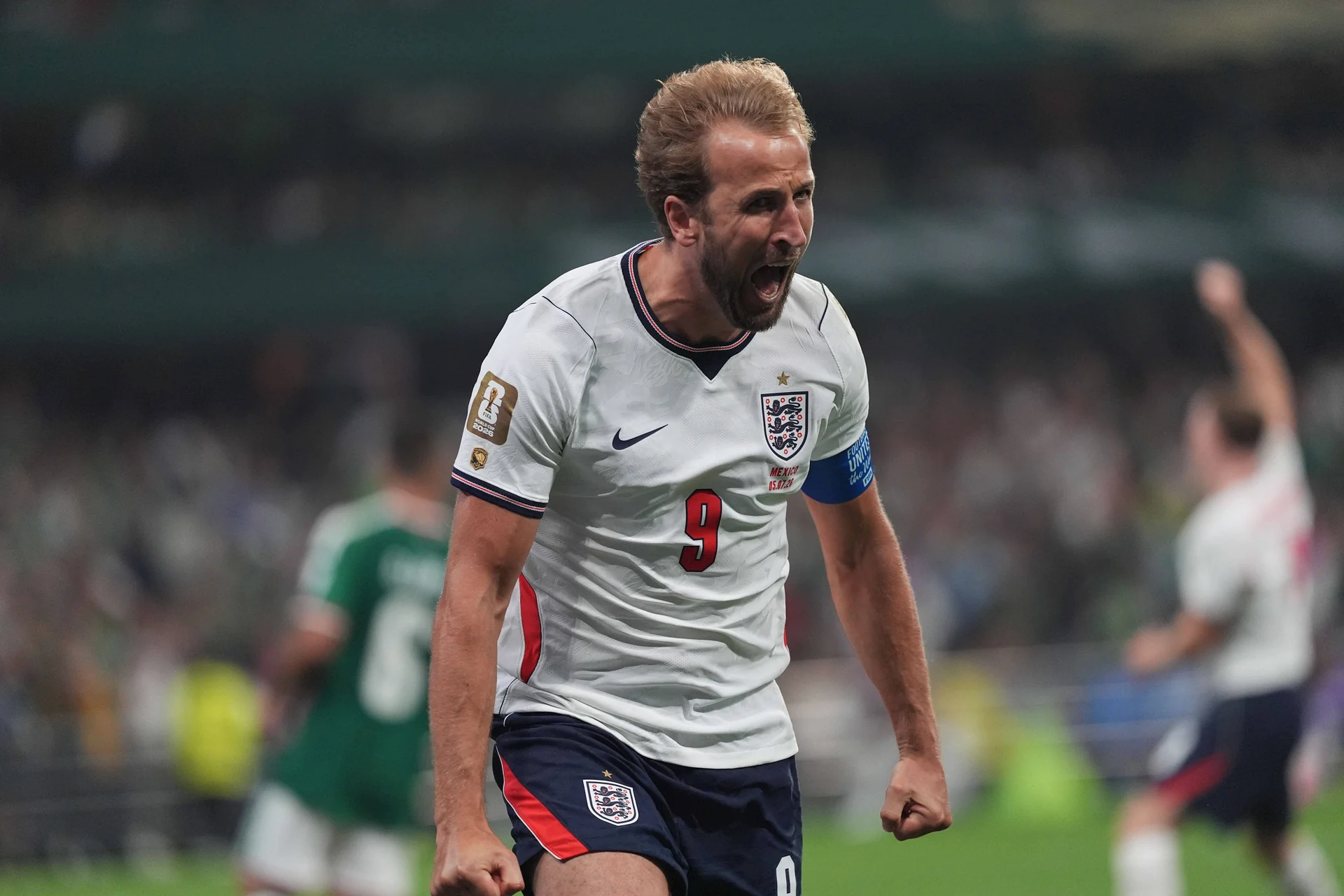
What the leading challengers tell us about the season
The ranking behind Kane is useful because it shows several routes to a strong league total. Central strikers, wide creators and players arriving from deeper positions all reached significant numbers. The chart places them on the same scale, but a supporter should still consider the job each player performs and the opportunities the team creates around him.
Undav, Guirassy and Schick led different attacks
Undav's 19 goals made him Kane's nearest challenger. Stuttgart's historical profile records 29 appearances and 2,247 minutes, providing a useful context for the total. It was not a record assembled through 34 full games. That does not invite an automatic per-minute ranking against every other player; a fair comparison would require the same minute information for all of them.
Guirassy finished on 17 for Dortmund and Schick on 16 for Leverkusen. Guirassy's post-season Bundesliga interview acknowledged Kane as the standout forward while expressing his own desire for more goals. That is a reminder that a strong final rank and a player's ambitions are different things. A striker can finish near the top and still see opportunities that should have been converted.
Their totals belong to distinct attacking environments. A centre-forward's movement can occupy defenders, connect play or attack a delivery, while the surrounding players determine how often those actions become shooting opportunities. The ranking measures goals completed, not every contribution made before the finish. It is useful evidence, but it should not turn three separate club seasons into one identical tactical story.
Bayern's wing pair added a second source of goals
Díaz and Olise each scored 15 league goals. Alongside Kane's 36, that gives the trio 66. The calculation counts goals by three separate players; it does not add assists to goals and risk counting the same scoring move twice. Bayern's danger was therefore distributed across the central striker and both sides of the attack.
That distribution changes what a defence must manage. Paying extra attention to the centre-forward can leave a wide attacker room to move inside. Closing the winger can make the striker more accessible. A team with several credible scorers can exploit either decision. The final figures illustrate the output of that collective threat without proving that every Bayern attack followed the same pattern.
For supporters comparing players, the useful next step is to watch how the chances were created. Did the forward make separation in the box, finish a transition or convert service after sustained possession? Those differences explain the football behind similar totals and help the historical ranking become more than a list of names.

Why goals and goal contributions produce different lists
A top-scorer list ranks goals. A goal-contribution list usually adds goals and assists. A club league table ranks teams by points. Those are three different questions, even when a search bundles the words together. Keeping the measure clear prevents a player with outstanding creativity from being described as the scoring winner when someone else scored more.
Olise's assist record answers another question
Olise's 15 goals and league-recorded 19 assists give him 34 direct goal contributions in 2025/26. His assist total led the Bundesliga, and his overall season earned the league's Player of the Season award. None of that changes the goal ranking in which Kane finished first on 36. It adds a different view of influence: how often the winger supplied the final pass as well as completed the finish.
An assist also depends on the teammate converting the chance. An excellent delivery followed by a missed shot does not become an ordinary assist, while a simple pass can receive one if the next player scores a difficult goal. The figure remains useful, but the chance itself helps explain the creative performance. Goals and assists describe completed scoring actions, not every useful decision in an attack.
Consistency of definition matters too. Some providers treat deflections, penalties won and indirect involvement differently. This guide uses the league's 19-assist figure for Olise, rather than combining a broader tally from another provider with league goals. A comparison becomes less reliable when the numbers look similar but measure different types of contribution.
The competition boundary is equally important. Kane's July 2026 league review lists 36 Bundesliga goals within a much larger total of 61 for Bayern across all competitions. The latter includes the DFB Cup, Champions League and Supercup. Neither figure is wrong; they answer different questions. Adding England goals creates another scope again, which should not appear in a Bundesliga-only chart.
Finally, do not add every player's goals and assists to estimate a club's total goals. An assisted team goal contributes one scorer entry and one assister entry, so that calculation can count the same goal twice. Adding Kane, Díaz and Olise's goals gives 66 goals by those players; adding their assists as well gives a different measure of involvement. Clear labels are what make the numbers useful to supporters.
Where 36 goals sits in Bundesliga history
Thirty-six goals is an exceptional Bundesliga total, but it is not the league's single-season record. Historical comparisons work best when they preserve that distinction. Kane's 2025/26 achievement combined a very high number with a third consecutive scoring crown, while the absolute benchmark remained above him.
Matching his debut total while winning again
Kane scored 36 in his debut Bundesliga season of 2023/24, then 26 in 2024/25 and 36 again in 2025/26. Those three totals add up to 98. The repetition is particularly striking because the scoring award remained his across all three campaigns, even though the number needed to finish first varied.
Matching a previous total does not mean repeating an identical season. Match availability, minutes, the opposition and the team's attacking relationships can change. The same final number can be built from different types of chances and different sequences of goals. For a supporter, the historical table establishes the scale; the season's football explains how he reached it.
A scoring crown is also a relative achievement. A player wins by finishing above the other scorers in that campaign, not by reaching a universal threshold. Kane's 26 was enough in 2024/25, while his 36 gave him a much larger total the following season. Both belong to the record, and neither should be rewritten to make the three-year run appear numerically uniform.
Lewandowski's 41 remains the single-season benchmark
Robert Lewandowski scored 41 Bundesliga goals for Bayern in 2020/21, overtaking Gerd Müller's 40 from 1971/72. Kane's 36 in 2025/26 was five below Lewandowski's record. That is the precise comparison: an outstanding season approaching the very highest totals, rather than a new single-season record.
The figures can be compared directly as league goals, but the eras and playing conditions still differ. A record is a clear numerical benchmark; it is not a complete ranking of every striker's career quality. Keeping the comparison narrow helps avoid turning a useful historical fact into an unsupported claim about who was better in all respects.
Our Kane 100-goal milestone analysis follows the later accumulation of his league goals. This 2025/26 archive answers the season-specific question: what he scored during that completed campaign, where he finished and how the total compares with the established Bundesliga benchmark.
How to read the scorer list alongside the final table
The scorer ranking and the final club table belong together, but one cannot replace the other. A forward's goals contribute to matches whose results produce points. The club's position also depends on defending, chance creation, availability and how goals are distributed across the campaign. Having a leading scorer is valuable; it does not automatically settle every team objective.
Bayern provide a useful example of collective scale. The champions scored 122 league goals in 2025/26, while Kane, Díaz and Olise supplied 66 between them. Their prominence is clear, but the remaining goals and the work outside the final touch still belong to the team story. A scorer table highlights the players completing attacks, not the entire structure that made those attacks possible.
Distribution across matches matters as well. Three goals in an already comfortable win and one late equaliser affect the points differently, even though the former contributes more to a personal total. The scorer ranking correctly counts both situations. A supporter analysing a club's season should also examine when the goals arrived and what changed after them.
Availability is another reason to avoid a quick verdict from rank alone. A player with fewer appearances can finish below someone who had more opportunities while still producing useful football whenever selected. The historical total should stay intact, but judging efficiency requires minutes and context. Likewise, an injury or tactical change should not be inferred merely because a player finished on a smaller number.
Our 2025/26 final table explanation covers the team outcomes behind the completed campaign. This scorer archive supplies the individual goal ranking alongside that account. Using the two together gives a clearer picture than treating a top-five scorer as an explanation for every success or disappointment at his club.
For the current campaign, move to the live Bundesliga table and the fixture list. Keep the season distinction visible: the 2025/26 totals above remain final, while 2026/27 results develop separately. That simple separation lets a historical ranking remain useful without being mistaken for today's race.
JOIN THE DISCUSSION
Comments
Sign in with Google to comment. Keep the discussion focused on Bundesliga football and respectful to other supporters. New comments are reviewed before publication.
Loading comments…