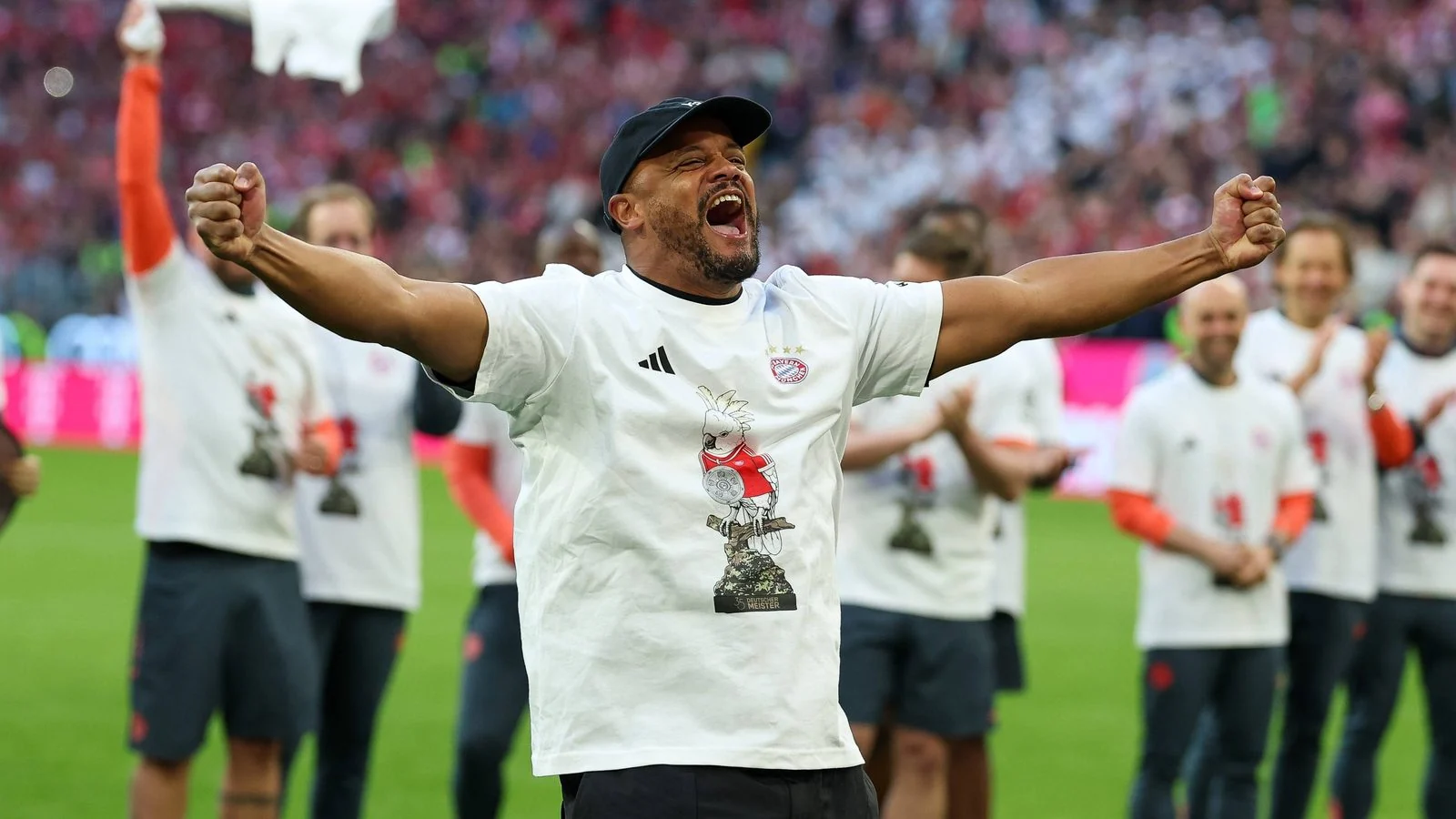
The 2025/26 Bundesliga season in one answer
Bayern Munich won the Bundesliga with 89 points, finishing 16 clear of Borussia Dortmund. RB Leipzig and VfB Stuttgart completed the Champions League places; Hoffenheim and Bayer Leverkusen qualified for the Europa League; Freiburg earned a Conference League play-off place. At the bottom, Heidenheim and St. Pauli were relegated automatically, and 16th-placed Wolfsburg later joined them after losing the play-off to Paderborn.
This is the settled historical table for the season that ended on 16 May 2026, including the play-off outcome decided on 25 May. It separates what the final 34-match standings awarded from what happened afterward, then explains the title margin, European cut lines, mid-table changes and relegation tie-breaks. For the live campaign, use the current Bundesliga table.
Bundesliga 2025/26 final table at a glance
Bayern Munich finished champions on 89 points, 16 clear of Borussia Dortmund, while Wolfsburg, Heidenheim and St. Pauli occupied the bottom three after Matchday 34. The table below is the settled league record from 16 May 2026. Wolfsburg’s 16th place earned a play-off rather than safety; their eventual relegation came nine days later.
| Pos | Club | P | W-D-L | Goals | GD | Pts | League outcome |
|---|---|---|---|---|---|---|---|
| 1 | Bayern Munich | 34 | 28-5-1 | 122-36 | +86 | 89 | Champions / Champions League |
| 2 | Borussia Dortmund | 34 | 22-7-5 | 70-34 | +36 | 73 | Champions League |
| 3 | RB Leipzig | 34 | 20-5-9 | 66-47 | +19 | 65 | Champions League |
| 4 | VfB Stuttgart | 34 | 18-8-8 | 71-49 | +22 | 62 | Champions League |
| 5 | TSG Hoffenheim | 34 | 18-7-9 | 65-52 | +13 | 61 | Europa League |
| 6 | Bayer Leverkusen | 34 | 17-8-9 | 68-47 | +21 | 59 | Europa League |
| 7 | SC Freiburg | 34 | 13-8-13 | 51-57 | -6 | 47 | Conference League qualifying |
| 8 | Eintracht Frankfurt | 34 | 11-11-12 | 61-65 | -4 | 44 | Stayed up |
| 9 | FC Augsburg | 34 | 12-7-15 | 45-61 | -16 | 43 | Stayed up |
| 10 | Mainz 05 | 34 | 10-10-14 | 44-53 | -9 | 40 | Stayed up |
| 11 | Union Berlin | 34 | 10-9-15 | 44-58 | -14 | 39 | Stayed up |
| 12 | Borussia Mönchengladbach | 34 | 9-11-14 | 42-53 | -11 | 38 | Stayed up |
| 13 | Hamburger SV | 34 | 9-11-14 | 40-54 | -14 | 38 | Stayed up |
| 14 | 1. FC Köln | 34 | 7-11-16 | 49-63 | -14 | 32 | Stayed up |
| 15 | Werder Bremen | 34 | 8-8-18 | 37-60 | -23 | 32 | Stayed up |
| 16 | VfL Wolfsburg | 34 | 7-8-19 | 45-69 | -24 | 29 | Play-off; later relegated |
| 17 | 1. FC Heidenheim | 34 | 6-8-20 | 41-72 | -31 | 26 | Relegated |
| 18 | FC St. Pauli | 34 | 6-8-20 | 29-60 | -31 | 26 | Relegated |
The cut lines tell the season’s shape immediately: four Champions League places, two Europa League places and one Conference League qualifying place, followed by eight clubs outside Europe and three in the relegation zone. Equal points are separated first by goal difference, then goals scored. That put Gladbach above Hamburg and Köln above Werder; Heidenheim and St. Pauli were level on both 26 points and -31, so Heidenheim’s 41 goals beat Pauli’s 29 for 17th.
The gaps are as revealing as the positions. Dortmund sat eight points above Leipzig, yet only four points covered Leipzig in third through Hoffenheim in fifth. Freiburg were 12 behind Leverkusen but still three ahead of Frankfurt, creating a clean European cut after seventh. At the other end, Werder’s 32 points left only three between 15th and Wolfsburg’s play-off place. That combination produced a settled champion, a compressed Champions League race and a tense survival line within the same table.
For the live campaign rather than this historical snapshot, use the current Bundesliga table. Here, every total remains fixed—even though the meaning of 16th was not finally resolved until the play-off.
Why Bayern Munich won the title by 16 points
Bayern did not merely finish first; they removed nearly every route by which a challenger normally stays close. Their 28 wins from 34 matches produced 89 points, while a league-high 122 goals and only 36 conceded created a remarkable +86 goal difference. Second-placed Borussia Dortmund ended on 73 points and +36. That 50-goal gap between the two clubs’ goal differences shows why the championship was more decisive than even the 16-point margin suggests.
Points
89
2.62 per match
Record
28–5–1
Only one defeat
Goals
122–36
+86 difference
Final margin
16 pts
Ahead of Dortmund
The split table underlines their consistency. Bayern took 47 points in the Hinrunde, going unbeaten at 15 wins and two draws with 66 goals scored. The Rückrunde was marginally less overwhelming but still championship form: 42 points, 13 wins, three draws and one loss. There was no prolonged slump for Dortmund or anyone else to exploit. Harry Kane supplied 36 league goals—29.5 percent of the team total—and became Bundesliga top scorer for a third straight season. Yet the remaining 86 goals are the important supporting detail: this was an elite attack with far more than one finish line.
Converted into match rates, the scale becomes easier to grasp. Bayern won 82.4 percent of their league games, scored 3.59 goals per match and conceded 1.06. Even five draws barely interrupted the pace because victories were so frequent. Kane’s output was historic, but opponents also had to contain a supporting cast responsible for more than two goals per match after his 36 were removed. The champions could therefore win shootouts, control routine fixtures and recover from falling behind.
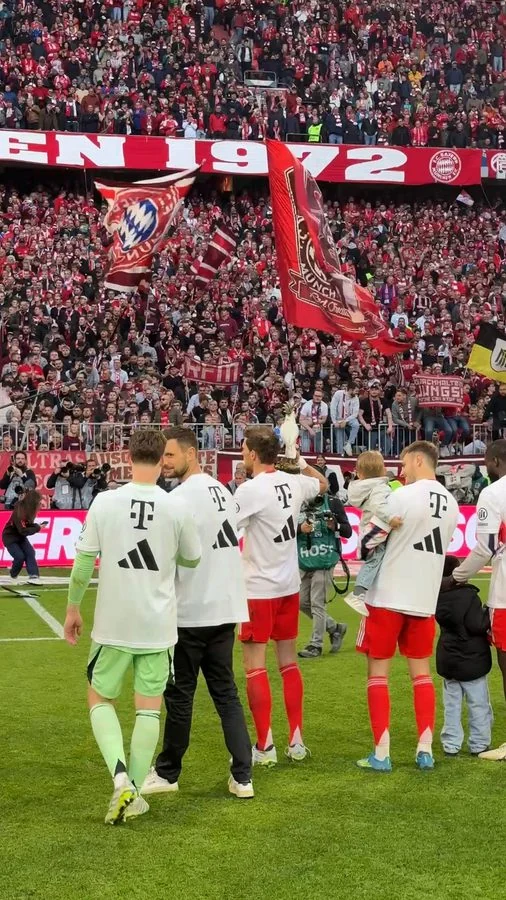
The clincher captured the season in 90 minutes
Stuttgart led at the Allianz Arena on Matchday 30, but Bayern answered with three goals before half-time and won 4-2. Because Dortmund had lost the previous day, Bayern needed only a draw; instead they turned a deficit into a four-goal performance and moved 15 points clear with four games remaining. The distinction matters: it was Bayern’s 34th title of the Bundesliga era and their 35th German championship overall.
For supporters following what comes next, the Bayern Munich schedule provides the live fixture view. The historical verdict on 2025/26, though, is straightforward: unmatched scoring, one defeat all season and virtually identical excellence on both sides of the winter break.
How Dortmund, Leipzig and Stuttgart claimed the other Champions League places
Behind Bayern, the top-four race produced three distinct outcomes. Borussia Dortmund made second place comfortable, RB Leipzig secured their return to Europe with a week to spare, and VfB Stuttgart survived a final-day contest in which one point separated Champions League football from the Europa League.
The spacing clarifies who was actually under pressure. Dortmund’s 73 points left them eight above Leipzig, so second was no longer in doubt on the final day. Leipzig stood three above Stuttgart and four above Hoffenheim. Fourth, not second or third, was therefore the live Champions League cut on 16 May. That is why the Frankfurt and Mönchengladbach scorelines mattered more than Dortmund’s position, even though all three clubs finished inside the same qualification band.
2nd · Dortmund
73 points
A 22-7-5 record and +36 goal difference. Qualification was secure on Matchday 31; a 2-0 win at Bremen completed their best league points total since 2018/19.
3rd · Leipzig
65 points
They went 19-8-7 with a +19 difference. Victory over St. Pauli on Matchday 33 guaranteed a top-four finish and a Champions League return.
4th · Stuttgart
62 points
Their 18-8-8 record and +22 difference carried them over the line after a 2-2 draw at Frankfurt on the final afternoon.
The fourth-place cut came down to Matchday 34
Stuttgart and Hoffenheim began the last round level on 61 points. Stuttgart did not win at Eintracht Frankfurt, but their draw became enough when Hoffenheim lost 4-0 at Borussia Mönchengladbach. The result created the table’s most consequential single-point gap: Stuttgart finished fourth on 62, Hoffenheim fifth on 61. Stuttgart’s superior goal difference would also have protected fourth place had the clubs remained level, but the final scores removed the need for that calculation.
The half-season totals explain the changing pressure. Dortmund improved slightly from 36 Hinrunde points to 37 in the Rückrunde, and Leipzig moved from 32 to 33. Stuttgart declined from 33 to 29, while Hoffenheim fell from 34 to 27. In other words, Dortmund and Leipzig stabilized their positions while the fourth-place rivals slowed; Stuttgart ultimately lost less ground.
Why fifth, sixth and seventh still qualified for Europe
The European cut line did not stop beneath Stuttgart in fourth. Hoffenheim and Bayer Leverkusen reached the Europa League league phase, while Freiburg’s seventh-place finish carried a place in Conference League qualifying. To read those rows correctly, supporters need both the league order and the cup results that redistributed Germany’s berths.
The DFB Cup pushed a Europa League place down to sixth
Germany’s domestic cup winner normally owns a Europa League berth. The 2026 final, however, paired Bayern and Stuttgart—two clubs already qualified for the Champions League through the Bundesliga. That left the cup berth to be reassigned through the league. The effect was decisive for sixth-placed Leverkusen: instead of dropping into the Conference League route, they joined fifth-placed Hoffenheim in the Europa League league phase. Freiburg, one row lower, inherited the Conference League qualification place.
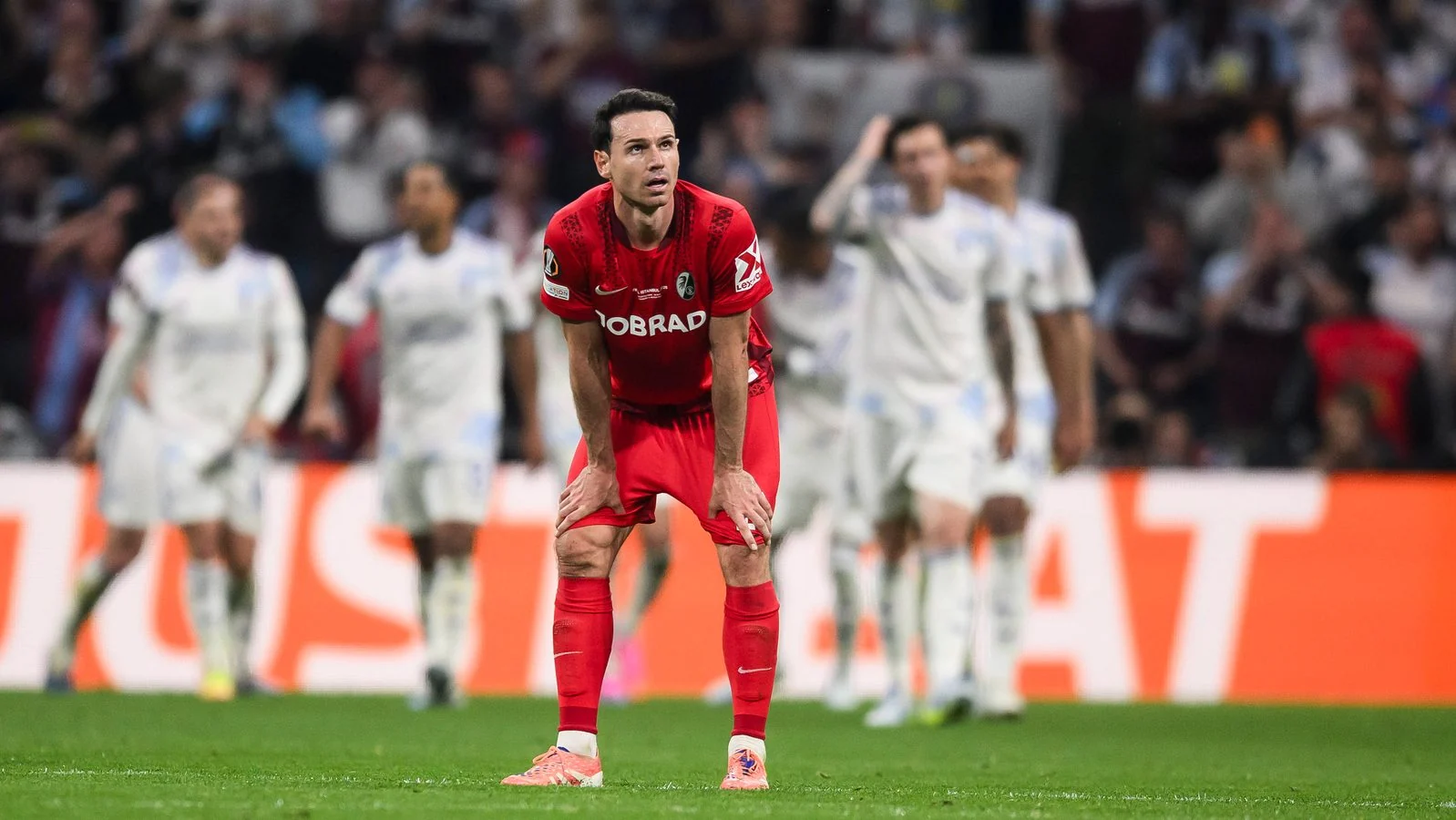
Freiburg’s situation had one extra wrinkle. They beat Leipzig 4-1 on Matchday 34 to lock down seventh, then faced Aston Villa in the Europa League final. Winning in Istanbul would have delivered a Champions League place independent of the Bundesliga table. A 3-0 defeat meant that route closed, confirming Freiburg in the Conference League play-off instead.
What the middle of the table says about the season
Positions eight to 15 covered only 12 points, but those eight clubs did not travel the same route. Comparing the two equal 17-match halves reveals the hidden shape: Augsburg and Mainz surged after winter, Eintracht Frankfurt and Union Berlin lost momentum, and Gladbach produced an unusually symmetrical points return.
| Final | Club | Hinrunde | Rückrunde | Change | Total |
|---|---|---|---|---|---|
| 8 | Eintracht Frankfurt | 26 | 18 | −8 | 44 |
| 9 | FC Augsburg | 15 | 28 | +13 | 43 |
| 10 | Mainz 05 | 12 | 28 | +16 | 40 |
| 11 | Union Berlin | 23 | 16 | −7 | 39 |
| 12 | Mönchengladbach | 19 | 19 | 0 | 38 |
| 13 | Hamburger SV | 16 | 22 | +6 | 38 |
| 14 | 1. FC Köln | 17 | 15 | −2 | 32 |
| 15 | Werder Bremen | 17 | 15 | −2 | 32 |
The recoveries mattered more than the final labels suggest
Mainz had only 12 points at halfway but collected 28 thereafter, the largest positive swing in this group. Augsburg also moved from 15 to 28. Those are not tiny fluctuations: each club’s Rückrunde alone produced more than half of its final total. Frankfurt did the reverse, falling from 26 to 18, while Union dropped from 23 to 16. Final positions eight and 11 therefore disguise contrasting trajectories.
The tied totals also reward careful reading. Gladbach and Hamburg both had 38 points, but Gladbach’s -11 goal difference ranked above HSV’s -14. Köln and Werder both finished on 32; Köln’s -14 beat Werder’s -23. Supporters can use the table by matchday to inspect that kind of movement in the current campaign instead of waiting for the final row order.
How the relegation battle ended—and why Wolfsburg still went down
The bottom of the final table needs a postscript. Wolfsburg finished 16th and escaped automatic relegation on Matchday 34, but 16th only grants entry to the two-leg Bundesliga relegation play-off. Their subsequent defeat to SC Paderborn meant all three clubs in the last-day survival fight ultimately left the top flight.
Five moments that settled the bottom three
Before Matchday 34
Wolfsburg, Heidenheim and St. Pauli all stood on 26 points—an extraordinary three-club tie with only two automatic relegation places and one play-off place available.
16 May 2026
Wolfsburg won 3-1 at St. Pauli to reach 29 points. Mainz won 2-0 at Heidenheim. Wolfsburg took 16th; Heidenheim and Pauli went down automatically.
The tie-break
Heidenheim and St. Pauli both ended on 26 points and -31 goal difference. Heidenheim’s 41 goals scored ranked them 17th, above Pauli’s 29 and 18th place.
21 May 2026
Wolfsburg hosted Bundesliga 2 side Paderborn in the first play-off leg. A 0-0 draw left the entire tie unresolved.
25 May 2026
Wolfsburg scored after three minutes in Paderborn, but Filip Bilbija levelled. Laurin Curda struck in the 100th minute, giving Paderborn a 2-1 extra-time win and a 2-1 aggregate victory.
Sixteenth is a second chance, not safety
That distinction explains why two apparently conflicting summaries can both describe different moments. Wolfsburg “survived” the automatic drop on the final league day, while St. Pauli and Heidenheim occupied 18th and 17th. Nine days later, Paderborn completed the play-off win, earned promotion and sent Wolfsburg down. A final league table usually freezes Wolfsburg beside a play-off marker; the settled season record must also state the outcome of that marker.
It also explains why Heidenheim sit above St. Pauli despite matching them on points and goal difference. Goals scored is the next Bundesliga tie-breaker, and the 41-to-29 advantage decided 17th versus 18th. It did not change either club’s division for the next season, but it is essential when reproducing the official row order accurately.
JOIN THE DISCUSSION
Comments
Sign in with Google to comment. Keep the discussion focused on Bundesliga football and respectful to other supporters. New comments are reviewed before publication.
Loading comments…