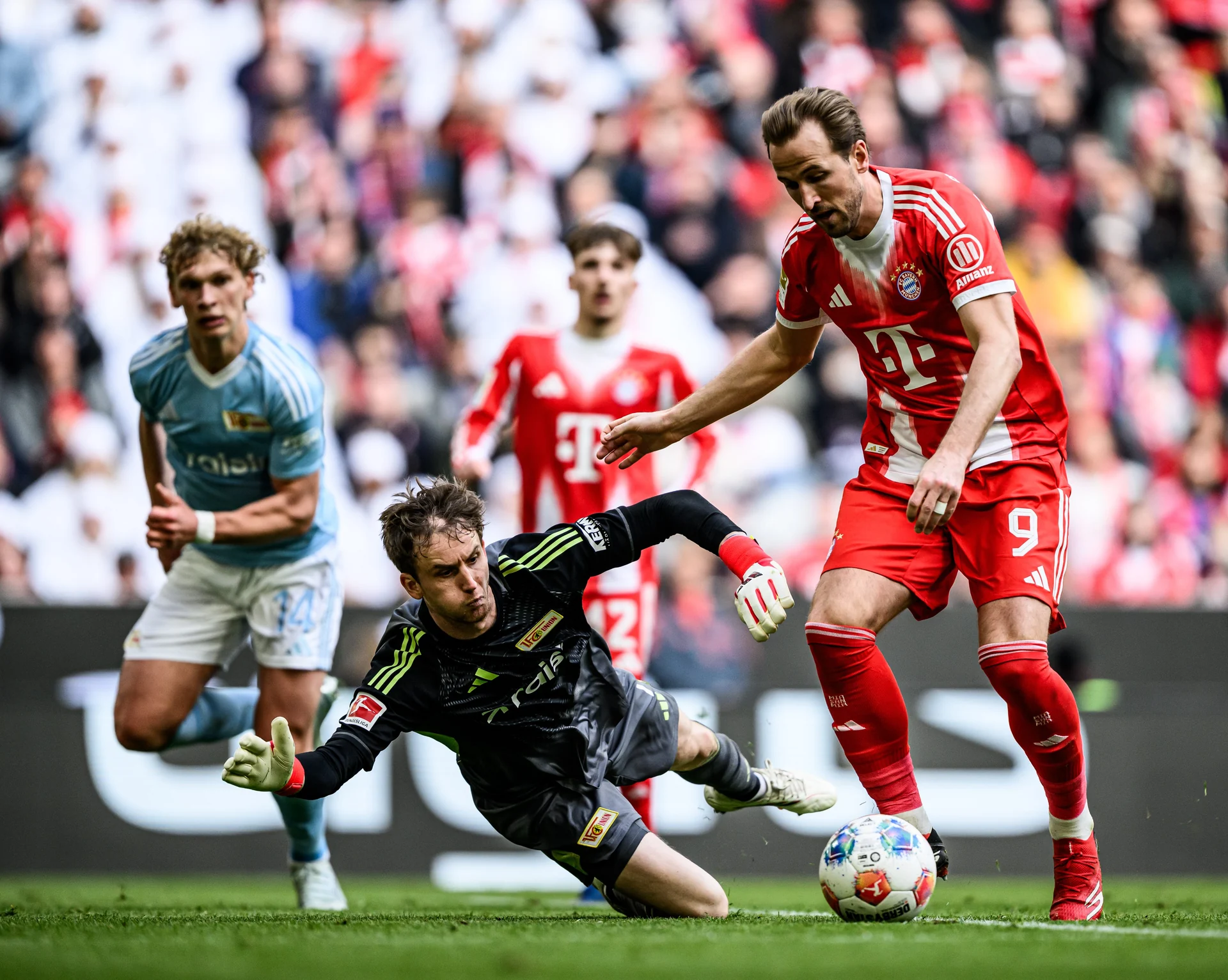
Harry Kane became the fastest player to score 100 Bundesliga goals when his 39th-minute penalty against Union Berlin on 18 September 2026 brought up the century in his 98th league appearance. Dieter Müller had held the previous mark at 129 games, so Kane reached it 31 appearances sooner. Bayern won 7–0, and Kane added a header later in the same match to move to 101.
That sequence creates an easy statistical trap. The record is for Bundesliga goals and appearances, while a detailed league breakdown published after the match counts all 101 Kane goals through the final whistle. Here is the match sequence, the comparison with Müller, the season-by-season route and what the goal patterns actually tell us about Bayern’s striker.
The night Kane hit 100—and then 101
Harry Kane's Bundesliga century arrived in a 7–0 Bayern Munich win over Union Berlin at the Allianz Arena on Friday, 18 September 2026. The precise milestone was Bayern's second goal, a 39th-minute penalty. It was Kane's 100th goal in Germany's top flight and came in his 98th Bundesliga appearance. The match then produced another Kane goal, so the final whistle left him on 101. That one-goal difference matters whenever a later statistical breakdown is described as “his first 100.”
The penalty that made history
Bayern had taken an 18th-minute lead through Jamal Musiala. In the 39th minute, Union defender Tom Rothe fouled Michael Olise in the penalty area. Kane converted to make it 2–0 and reach exactly 100 Bundesliga goals. FC Bayern's announcement ties the number to 98 top-flight appearances, and the league's match report identifies the penalty as the record-setting action. A reader looking at a video or scoreline should therefore look for the 2–0 penalty, rather than the later header or any of Bayern's other five goals.
A penalty can appear routine on a highlights reel, but the record is about a long sequence of league matches, not the difficulty of this one finish. Every valid Bundesliga goal counted toward the hundred, regardless of whether it was a spot kick, a header or a shot from open play. The narrow definition also matters: this was Kane's 100th Bundesliga goal, not his 100th Bayern goal across cups, the Champions League and other competitions. Those broader totals answer a different question.
A second goal in the same match changes the totals
Just after the interval, Olise supplied a dinked cross and Kane headed in Bayern's fourth in the 54th minute. That was league goal 101. Olise went on to complete a hat-trick as Bayern reached seven, which is why the night should also be understood as a collective attacking performance. Kane's record belonged to his 39th-minute penalty; the 54th-minute header extended it immediately. The latest results page is the place to follow subsequent matches, while the figures in this article are a dated September snapshot.
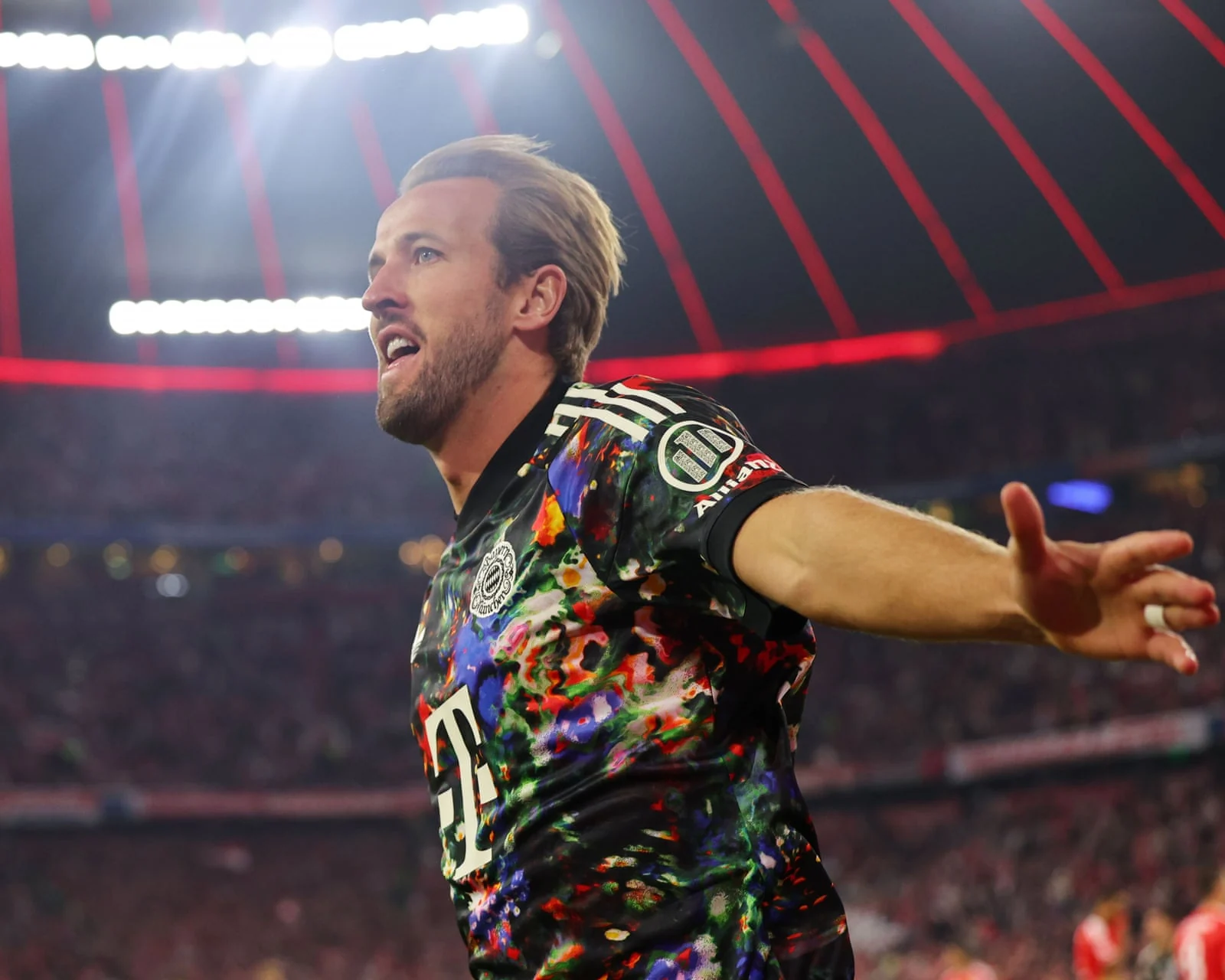
The league's own follow-up statistical feature is an excellent source of detail, but its body-part, venue and timing splits refer to the 101 goals he had by the end of the Union game. We will use those numbers with their correct denominator below. For the record itself, hold onto the simple chain: 18 September, 39th-minute penalty, goal number 100, appearance number 98. Everything else on the night explains how quickly his tally kept moving.
Why 98 league appearances beat a 49-year record
The record is a race to a fixed scoring target. Count each player's Bundesliga appearances until his 100th Bundesliga goal, then compare the totals. Kane needed 98; Dieter Müller, whose benchmark had stood since 1977, needed 129 for the same mark while playing for Cologne. Kane therefore reached 100 31 league appearances sooner. “Fastest” in this context means the fewest matches played to the milestone. It does not mean youngest scorer, highest sprint speed, most goals in one season or most goals across every competition.
The direct comparison with Dieter Müller
| Player | Bundesliga appearances to goal 100 | Milestone context |
|---|---|---|
| Harry Kane | 98 | Bayern, 2026; Union Berlin penalty |
| Dieter Müller | 129 | Cologne, 1977; former record |
The raw arithmetic gives another way to picture the gap. At the instant they crossed 100, Kane had averaged about 1.02 goals per appearance, Müller about 0.78. Those are simple milestone ratios, not minute-adjusted rates: a substitute appearance and a full 90 minutes both count as one match in this record. That distinction is useful because different articles may cite goals per 90 minutes, average minutes between goals or career goals per game. Each statistic asks something slightly different. The 98-versus-129 comparison answers one question cleanly without requiring an assumption about how long each man spent on the pitch in every appearance.
There is also an easy name trap. The previous record holder was Dieter Müller of Cologne, not Gerd Müller, the Bayern icon. Gerd still owns the all-time Bundesliga goals total: 365 in 427 league appearances. Dieter finished his league career with 177, according to the league's historical scoring list. Kane's new mark concerns the start of a Bundesliga career, while Gerd's 365 describes long-run accumulation. Neither achievement cancels the other. A player can reach 100 extraordinarily quickly and still need many seasons to challenge a career tally of 365.
The 49-year interval makes the milestone striking, but it should not be used to claim that every part of 1977 football is directly comparable with 2026. Rules, teammates, opponents and roles have changed. The measured claim is narrower and stronger: on the league's appearance count, no previous Bundesliga player had arrived at 100 as soon as Kane. His record was secure the moment the penalty went in, even though he added goal 101 later the same night.
Kane’s route to the century across Bayern seasons
The September penalty did not create the record by itself; it completed a run built over three full Bundesliga campaigns and the opening weeks of a fourth. Kane scored 36 league goals in 2023/24, 26 in 2024/25 and another 36 in 2025/26. That left him on 98 before the 2026/27 season began. His winner away to Elversberg on 13 September was Bundesliga goal 99; the Union Berlin penalty five days later was number 100, and the header in the same match number 101. Putting the seasons in order makes the count easy to audit.
| Stage | Bundesliga goals in stage | Cumulative league goals |
|---|---|---|
| 2023/24 | 36 | 36 |
| 2024/25 | 26 | 62 |
| 2025/26 | 36 | 98 |
| 13 Sep 2026, Elversberg | 1 | 99 |
| 18 Sep, Union penalty | 1 | 100 |
| 18 Sep, Union header | 1 | 101 |
Every completed season in that table ended with Kane as the Bundesliga's top scorer. The first 36 came in his debut German league campaign, when Bayern did not win the championship; the second-season 26 helped him retain the individual prize as Bayern took the title; the third 36 accompanied another Bayern title. The record therefore reflects more than an exceptional first month after transfer. Even a lower-output second season still supplied more than a quarter of the eventual century, and the third restored his debut scoring level.
The Elversberg match is a good example of why labels matter. The Bundesliga reported his late 2–1 winner as his 150th goal for Bayern in all competitions. In the league-only sequence here, it was number 99. Both descriptions can be true at once because one count includes DFB Cup, Champions League and other competitive Bayern matches and the other includes only Bundesliga fixtures. The league's own 2025/26 accounting puts the difference in plain sight: 36 Bundesliga goals within 61 Bayern goals in all competitions that season.
By the end of Matchday 4 in 2026/27, Kane had added three league goals to the 98 carried from previous seasons. Do not confuse that three-goal current-season contribution with a claim that Bayern scored only three times: the team had 14 league goals after four games. Nor should the cumulative 101 be treated as his exact total for all future dates. It is the post-Union snapshot used for the analysis below. The record will remain “100 in 98 games” even as the live career tally and team results continue to change.
What the goal mix says about Kane’s finishing
Kane's speed to 100 is supported by more than one type of finish. The Bundesliga's published breakdown after the Union Berlin match covers 101 goals, including the header that followed the milestone penalty. Within that 101-goal sample, he scored 68 with his right foot, 16 with his left and 17 with his head. The numbers add to 101 exactly. They show a clear dominant foot, but also enough left-foot and aerial finishing that defenders cannot simply block one favored shot lane.
Right foot, left foot and headers
The body-part split describes how Kane finished, not where the chance began. A right-foot penalty belongs in the 68 right-foot goals and in the penalty count discussed below; a headed goal can come from a cross or a corner. These categories must not be added together as if they represented separate goals. The 17 headers are substantial for a forward who often drops away from the penalty spot to link play: he can return to the box and attack a delivery, as the 54th-minute header from Olise against Union illustrated immediately after the record was broken.
A supporter watching Bayern can use this mix to look beyond the question of whether Kane scored. Does he arrive at the far post when a winger has time to cross? Does his first touch open the angle on his weaker side? Is a defender stepping out to stop a right-foot shot leaving a pass to another runner? The figures cannot answer every tactical question by themselves, but they explain why the team can create chances for him through different routes rather than a single repeated pattern.
Penalties, service and goals from distance
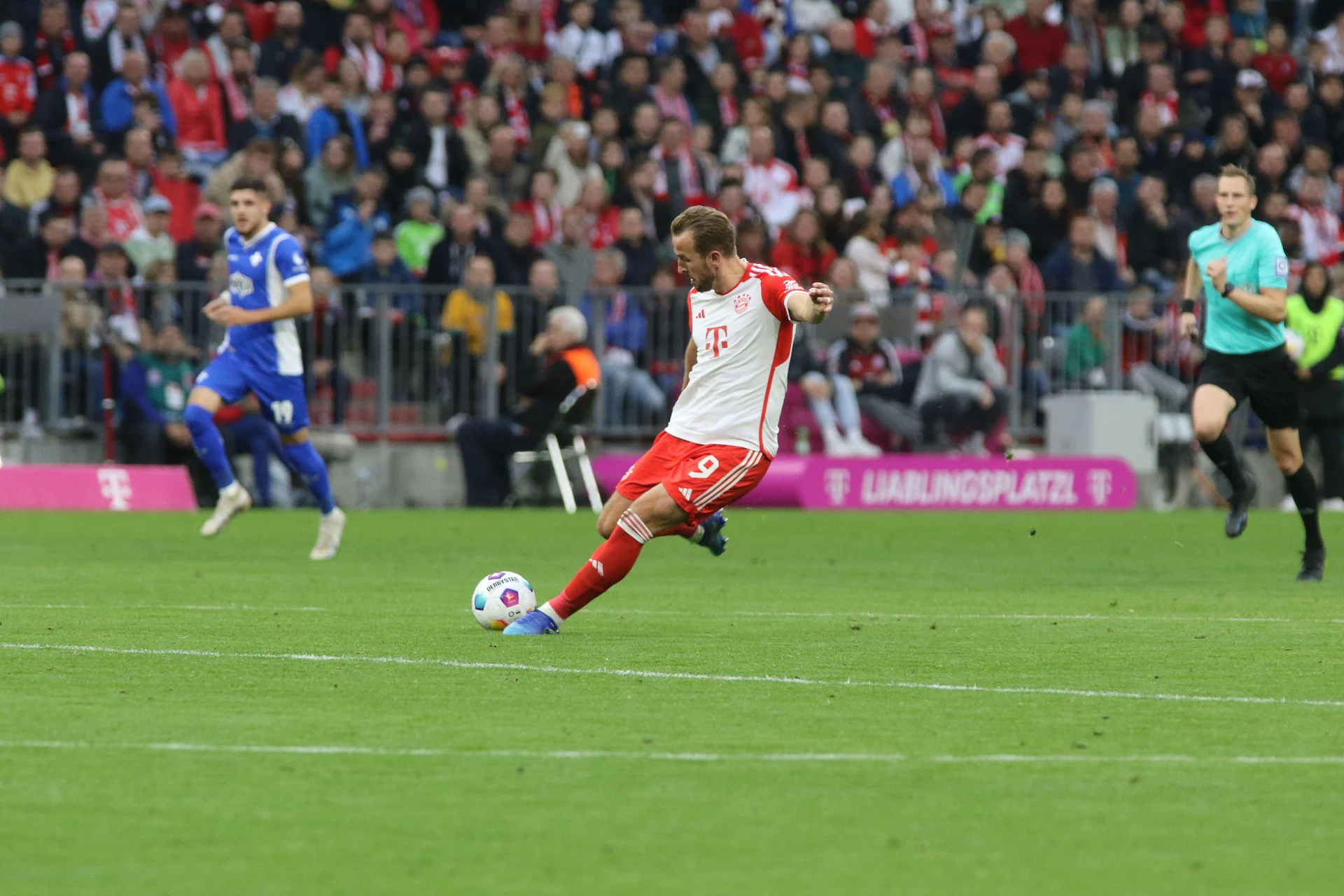
The penalty question deserves a number. Kane had converted 25 of 26 Bundesliga spot kicks through goal 101, according to the league. That means 25 of the 101 goals were penalties and 76 were not. His role as Bayern's taker clearly helped the total, but a quarter of the tally is a long way from the whole story. Bayern's supply also matters: the league attributes 55 goals to passes from open play and nine to crosses from open play, while other goals came from corners, free kicks or individual situations. These are a separate classification of chance origin, not extra goals on top of the body-part figures.
Most of the finishing happened close to goal: 89 of 101 were struck from inside the penalty area and 12 from outside. That balance is what one would expect from a prolific No. 9 who repeatedly finds space where a chance is most valuable. It does not mean he lacks range. The league credits him with six outside-box goals in 2025/26 alone, and its live record measured his spectacular long-range strike against Darmstadt in 2023/24 at 56.4 metres. The memorable exception illustrates his ability; the 89 inside-area goals explain the volume that carried him to the record.
Where and when he scored most often
The 101-goal snapshot after Union Berlin also reveals a scorer who has produced at home and away, early and late. Sixty of those goals came in Bayern home games and 41 on the road. Forty-one came before half-time and 60 after it. Those pairs each add to 101 because they are two different ways of sorting the same goals. The balance is useful for describing what happened, but it does not tell us that the stadium or the clock caused a finish. Bayern have played different opponents and match states in each setting.
The league identifies the 60th-to-70th-minute period as his richest ten-minute window, with 19 goals in the 101-goal sample. That should be read as a descriptive bucket, not an instruction to expect a goal at minute 65 every week. Kane has also opened the scoring in a match 24 times across the 98 appearances counted through the Union fixture. Opening goals can be especially valuable because they change what the opposition must do, but this total is not a measure of how often he wins games alone. It sits alongside Olise, Díaz, Musiala and Bayern's other creators, whose movement helps create the situations from which Kane finishes.
Opponent totals need context
Stuttgart had conceded more Kane Bundesliga goals than any other opponent through 18 September: ten in seven meetings. Werder Bremen and Hoffenheim had conceded eight each; Union Berlin, Augsburg and RB Leipzig seven each. That spread matters more than a single “favorite victim” label because it shows he has scored repeatedly against clubs with different defensive styles. Still, opponent totals are shaped by how many times he has faced a team. Ten in seven games against Stuttgart is a different observation from one in six against Bayer Leverkusen, or none against a newly promoted side faced once.
In fact, the Bundesliga says Kane had scored against 21 of the 22 clubs he had faced in its top division by the end of the Union game. Schalke were the sole exception after one meeting. Bayern drew that match 0–0, with Kane starting on the bench as Vincent Kompany rotated his attack. That detail provides context for the blank, but it cannot tell us what would have happened if he had started or if Bayern had generated a different chance. Leverkusen had limited him to one goal in six encounters. The contrast between those two opponent rows shows why both tally and sample size belong in any sensible comparison.
For fans, the practical reading is simple: he has scored in a wide range of places and times, yet certain opponents have so far made the job harder. A season record is built by turning many types of match into goals, not by inflating one result. The split cannot predict the next meeting; it can show what a defence must prepare for. Against Bayern, surviving the first half offers no comfort by itself when Kane's second-half total is higher, while a well-organised Leverkusen-style match demonstrates that the overall century does not guarantee an individual goal on any given day.
What this milestone means for Bayern—and what it does not
Bayern have a forward who reached a major league scoring target earlier in his Bundesliga career than anyone before him. That gives Vincent Kompany a reliable end point for many attacking moves, and the Union match illustrated it in two contrasting ways: a composed penalty and a header from Olise's cross. But the value to Bayern is more practical than a commemorative number. A team can create chances through different players and trust Kane to turn a strong share of them into goals. The century is evidence of that relationship over three-plus seasons, not a trophy in itself.
The wider attack is visible in the last completed league campaign. Bayern set a Bundesliga team record with 122 goals in 2025/26. Kane supplied 36, about 29.5 percent, while the league records 18 Bayern scorers and a league-leading 19 assists for Michael Olise. Those figures make Kane central without pretending he did everything alone. When opponents focus on his runs, teammates can finish; when they move toward other scorers, he can occupy the most dangerous space. Olise scoring three against Union while assisting Kane's header is a compact example of how intertwined their outputs can be.
The record is also specific. Kane's 100 in 98 appearances is not the Bundesliga record for goals in a single season: Robert Lewandowski's 41 in 2020/21 remains that mark. Nor does it overtake Gerd Müller's 365 career Bundesliga goals. The categories reward different things. Reaching 100 rapidly captures an extraordinary opening stretch; a 41-goal season measures one campaign at a peak; 365 requires sustained output across many years. Kane could continue to challenge other figures, but multiplying his early ratio by future fixtures would assume the same availability, service and conversion conditions indefinitely. No such forecast follows from this milestone.
As of the first four 2026/27 matchdays, Bayern had scored 14 league goals and earned ten points; Dortmund were two points ahead. Kane's three current-season league goals include the Elversberg winner and Union brace. These are useful facts for the early title discussion, yet a personal scoring record cannot recover points Bayern dropped in the 0–0 draw with Schalke or guarantee results in October. The team still has to defend, adapt and win. Supporters can use the current Bundesliga table to see how that team task develops, while keeping the 98-game record as a fixed historical fact.
The clean takeaway is a measured one: Kane reached 100 league goals in fewer appearances than Dieter Müller, then immediately scored number 101. His goal mix shows a striker supported by penalties and an excellent side, but capable of finishing in several ways. Bayern benefit from both his precision and the attack around him. The league title race, future scoring totals and other records remain questions for the matches still to be played.
JOIN THE DISCUSSION
Comments
Sign in with Google to comment. Keep the discussion focused on Bundesliga football and respectful to other supporters. New comments are reviewed before publication.
Loading comments…