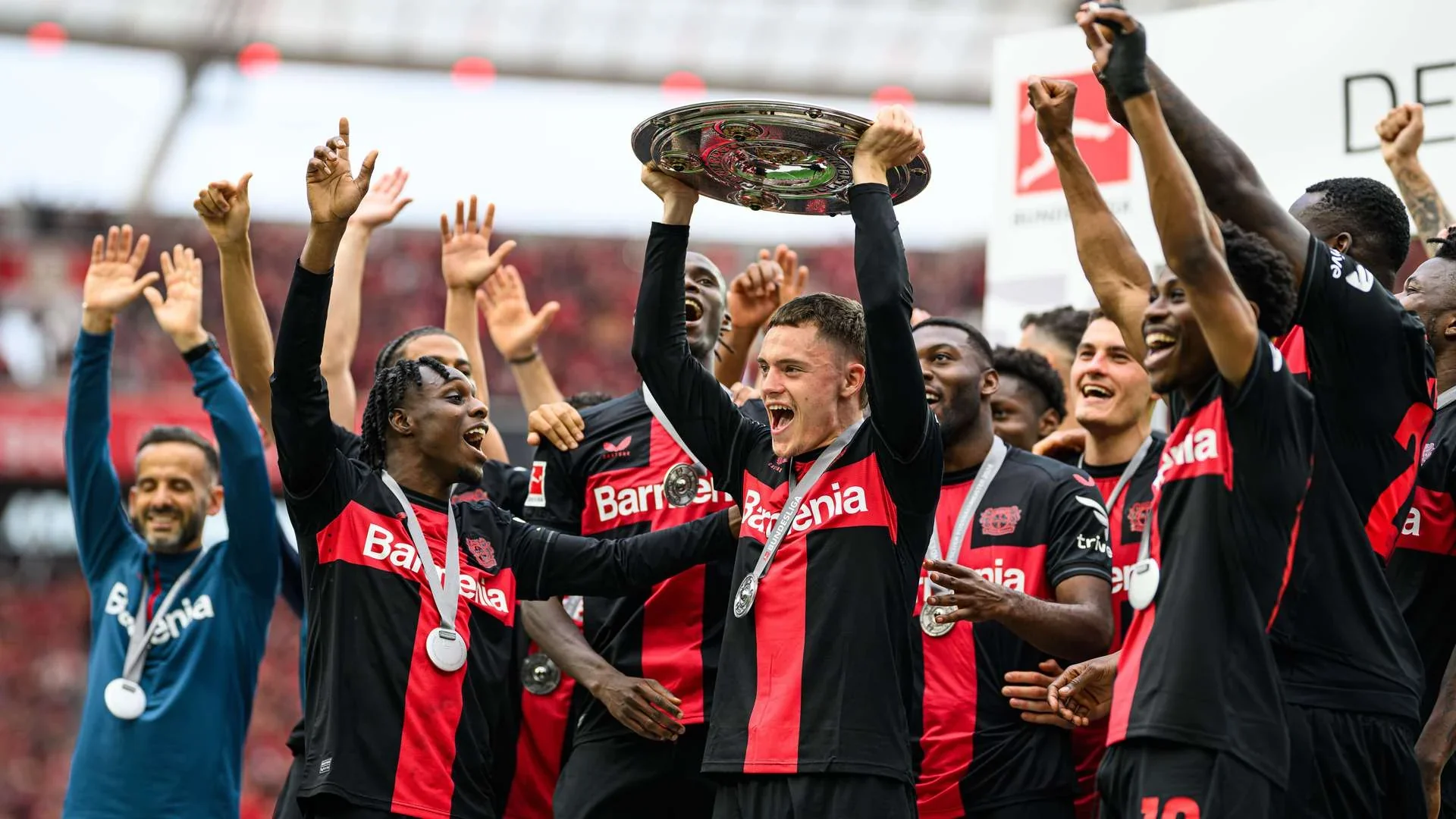
Bayer Leverkusen won their first Bundesliga title in 2023/24 with an unbeaten record built on more than a memorable first eleven. Xabi Alonso connected an experienced defensive core, Xhaka's midfield control, Wirtz's creativity, attacking wing-backs and several forward options. This guide identifies the senior squad and explains the roles behind that championship.
The players in Leverkusen's 2023/24 championship squad
Leverkusen's 2023/24 title-winning side combined an established defensive core with transformative additions such as Xhaka, Grimaldo, Hofmann and Boniface. Alonso did not rely on one unchanged eleven. He had a recognisable structure, several ways to fill its roles and players who could shift responsibilities during a match. The following senior-squad guide groups players by their practical contribution rather than pretending every registration label captures how they were used.
| Role group | Players across the campaign |
|---|---|
| Goalkeepers | Lukas Hradecky, Matej Kovar, Niklas Lomb |
| Central and covering defenders | Jonathan Tah, Edmond Tapsoba, Odilon Kossounou, Piero Hincapie, Josip Stanisic |
| Wide defensive options | Jeremie Frimpong, Alejandro Grimaldo, Arthur, Timothy Fosu-Mensah |
| Central midfield options | Granit Xhaka, Exequiel Palacios, Robert Andrich, Gustavo Puerta, Noah Mbamba |
| Creative and wide attacking options | Florian Wirtz, Jonas Hofmann, Amine Adli, Nathan Tella, Adam Hlozek |
| Centre-forwards | Victor Boniface, Patrik Schick, Borja Iglesias |
| Part-season senior midfielder | Nadiem Amiri: moved to Mainz on 31 January 2024 |
The table covers the senior group around the championship campaign, including the clearly marked January departure. It is not an academy registration list or a claim that every named player appeared in the league. Younger players also trained or joined matchday squads, and injuries restricted some senior members. Those distinctions matter when a search result calls a bench list, a training-camp party or a particular starting team the complete winning squad.
The loan situations also explain why later rosters look different. Stanisic was at Leverkusen from Bayern, while Iglesias arrived from Real Betis during the winter. Their presence belongs to this historical season. A current player page cannot be substituted for the 2023/24 record without changing the question being answered. Similarly, Amiri's move before the title was secured does not erase the fact that he had been part of the earlier campaign.
A useful way to remember the group is through its relationships: Hradecky behind the defensive core, Xhaka connecting the build-up, Wirtz finding spaces ahead of midfield, wing-backs stretching the pitch and different forwards completing attacks. The less prominent options gave Alonso additional combinations when opponents, injuries or the calendar required them. The championship story is therefore a squad story even when a few names dominate the highlights.
These roles were not rigid boundaries. Adli could lead the line, Tella could provide attacking width from deeper or higher positions, and defenders could alter the back line's shape. The value of the table is to identify the players before examining those movements. The sections that follow explain how the names became a functioning team, rather than simply repeating a list beside the final league position.
Hradecky and the defenders who protected the attack
Leverkusen conceded only 24 goals across the 34-game Bundesliga season, the division's strongest defensive record. That was the essential protection beneath the attacking freedom. Captain Hradecky was the principal league goalkeeper, while Kovar played an important part in the wider schedule. Their competition roles should not be oversimplified: Kovar handled many cup assignments, but Hradecky started the DFB Cup final against Kaiserslautern.
In front of them, Tah supplied an experienced central reference, with Tapsoba and Kossounou offering athleticism and the ability to move the ball forward. Hincapie added a left-sided option who could also operate wider, while Stanisic gave Alonso another intelligent defender for a variety of demands. The purpose was not merely to assemble three strong individuals. The back line had to understand when to advance, when to cover a teammate and when a forward pass was worth the risk.
A possession team still faces dangerous defensive moments. When several players have moved ahead of the ball, one poor pass can expose open space. Centre-backs who are comfortable receiving under pressure help reduce those losses; defenders who read the next action help manage the ones that still occur. Leverkusen's low concession total was therefore connected to the quality of its possession as well as to tackling, heading and goalkeeping.
Frimpong and Grimaldo changed what the wide roles could produce
The wing-backs made that relationship especially important. Frimpong could attack space at speed on the right, while Grimaldo offered combinations, delivery and a goal threat from the left. Their high positions gave opponents difficult choices: protect the centre and concede room outside, or move wider and leave space for Wirtz and the other attacking midfielder. Width became a way to create central opportunities rather than an instruction to cross on every attack.
The price of those forward positions was responsibility behind them. A wide centre-back might have to cover the channel, a central midfielder might need to protect a counterattack and the opposite wing-back might need to narrow his position. That coordination made the attacking roles sustainable. It would be misleading to celebrate the wing-backs' output as if it happened independently of the defensive work that allowed them to arrive so high.
This is why the defensive group belongs near the centre of any explanation of the squad. Hradecky and the defenders were not simply waiting for the attackers to win games. They helped decide where the next attack began, how securely possession could be kept and how much freedom teammates could use. A strong championship team needs that platform even when its most famous images show goals at the other end.
The midfield relationships: Xhaka, Palacios, Andrich and Wirtz
The midfield worked because its jobs complemented each other. Xhaka gave the team a constant organiser underneath the attack, while Palacios and Andrich provided alternative partnerships around him. Wirtz and Hofmann operated further forward, finding positions from which they could connect with the wing-backs and forwards. A pass into one player often became more valuable because of where another had moved.
The double pivot supplied control and alternatives
Xhaka's arrival from Arsenal in summer 2023 added a player comfortable setting the tempo and receiving under pressure. His value was not measured only by the number of direct goal contributions. A midfielder who remains available, changes the direction of play and delivers the ball on a useful angle can repeatedly improve the next player's situation. That was an important relationship with the centre-backs behind him and Wirtz ahead.
Palacios offered energy and technique alongside that control, while Andrich gave Alonso a strong alternative with his own passing and defensive qualities. Rotation did not mean replacing a complete midfielder with a player capable of only one task. Both could contribute to possession and protect the centre. Palacios also supplied crucial late league goals, including the penalty at Bayern and the winner at Augsburg, showing that the midfield platform could become decisive in the penalty area too.
The options mattered during a demanding schedule. Injuries, international commitments and different opponents altered the available combination, but the basic need remained: progress possession without leaving the team exposed. Having several players who understood that balance allowed Alonso to adapt without inventing a new midfield identity every week. The squad's strength was partly the continuity of its relationships when personnel changed.
Wirtz and Hofmann connected midfield with the forwards
Ahead of the pivot, Wirtz and Hofmann offered receiving points between the opposition's lines. Their task was not to stand permanently beside the striker. Dropping towards a pass could draw a defender out; moving towards the wing-back could create a short combination; running beyond the forward could add another threat inside. The possession became harder to anticipate because those movements were connected rather than random.
Wirtz's individual quality was central, but the wider squad explains why he could use it so effectively. Hofmann gave another experienced option in the creative line, while the central midfielders maintained access to the ball and the wing-backs kept opponents stretched. Our Wirtz season-award analysis examines his own campaign; the point here is how the teammates around him made that influence repeatable. The championship midfield was a set of complementary relationships, not four players all trying to perform the same role.
Boniface, Schick and the attacking options around them
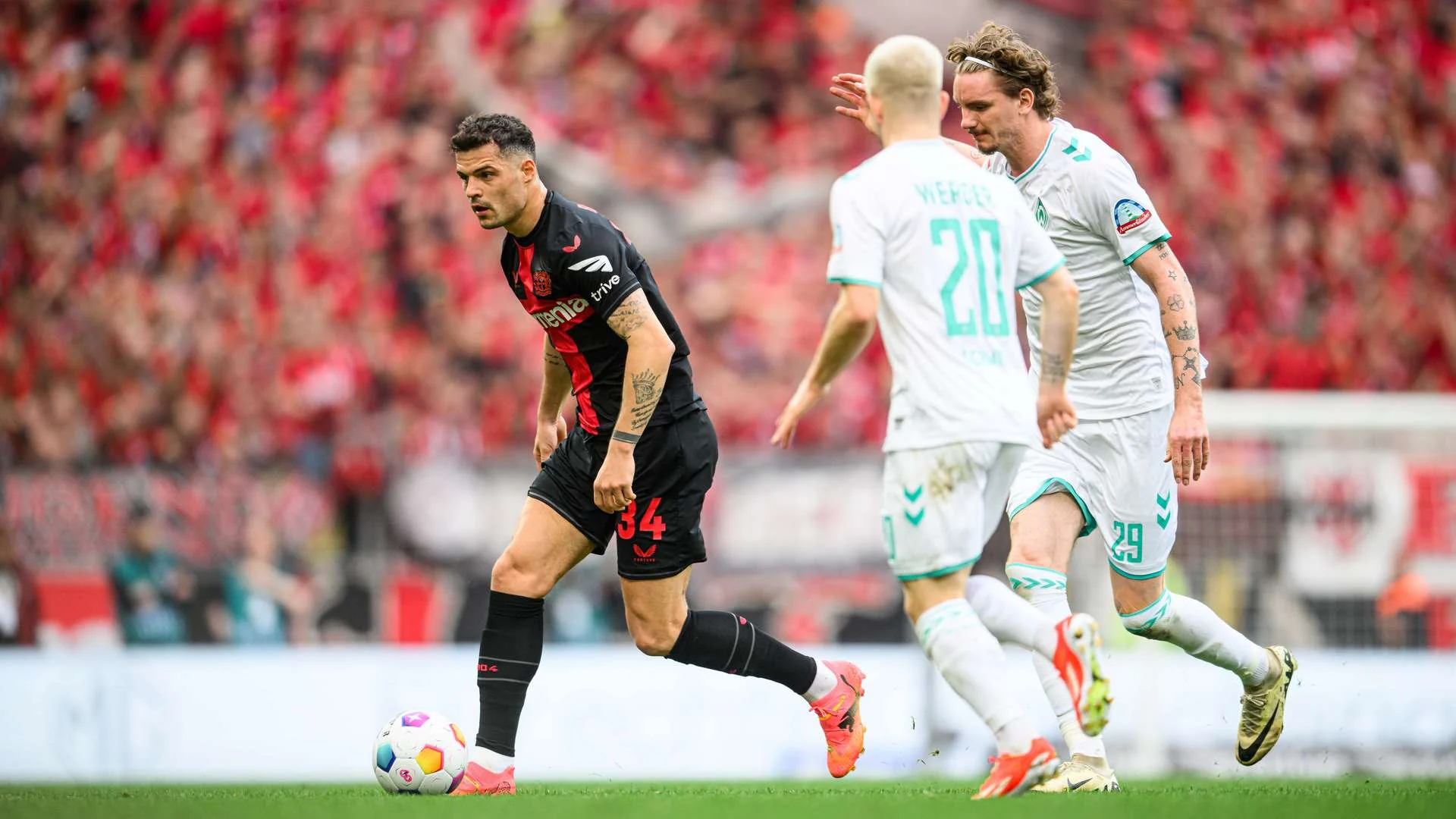
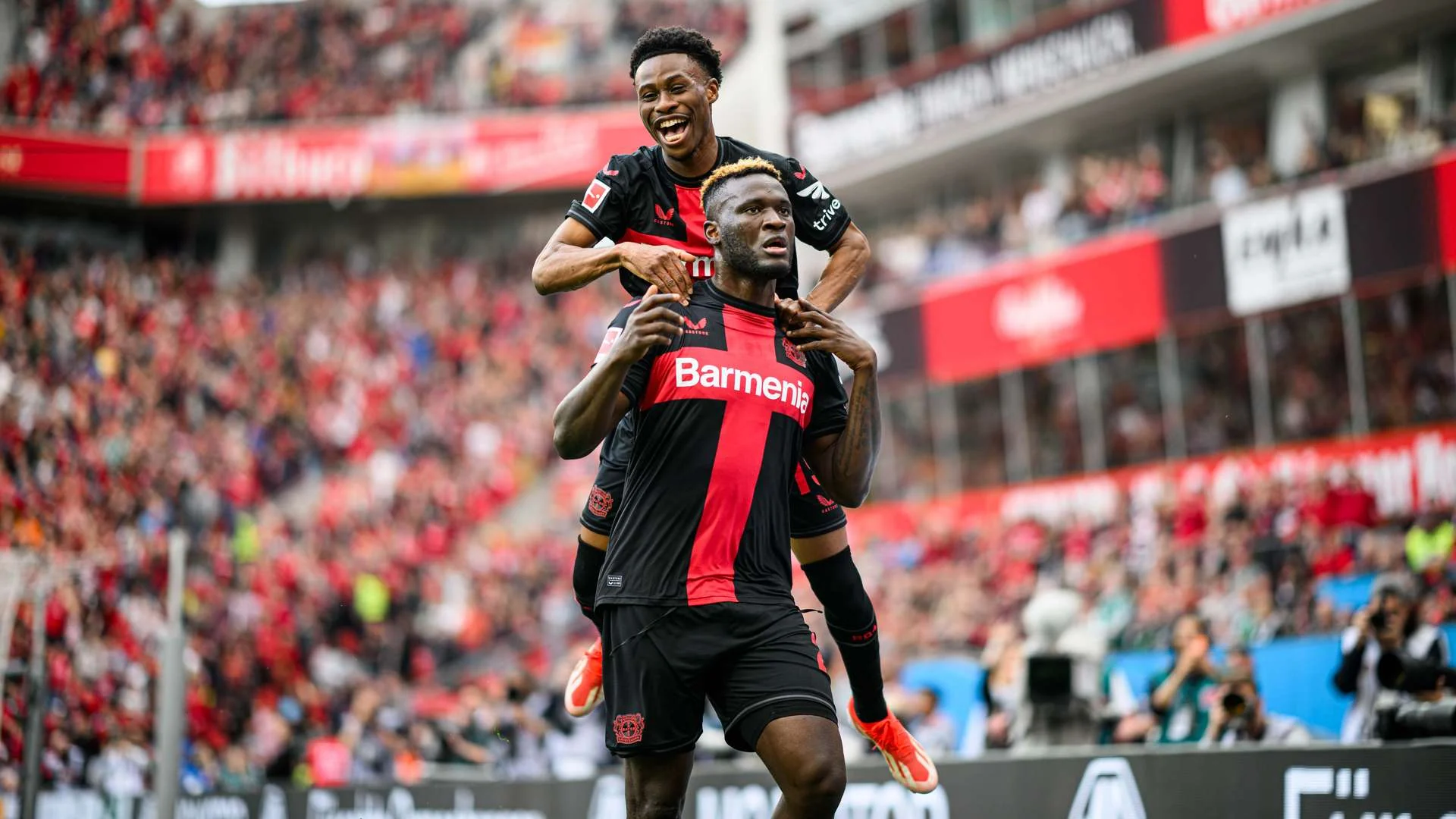
Boniface finished as Leverkusen's leading Bundesliga scorer with 14 goals, despite an injury interruption. He supplied a powerful central presence and was comfortable becoming involved outside the penalty area. That gave the team a forward who could occupy defenders, combine with the attacking midfielders and then threaten the goal himself. His season also brought the league's Rookie of the Season honour, recognising the impact of a player new to the competition.
Schick offered another high-quality central option, with penalty-area movement and finishing that became particularly valuable in tight games. His late winner in the 2-1 victory over Hoffenheim on 30 March is a useful example. Andrich had equalised in the 88th minute before Schick finished a cross from substitute Tella in stoppage time. The decisive sequence involved a midfielder, a replacement wide player and a striker, illustrating how squad contributions connected.
Why changing the striker did not mean abandoning the plan
The two forwards did not need identical playing styles for the same collective principles to survive. Teammates still required a central reference, movements that occupied defenders and a player ready to finish the chances created. The detail of an attack could change around the forward selected: more combinations into feet in one spell, more emphasis on deliveries or runs into the box in another. Continuity came from shared responsibilities rather than cloning one player's movements.
Adli added another possibility by bringing speed and movement through the centre or from a wider position. Tella could provide a threat on the right and contribute from different starting heights, while Hlozek gave additional attacking cover. Iglesias, on loan during the second half of the season, supplied another centre-forward option. Their minutes and output were not equal, but depth is partly about retaining useful choices when the first plan or first-choice player is unavailable.
That variety mattered because opponents did not defend Leverkusen in one uniform way. A deep block can make close combinations and patient movement essential; a higher line can create space for a runner. A game late in its second half can call for a different kind of penalty-area presence. Alonso could respond through personnel while keeping the supporting structure recognisable to the rest of the team.
The scoring responsibility was also shared across the squad. Boniface's 14 league goals led the team, yet Leverkusen scored 89 in total. That spread is a better description of the champion than the idea of one forward carrying every result. The attackers mattered enormously, but the system kept finding chances for wing-backs, midfielders and defenders as well. A wider range of scoring routes made the side more resilient when a striker was injured, rested or closely marked.
Alonso's 3-4-2-1 was a starting point, not a fixed picture
The familiar 3-4-2-1 is a useful starting description of Leverkusen, but it is not a photograph of every moment. A team changes shape when it builds from the goalkeeper, moves into the final third, presses or retreats. Alonso's players understood those different pictures well enough to alter their positions without losing the relationships that made the whole structure work.
The 3-0 home victory against Bayern on 10 February demonstrates the point. Stanisic, Tella and Adli started, while Frimpong, Hofmann and Schick were on the bench. Leverkusen did not insist on dominating possession simply to resemble their usual statistical profile. They had only 38 percent of the ball, defended compactly and chose moments to attack. The personnel reflected the opponent and the intended plan, rather than a requirement to field the same eleven whenever the title race became important.
The league's tactical breakdown described a 5-2-3 defensive shape and a move towards 4-2-3-1 in possession. Those numbers describe different phases of one match, not contradictory accounts of the team. Grimaldo's movement, Hincapie's ability to advance and Wirtz's changing position created new problems for Bayern as they tried to decide whom to follow. The strength lay in coordinated movement rather than simply changing the formation label.
UEFA's analysis of the Europa League semi-final first leg at Roma offered another picture, observing a 3-2-2-3 build-up structure. That European example belongs to the same squad campaign while remaining separate from its Bundesliga record. It illustrates how the players could occupy useful passing lanes and switch efficiently from defending to attacking. The important football question is where an extra passing option or unmarked runner appears, not whether one set of numbers can explain every sequence.
For a supporter rewatching the season, follow one player across a possession change. A wing-back may begin deep, become a wide attacker and then recover towards the defensive line. An attacking midfielder may move closer to the ball before running beyond it. A centre-back may advance only when the structure around him allows cover. These movements explain why knowing the squad's abilities is more useful than memorising a single formation diagram.
Alonso's achievement was to make the changes feel connected. The team could adapt to an opponent without asking its players to abandon their strongest qualities. That flexibility helped protect results in difficult matches and kept the attack varied when a predictable route was blocked. The title-winning squad was organised enough to repeat good principles and versatile enough to express them in more than one way.
How squad depth became an unbeaten league season
The title-clinching 5-0 win over Bremen on 14 April 2024 is an especially useful squad snapshot. Wirtz began on the bench and entered at half-time; Frimpong, Schick, Grimaldo and Palacios also came on. Boniface's penalty and Xhaka's long-range finish established the lead before Wirtz completed a hat-trick. Leverkusen secured their first Bundesliga championship with five league fixtures remaining, using both starters and substitutes to shape the occasion.
That match makes a simple point about depth: the famous championship eleven was not one permanent selection. Alonso could start with a particular balance and introduce different strengths later. A substitute's value could be a decisive goal, a new running threat or the ability to maintain control when another player left the pitch. The whole group needed to understand the same game, even when its members entered at different times.
The final league record was 28 wins, six draws and no defeats, with 90 points, 89 goals scored and 24 conceded. Those figures describe performance across 34 matches, not only the emotional afternoon when the title became certain. The historical final-tables guide provides the surrounding league context. Here, the record is the outcome of the squad's quality, organisation and ability to keep finding answers as circumstances changed.
The wider campaign ended with a domestic double, but it was not unbeaten in every competition. Atalanta won the Europa League final 3-0, ending Leverkusen's 51-game unbeaten run, before the German cup victory completed the season. The distinction matters: an unbeaten Bundesliga championship and an unbeaten domestic double are accurate descriptions; an entirely undefeated season across Europe and Germany is not.
What remains distinctive is how many kinds of contribution supported the league achievement. The goalkeeper and defenders enabled ambitious positioning, the midfield kept the team connected, the wing-backs added width and danger, and several forwards supplied different solutions. Wirtz's brilliance and Alonso's coaching were central, but they became more powerful inside that wider structure. The title-winning squad is best remembered through those relationships: a collection of strong players who could keep functioning together through a demanding and unprecedented championship run.
JOIN THE DISCUSSION
Comments
Sign in with Google to comment. Keep the discussion focused on Bundesliga football and respectful to other supporters. New comments are reviewed before publication.
Loading comments…