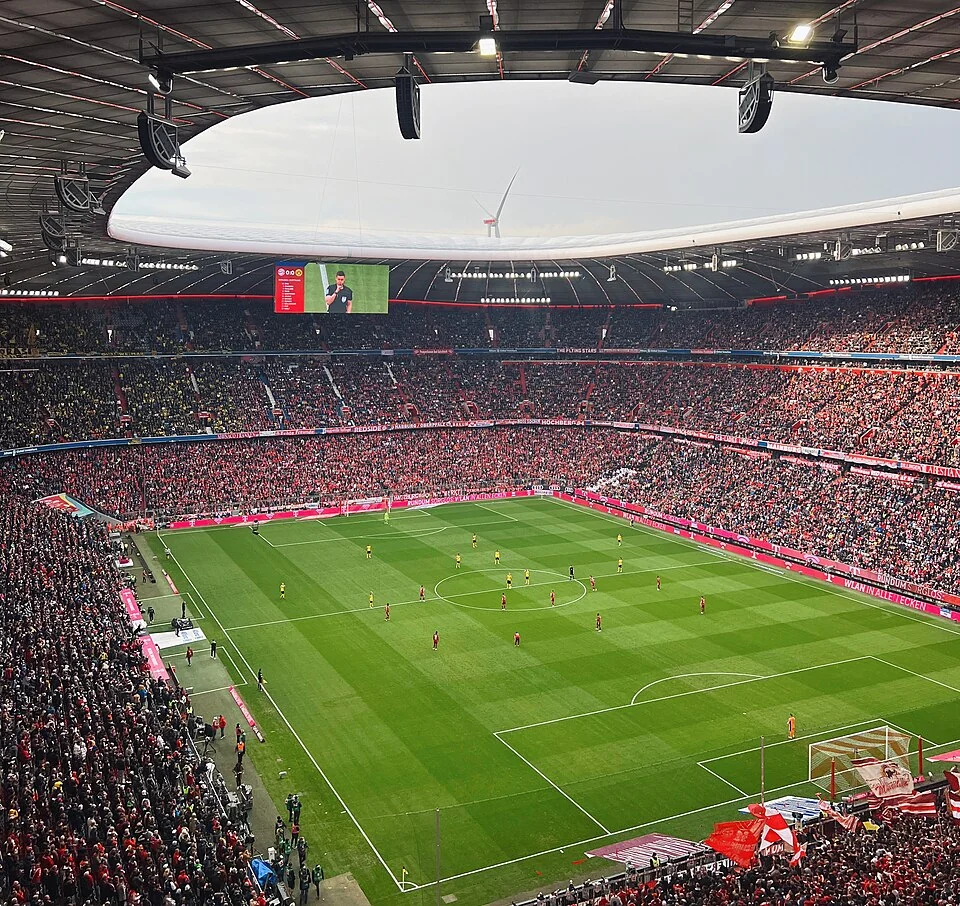
At a glance: Bayern Munich won the 2021/22 Bundesliga with 77 points, eight ahead of Borussia Dortmund. Leverkusen and Leipzig completed the Champions League top four. Union Berlin and Freiburg reached the Europa League, Cologne reached the Europa Conference League, and Frankfurt qualified for the Champions League by winning the Europa League despite finishing 11th. Stuttgart escaped the bottom three on the final day; Hertha survived a later playoff; Bielefeld and Fürth were relegated.
Cover photograph: UNTERMVIERENBERGE-2, CC BY-SA 4.0; resized and converted to WebP.

The complete 2021/22 Bundesliga final table
Bayern Munich finished top of the 2021/22 Bundesliga final table with 77 points, eight ahead of Borussia Dortmund. Bayer Leverkusen and RB Leipzig completed the top four. At the other end, Arminia Bielefeld and Greuther Fürth were relegated directly; Hertha Berlin finished 16th and still had a two-leg playoff to contest. These are the standings after all 34 league matchdays, not a live table or a projection for another season.
| Pos | Club | P | W | D | L | GF | GA | GD | Pts |
|---|---|---|---|---|---|---|---|---|---|
| 1 | Bayern Munich | 34 | 24 | 5 | 5 | 97 | 37 | +60 | 77 |
| 2 | Borussia Dortmund | 34 | 22 | 3 | 9 | 85 | 52 | +33 | 69 |
| 3 | Bayer Leverkusen | 34 | 19 | 7 | 8 | 80 | 47 | +33 | 64 |
| 4 | RB Leipzig | 34 | 17 | 7 | 10 | 72 | 37 | +35 | 58 |
| 5 | Union Berlin | 34 | 16 | 9 | 9 | 50 | 44 | +6 | 57 |
| 6 | Freiburg | 34 | 15 | 10 | 9 | 58 | 46 | +12 | 55 |
| 7 | Cologne | 34 | 14 | 10 | 10 | 52 | 49 | +3 | 52 |
| 8 | Mainz 05 | 34 | 13 | 7 | 14 | 50 | 45 | +5 | 46 |
| 9 | Hoffenheim | 34 | 13 | 7 | 14 | 58 | 60 | −2 | 46 |
| 10 | Borussia Mönchengladbach | 34 | 12 | 9 | 13 | 54 | 61 | −7 | 45 |
| 11 | Eintracht Frankfurt | 34 | 10 | 12 | 12 | 45 | 49 | −4 | 42 |
| 12 | Wolfsburg | 34 | 12 | 6 | 16 | 43 | 54 | −11 | 42 |
| 13 | Bochum | 34 | 12 | 6 | 16 | 38 | 52 | −14 | 42 |
| 14 | Augsburg | 34 | 10 | 8 | 16 | 39 | 56 | −17 | 38 |
| 15 | Stuttgart | 34 | 7 | 12 | 15 | 41 | 59 | −18 | 33 |
| 16 | Hertha Berlin | 34 | 9 | 6 | 19 | 37 | 71 | −34 | 33 |
| 17 | Arminia Bielefeld | 34 | 5 | 13 | 16 | 27 | 53 | −26 | 28 |
| 18 | Greuther Fürth | 34 | 3 | 9 | 22 | 28 | 82 | −54 | 18 |
P means played; W, D and L are wins, draws and defeats. GF and GA show goals scored and conceded, while GD is the difference. A win earned three points and a draw one. That is why a side with more wins can still have the same points as a side with more draws: Stuttgart's seven wins and 12 draws produced 33 points, exactly as Hertha's nine wins and six draws did. Stuttgart's less negative goal difference put them above Hertha when the two finished level.
Each club played every other club home and away, so 18 teams generated 306 league fixtures in total. The German Football Association's season record counts 954 goals across those games. The table offers a compact view of a long campaign, but the positions also settle different questions: the title, four Champions League league places, other European routes and which clubs had to fight for top-flight survival. The next sections unpack those decisions rather than treating every row as an isolated statistic.
If you came here through a search for “last season,” check the dates carefully: 2021/22 is a fixed historical season. The site's current Bundesliga table is a separate, changing resource. Mixing its points with this archive would produce a false comparison, particularly before a current season has completed all 34 rounds.
How Bayern won the title and who reached the top four
The first four rows carry two separate decisions: Bayern were champions, while Bayern, Dortmund, Leverkusen and Leipzig occupied the league's four Champions League positions. The final gap between first and second was eight points, but the trophy was settled before that margin appeared in the completed table. Reading only the final column misses when the decisive result arrived.
Bayern’s tenth straight championship
Bayern beat second-place Dortmund 3-1 at the Allianz Arena on 23 April 2022, matchday 31. Serge Gnabry, Robert Lewandowski and Jamal Musiala scored in the match that made the lead uncatchable with three fixtures remaining. That was Bayern's tenth consecutive Bundesliga championship, an extraordinary run even by the club's standards. It also means the 2021/22 title was not decided on the final weekend, despite the final table often being the first thing a reader sees when looking back.
Julian Nagelsmann's side ended with 24 wins, five draws and five defeats. They scored 97 league goals, 12 more than Dortmund's 85, and conceded 37, 15 fewer than their nearest challenger. Robert Lewandowski's 35 goals led the individual scoring chart, according to the DFB season record. His total alone was higher than the entire season's scoring output of relegated Bielefeld, who managed 27 goals, and Fürth, who scored 28. That comparison does not reduce the title to one forward, but it makes the scale of Bayern's attacking advantage tangible.
Dortmund, Leverkusen and Leipzig finish in the Champions League places
Dortmund's 69 points were enough for a clear second place, five ahead of Leverkusen. Their 22 league victories nearly matched Bayern's 24, yet nine defeats and only three draws gave them a different profile from the champions. Erling Haaland scored 22 league goals, the third-highest individual total in the DFB's season list. Dortmund were a prolific runner-up, not a team whose place in the top four was in jeopardy at the end.
Leverkusen took third with 64 points and 80 goals. Patrik Schick scored 24 of them, second only to Lewandowski in the league scoring chart. The five-point cushion over Leipzig meant their qualification was not decided by a goal-difference tie. Leipzig, fourth on 58, had a different statistical signature: 72 scored and only 37 conceded, the same goals-against total as champions Bayern. Christopher Nkunku supplied 20 league goals, but fourth place reflected the whole 34-game record rather than any single star's tally.
For a supporter comparing these sides, the table gives a more useful story than a simple “top four” label. Bayern combined the best attack with joint-best defensive figure. Dortmund scored heavily but allowed 52 goals; Leverkusen balanced 80 goals with 47 conceded; Leipzig defended exceptionally well yet finished one point above fifth-place Union Berlin. The Champions League boundary sat between fourth and fifth, making that one-point Leipzig–Union gap the closest major dividing line at the top of the completed standings.
The European race beyond fourth place
Fifth-place Union Berlin and sixth-place Freiburg entered the 2022/23 Europa League, while seventh-place Cologne went into the Europa Conference League. That is the actual outcome of this season, confirmed by UEFA's next-season participant lists. It is more reliable than applying a generic qualification legend to the league table: cup results and a European title produced important exceptions in 2021/22.
Union Berlin, Freiburg and Cologne in fifth to seventh
Union finished on 57 points, one behind fourth-place Leipzig and two ahead of Freiburg. Their fifth-place finish was sealed in suitably dramatic fashion on 14 May 2022: Bochum recovered from 2-0 down at An der Alten Försterei, but Taiwo Awoniyi's late second goal made it 3-2. The result mattered because it kept Union ahead of the other European hopefuls on the last day. UEFA subsequently listed the Berlin club in the following season's Europa League group stage, a step up in continental competition for a side only in its third Bundesliga campaign.

Freiburg's 55 points placed them sixth, with a positive 12 goal difference. They were within three points of fourth, yet their place in the next Europa League was the concrete reward shown by UEFA's 2022/23 lineup. Cologne finished seventh on 52 points and a slimmer plus-three goal difference. UEFA's following-season Conference League record confirms their participation there. Their final-day 2-1 loss at Stuttgart did not erase the progress represented by seventh place; it did, however, help decide the survival story at the opposite end of the table.
Why Frankfurt's Europa League triumph matters to the table
Eintracht Frankfurt are the clearest reminder that a domestic ranking is only one route into Europe. They finished 11th in the Bundesliga with 42 points, level with Wolfsburg and Bochum, and therefore earned no European place from that league position. Four days after the Bundesliga's last round, though, Frankfurt drew 1-1 with Rangers in the Europa League final on 18 May 2022 and won the penalty shootout 5-4. UEFA records that victory as the route to Frankfurt's first Champions League group-stage place.
The distinction is practical when reading an archive. A list of “German clubs in the 2022/23 Champions League” includes Frankfurt alongside the Bundesliga's top four, but that does not retroactively make Frankfurt fifth in the league. UEFA's own 2022/23 domestic competition summary marks Frankfurt as a Champions League entrant on the 11th-place table row, precisely because the Europa League trophy supplied the separate entitlement.
The DFB Cup also shaped the league-position allocation. Leipzig, already fourth and bound for the Champions League, beat Freiburg in the 2022 cup final on penalties. With the cup winner already occupying a Champions League place, the other Europa League route passed down the league standings, helping explain Freiburg's place and Cologne's Conference League path. For this season, the correct summary is therefore four Champions League places through the table, two Europa League places through league position, Cologne in the Conference League, and Frankfurt in the Champions League as Europa League winners.
Relegation, Stuttgart’s escape and Hertha’s playoff
Stuttgart finished 15th and stayed up directly; Hertha Berlin finished 16th and had to face Hamburg in the promotion/relegation playoff. Arminia Bielefeld and Greuther Fürth, 17th and 18th, went down automatically. The final table shows Stuttgart and Hertha level on 33 points, but it cannot show how close those fates came to changing in the closing minutes of matchday 34.
Stuttgart turn matchday 34 into survival
On 14 May 2022, Stuttgart hosted Cologne needing a result and help from elsewhere. Saša Kalajdžić put them ahead in the 12th minute, but Anthony Modeste equalised in the 59th. With the match at 1-1 and Hertha behind at Dortmund, Stuttgart still needed another goal to reach 33 points. The home side pushed bodies forward for a late corner; the ball was glanced on at the near post and captain Wataru Endo headed in at 90+2. Stuttgart won 2-1.
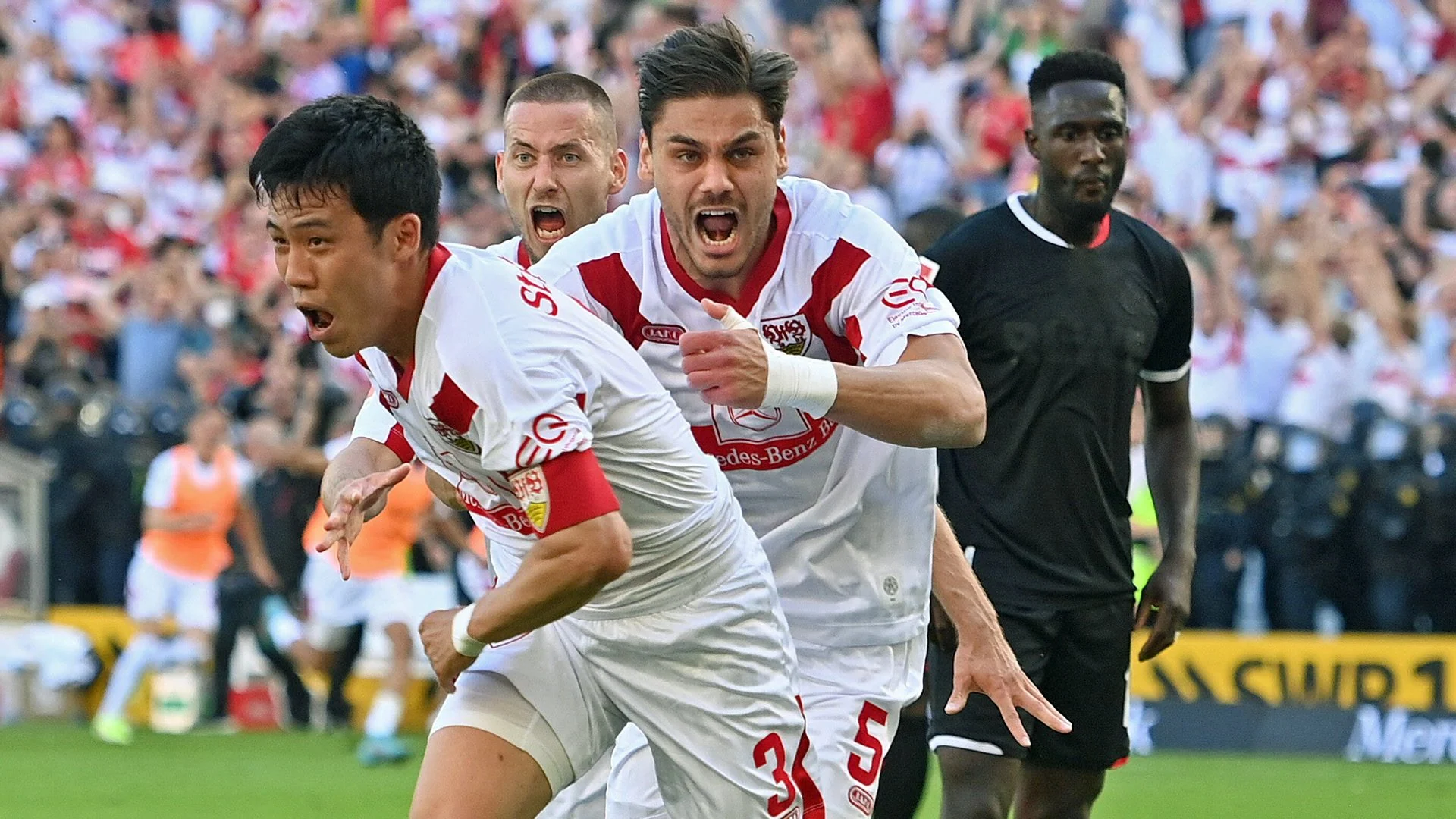
The late header mattered twice over. Three points brought Stuttgart level with Hertha on 33, and the earlier accumulation of goals and conceded goals then became decisive. Stuttgart ended with a goal difference of minus 18, Hertha minus 34. Without that winning goal, Stuttgart would have ended two points lower and remained in the playoff place. It is the kind of season-ending swing that a frozen table records accurately but cannot make emotionally obvious on its own.
Hertha's simultaneous 2-1 defeat at Borussia Dortmund completed the reversal. When looking back, keep the sequence straight: Stuttgart's win did not relegate Hertha directly, and Hertha's defeat did not guarantee their relegation. It assigned each team a different route to the following Bundesliga season. Stuttgart were safe as soon as the league schedule ended; Hertha still had two more matches to play.
Hertha survive after finishing 16th; Bielefeld and Fürth go down
Hertha's opponent was Hamburg, the third-place finisher from Bundesliga 2. Hamburg won the first leg 1-0 in Berlin, giving Hertha a deficit to overturn away from home. In the return match on 23 May, Dedryck Boyata scored early and Marvin Plattenhardt added a second-half free kick. Hertha won 2-0 in Hamburg and took the tie 2-1 on aggregate. Thus the 16th-place Bundesliga club retained its top-flight place even though the final league table rightly leaves it in 16th.
Bielefeld had no such second chance after ending five points below Hertha, on 28. Fürth's 18 points left them another ten adrift, with 82 goals conceded and only three league wins. Both clubs were relegated directly. For supporters using this archive to understand who actually played in 2022/23, the playoff result is essential alongside positions 15–18. The site's relegation playoff guide explains the competition's continuing format, while this section records the outcome of the specific 2021/22 tie.
What the final numbers reveal beyond rank
A league table is a ranking, but the columns around points explain why nearby clubs may have had very different seasons. In 2021/22, several teams finished level on points. Their goals-for and goals-against figures help separate them and show why looking only at wins can mislead. The arithmetic is simple; the meaning is more useful when tied to a specific competition boundary.
Goals and goal difference separate different campaigns
Mainz finished eighth and Hoffenheim ninth on exactly 46 points. They even had identical 13-win, seven-draw, 14-loss records. Mainz scored 50 and conceded 45, for a goal difference of plus five; Hoffenheim scored eight more, but conceded 60, leaving a minus-two difference. The extra attacking output did not lift Hoffenheim above Mainz because the net balance was seven goals worse. That is a useful reminder that “more goals scored” and “better season record” are not interchangeable claims.
At the top, the numbers also complicate a quick assumption about league place. Leipzig conceded only 37 goals, matching champions Bayern, yet finished fourth rather than first because their points and scoring totals differed. Freiburg ended sixth with a plus-12 goal difference, better than fifth-place Union's plus six, but Union earned two more points across the fixture list. Goal difference is important in tied-point comparisons; it is not a substitute for points when teams are separated on the main standings criterion.
Equal points do not mean equal outcomes
The three clubs on 42 points make a compact example. Frankfurt ranked 11th with a minus-four goal difference, Wolfsburg 12th at minus 11 and Bochum 13th at minus 14. Frankfurt won only ten matches compared with 12 each for Wolfsburg and Bochum, but 12 draws supplied points that those sides did not collect. The final ranking reflects all 34 results, not a league table sorted by victories alone. Frankfurt's subsequent Champions League entry came from the Europa League title, as explained above, not from winning this 42-point cluster.
The 33-point tie at the bottom had a far larger consequence. Stuttgart's 41 goals scored and 59 conceded gave minus 18; Hertha's 37 scored and 71 conceded gave minus 34. The 16-goal separation made Stuttgart 15th and Hertha 16th once both finished on 33. In that case the difference was direct survival versus a playoff. A reader who notices only “33 points each” misses the season's most consequential tie on the final standings sheet.
These examples are descriptive, not a diagnosis of every team's style. A single tally cannot tell you the match states, opponents or chances behind every goal. It does give you a disciplined way to compare clubs: start with points, check goal difference where points are level, then read goals scored and conceded to see which part of the balance made the difference. To follow movement within an active campaign, use the site's table by matchday rather than treating this season-end snapshot as a live trend chart.
How to use this historical table today
Treat the 2021/22 standings above as a completed record. Every club's row contains 34 league matches, and none of those points will change. A search phrase such as “Bundesliga table last season 21 22” mixes a fixed season with a relative date: by September 2026, 2021/22 is several seasons old. The year pair in the title is the reliable identifier, especially when sharing this page or comparing it with another archived campaign.
The table answers where each club finished after the regular Bundesliga season. It does not incorporate the later Hertha–Hamburg playoff into Hertha's 34-match league row. That two-leg contest decided whether Hertha retained its place for 2022/23; it did not award Hertha three more league points or change its listed 16th position. Likewise, Frankfurt's Europa League final happened after the last league match, so the Champions League berth that followed belongs in an explanation beside the league table, not in a rewritten points column.
For a quick historical comparison, first match the season labels on both pages. Then compare points only after checking that both seasons are complete; a team on ten points after four matchdays is not directly comparable with a club's final 34-game total. If you want to compare how a race developed within a season, select the same matchday in each available archive rather than placing a midseason position next to a final rank. These small checks prevent the most common misreadings of a standings screenshot.
For the active competition, use the site's current table. If the question is which scores produced that order, open the latest results. To see how a completed round affected positions, the table by matchday presents the standings at that point. Those tools change as matches are played; this article keeps the 2021/22 finish and its context intact.
The shortest answer to the original historical query remains the same: Bayern won the 2021/22 Bundesliga on 77 points; Dortmund were second on 69; Bielefeld and Fürth went down; Hertha survived the playoff after finishing 16th. The complete 18-club table above shows the precise record behind each part of that answer.
JOIN THE DISCUSSION
Comments
Sign in with Google to comment. Keep the discussion focused on Bundesliga football and respectful to other supporters. New comments are reviewed before publication.
Loading comments…