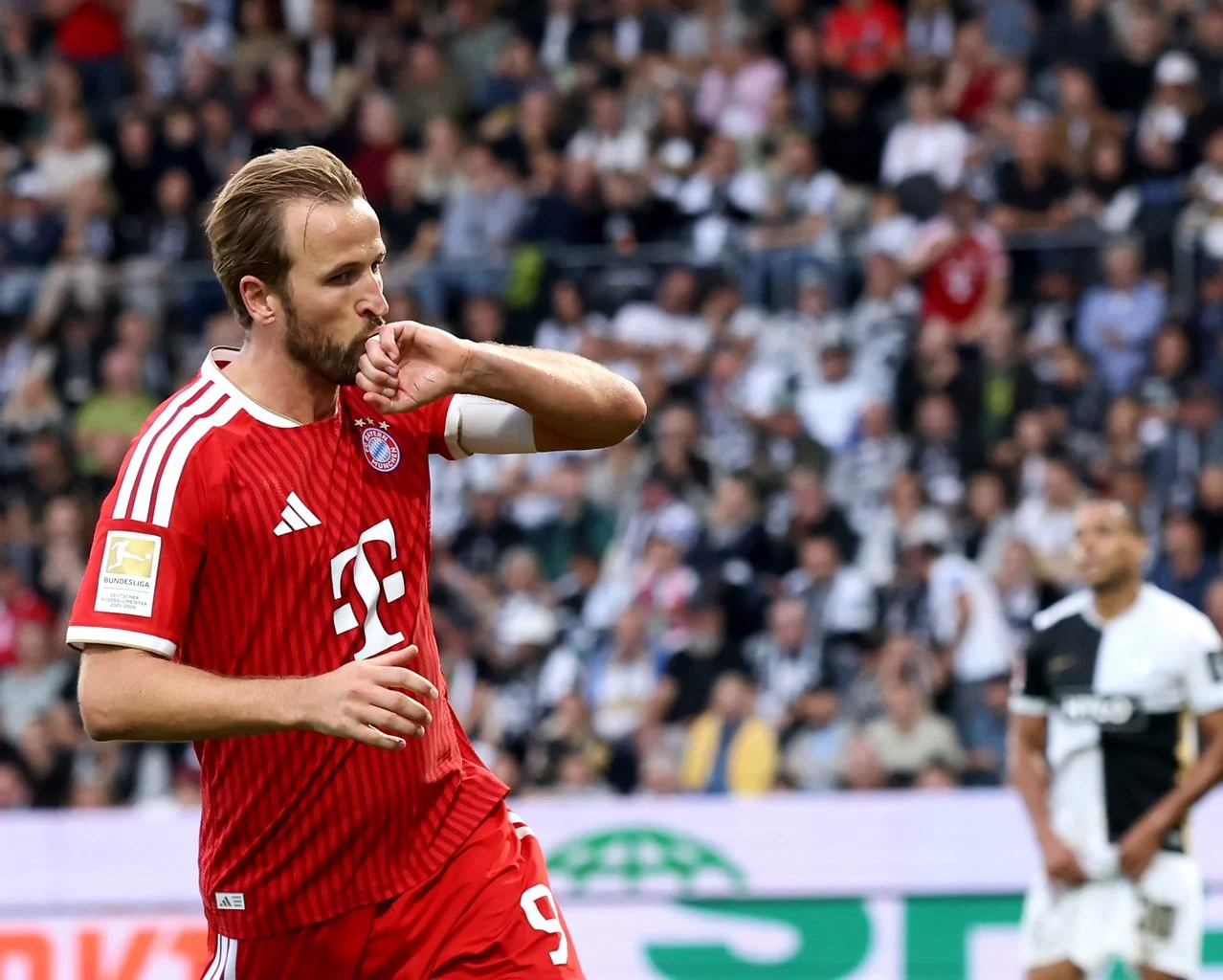
Quick answer: The 2026/27 Bundesliga produced 137 goals in its first four matchdays, an average of 3.81 across 36 games. Only the starts of 1984/85 (140) and 2023/24 (138) were higher after the same number of rounds. That makes this an exceptional opening, not a completed-season record. Bayern's seven-goal win over Union Berlin gave the total a lift, but goals from Freiburg, Augsburg and many other clubs show why the story is broader than one result. Here is what the number measures, how the scoring was distributed, and what would have to happen for the pace to last.
What 137 goals actually measures
The 2026/27 Bundesliga produced 137 goals in its first four matchdays, across 36 league games. That works out to 3.81 goals per fixture when rounded to two decimals. It is the third-highest four-round total in the league's history: 1984/85 had 140 by the same point, and 2023/24 had 138. The headline is striking, but it describes a particular snapshot after Matchday 4 ended on 20 September 2026. It is not a final season total, and it will no longer be the current cumulative figure once Matchday 5 begins in October.
The denominator helps make the scale intelligible. An 18-club Bundesliga round normally has nine matches, so four completed rounds give 9 × 4 = 36 fixtures. Divide 137 by 36 and you get about 3.8056. The number includes goals scored by both teams in those Bundesliga matches: a 3-3 draw contributes six; a 7-0 win contributes seven. It does not include goals from Germany's national-team games, Champions League ties, the DFB Cup or the Supercup, even if the same Bayern or Dortmund player scored in those competitions.
| Early-2026/27 measure | Figure | How to read it |
|---|---|---|
| Matches played | 36 | Nine fixtures on each of four matchdays. |
| Goals scored | 137 | Both sides' Bundesliga goals added together. |
| Average per game | 3.81 | 137 divided by 36, rounded. |
| Historical opening-four rank | Third | Behind 140 in 1984/85 and 138 in 2023/24. |
The pace did not depend on one isolated opening weekend. The league counted 35 goals on Matchday 1 and 36 on Matchday 2. Our Matchday 4 results show another 33 goals. The remaining 33 are the arithmetic difference between those rounds and the 137 total, corresponding to Matchday 3. That calculation tells you the first four rounds were all productive without pretending that a single 7-0 result accounts for the whole story.
It is also worth keeping the rank precise. “On record pace” means that this opening average is high relative to completed seasons; “a new opening-four record” would be false, because two previous seasons were still ahead at the same stage. The next questions are where those goals came from and whether the pattern is spread through the league. Both matter more to a supporter than an unsupported promise that the season is destined to break a record.
Where the early goal rush came from
The 137 did not arrive as 36 identical high-scoring matches. Some fixtures added exceptional chunks to the total, while many other clubs kept the scoreboard moving across the four rounds. That distinction matters if you are trying to understand what kind of season this might become. A single 7-0 can make a weekly total look spectacular; ten clubs already scoring at least eight times suggests the opening surge is also wider than one team.

Big games moved the total, but no single game explains it
Two six-goal matches set the tone on the opening weekend: Bayern beat Stuttgart 5-1, while Union Berlin and Eintracht Frankfurt drew 3-3. Matchday 4 then produced two seven-goal games with completely different shapes. Bayern overwhelmed Union 7-0; Mainz won 4-3 at Borussia Mönchengladbach after a sequence of late goals. One was an emphatic clean-sheet victory, the other a contest where both sides repeatedly answered each other. Lumping them together as “bad defending” loses the difference in how the goals arose.
| Match | Total goals | What the score illustrates |
|---|---|---|
| Bayern 5-1 Stuttgart, Matchday 1 | 6 | A large winning margin can lift a round's total. |
| Union 3-3 Frankfurt, Matchday 1 | 6 | Both teams can contribute equally to a goal-heavy game. |
| Bayern 7-0 Union, Matchday 4 | 7 | The biggest early blowout, with an Olise hat-trick. |
| Gladbach 3-4 Mainz, Matchday 4 | 7 | A late back-and-forth thriller rather than a shutout. |
The two seven-goal Matchday 4 games alone supplied 14 goals, about one tenth of the four-round total. That is noticeable but leaves 123 goals across the other 34 fixtures. Bayern's 7-0 was half of the club's 14 league goals to this point, so it is a particularly important outlier for Bayern's own tally. The league still reached a high cumulative number on rounds that did not feature seven-goal games.
Ten clubs reached eight goals or more
The league's four-round count says ten of 18 clubs have scored at least eight times, equivalent to at least two goals per game on average for those teams. Bayern lead on 14, but Freiburg have 12 and Augsburg 11. Freiburg and Augsburg both set club marks for their goal totals after four fixtures. This spread is a useful check against the idea that the headline exists only because Bayern had one enormous night. Bayern's 14 represent roughly 10.2 percent of all 137 goals; the other clubs have supplied the remaining 123.
That does not mean all ten teams are equally consistent. One side can reach eight through a blowout and quiet games; another can score twice in every fixture. To understand the difference, look at the individual results through Matchday 4 rather than using one league average to judge every club. The next question is whether the goals also tell a simple story about the quality of defending. The results themselves argue for more care.
Does a high goals total mean every defence is struggling?
No. The league-wide average combines very different match stories. A 7-0 result adds seven goals even though the winning team's defence gives up none. The same Matchday 4 that contained two seven-goal games also ended with Schalke and Elversberg drawing 0-0. A high combined total tells us how often the ball crossed the line across the division; by itself it cannot tell us whether defensive organisation has deteriorated everywhere, whether finishing has been unusually sharp, or whether a few particular mismatches drove the number.
Bayern's own first four fixtures illustrate the danger of treating an average as a prediction for each game. The champions put seven past Union Berlin, yet newly promoted Schalke had held them to a goalless draw on Matchday 2. In that 0-0 the league's match report recorded 1.70 expected goals for Bayern and 0.10 for Schalke. Bayern created chances but did not convert one. Against Union, the report recorded 3.90 expected goals for Bayern and 0.23 for their visitors, while the real score was 7-0. That gap between a chance-quality estimate and actual finishing in one game is interesting; it cannot alone prove why 36 league fixtures yielded 137 goals.
Bayern’s 7-0 and Dortmund’s stinginess tell different stories
Dortmund sit atop the table after four wins, but their route to the top has not been a succession of open, six-goal matches. The league's season stocktake notes that Hoffenheim are the only opponent to score against BVB so far; Dortmund conceded twice in that 3-2 game and kept opponents out in the other three. Their latest result was a narrow 1-0 win at Stuttgart. That is a very different contribution to the league's 137 than Bayern's Union rout. Both clubs can be prominent in a goal-rich season while one earns points through defensive control and the other supplies a large single-match scoring burst.
Schalke's two goalless results sharpen the point. Their 0-0 with Bayern ended a long scoring streak for the champions; their 0-0 with Elversberg on Matchday 4 supplied no goals to the league total at all. Those examples do not mean the wider burst is imaginary. They mean the early season has room for scoreless matches, one-goal wins, balanced thrillers and blowouts at the same time. A fan who watches only the highlight of a 7-0 or only the table average will miss that variety.
It is tempting to assign one tactical label to the whole league: high pressing, open transitions or weak defending. Some individual match reports may support those observations for a particular fixture. A league-wide claim would require a consistent comparison of shots, chances, possession and playing styles across seasons, not four scorelines. For now the evidence supports the narrower conclusion: the Bundesliga has started at an unusually high scoring rate, but that rate is made from different football matches rather than one repeated defensive failure. The historical comparison makes the same caution even more important.
How the start compares with Bundesliga history
There are two separate records in play. One asks which seasons scored the most goals over their first four matchdays. The other asks which completed season averaged the most goals across all 34 rounds. The 2026/27 campaign ranks third on the first measure and currently runs above the record pace on the second. Neither statement means that a full-season record has already been broken. Comparing like with like keeps a dramatic September number from becoming a misleading season claim.
The two opening-four totals still above 2026/27
The official league comparison puts 1984/85 first with 140 goals in its opening four rounds, 2023/24 next with 138, and this season on 137. The gaps are small: three goals to the top figure and just one to second. This is genuinely rare territory at a matched stage of the schedule, which is why the 137 deserves attention. It is still third, not first. A six-goal game replacing a three-goal game would have tied 1984/85's early tally, but counterfactuals do not change the recorded results.
| Season | Goals after four matchdays | Compared with 2026/27 |
|---|---|---|
| 1984/85 | 140 | Three more |
| 2023/24 | 138 | One more |
| 2026/27 | 137 | Current four-round snapshot |
The table is deliberately limited to the same four-round checkpoint. It would be misleading to put the current 137 beside a completed season's final goals and call the difference a deficit. Four rounds are 36 matches; a full 18-team campaign is 306 matches. The next 270 games can raise or lower the average dramatically, and past fast starts were made of different players, fixtures and goalscoring patterns. This comparison establishes rarity, not a causal link among those seasons.
A 3.81 average is a pace, not a season record
For the full-season benchmark, the Bundesliga cites 1983/84: 1,097 goals in 306 matches, about 3.58 per fixture. This season's 137 in 36 matches equals about 3.81 per fixture, roughly 0.22 higher at this point. If you mechanically extend 137/36 across 306 games, you get about 1,165 goals. That is a way to illustrate the current rate, not a prediction that the league will finish there. Even one quieter or wilder Matchday 5 will alter the pace, and there are 30 rounds left after the international break.
There is a useful warning built into the historical names themselves. The season with the highest opening-four count, 1984/85, is not the one the league identifies as the record holder for full-season goals per game; that is 1983/84. Early scoring and sustained scoring measure different things. For fans following the 2026/27 race, the best way to discuss the number is “third-highest four-round start, at a rate above the completed-season record so far.” That wording leaves room for what actually happens once domestic football resumes.
The scorers turning the team numbers into goals
The team totals hide several different individual scoring patterns. After Matchday 4, five players shared the top Bundesliga mark with four goals: Bayern's Michael Olise, Freiburg's Yuito Suzuki, Mainz's Phillip Tietz, Frankfurt's Younes Ebnoutalib and Leverkusen's Patrik Schick. The league counted 11 players on at least three goals. That is a reasonably broad early group rather than one striker carrying a disproportionate share of the 137. Yet even among the five leaders, “four in four” does not mean the goals arrived in the same way.
Schick provides the consistent-weekend example. The league says he is the only player who scored in each of the opening four matchdays. A goal in every round means Leverkusen have received a scoring contribution regardless of opponent or match flow. The 30-year-old's fourth strike came as Leverkusen beat RB Leipzig 2-0 before the international pause. That does not guarantee he will continue to score every weekend, but it is a different early form signal from a player who scores three in one game and then goes quiet.

Suzuki and Olise show the clustered version. Suzuki hit a hat-trick as Freiburg beat Werder Bremen 4-1 on opening weekend; Igor Matanović supplied Freiburg's other goal that day. Olise's first league goal of the season came against Stuttgart, then he scored three against Union Berlin on Matchday 4 and assisted Harry Kane as Bayern won 7-0. Both had four after four rounds, but three quarters of each player's tally came from one match. Their performances were decisive and memorable; an early Golden Boot prediction based only on the raw four would still be premature.
Kane's numbers require an extra label. His penalty against Union was the 100th Bundesliga goal of his career, and a later header in the same match took that career tally to 101. His 2026/27 league-season tally after four rounds was three. Mixing the career milestone with this season's top-scorer chart would make the early race nonsensical. The same rule applies to goals in European or cup competitions: they may show form, but they do not count toward the 137 Bundesliga goals discussed here.
For fans, these patterns create three useful things to watch after the pause. Can Schick extend a matchday-by-matchday run? Do Suzuki and Olise keep producing beyond their hat-trick fixtures? And can players on three, such as Kane, close the one-goal gap to the leading group? Those are open questions, not predictions. The numbers already show that the league's fast start is supported by scoring from Freiburg, Mainz, Frankfurt and Leverkusen as well as Bayern, with very different routes to the same four-goal mark.
What to watch when Bundesliga play returns
The next evidence arrives with Matchday 5, beginning on Friday, 9 October 2026, when Borussia Dortmund host Werder Bremen at 20:30 CEST. Cologne's Rhine derby against Borussia Mönchengladbach follows on Sunday, 11 October, at 15:30 CEST. Those fixtures are scheduled; their scores and lineups are unknown as of this 30 September review. Use the Matchday 5 page for the complete slate rather than making a prediction from the first-four average.
First, count all nine Matchday 5 scorelines after the round is complete. The first two weekends produced 35 and 36 goals; Matchdays 3 and 4 each account for 33 in the 137 total. A fifth round in the same range would keep the recent pattern visible. A quieter round would lower the 3.81 average, but it would not erase the fact that the opening four already rank third historically. The latest results provide the raw scores; adding both teams' goals is a simple way to audit any new headline total.
Second, watch who supplies the goals. Bayern's seven against Union were spectacular, but ten clubs reached eight or more by the pause. Does Matchday 5 again feature contributions from several clubs, or does the league total depend on one or two large scorelines? The answer tells us more about the breadth of the scoring rush than a single updated average. The league table puts each club's goals for and against beside its results, so you can separate an exciting attack from a side that has simply played one unusual game.
Third, follow the individual patterns. Schick had scored on every opening matchday; Olise and Suzuki reached four with hat-tricks; Kane sat one goal behind the leading five after his career milestone against Union. International duty and club selection may change who starts next, so the interesting question is what they do once the league resumes, not what a pre-break projected team sheet promises. A fresh goal by a new player would also broaden the story beyond the current leaders.
Even after nine more games, it will still be early to pronounce a season record inevitable or impossible. The clear, defensible conclusion today is that 137 goals in four rounds is an exceptional start, one goal shy of the second-highest matched checkpoint and three shy of the highest. Following the next scores, club distribution and scorers will show whether the opening energy survives the three-week league gap. The final verdict on a full-season record belongs to May, after the remaining fixtures have actually been played.
JOIN THE DISCUSSION
Comments
Sign in with Google to comment. Keep the discussion focused on Bundesliga football and respectful to other supporters. New comments are reviewed before publication.
Loading comments…