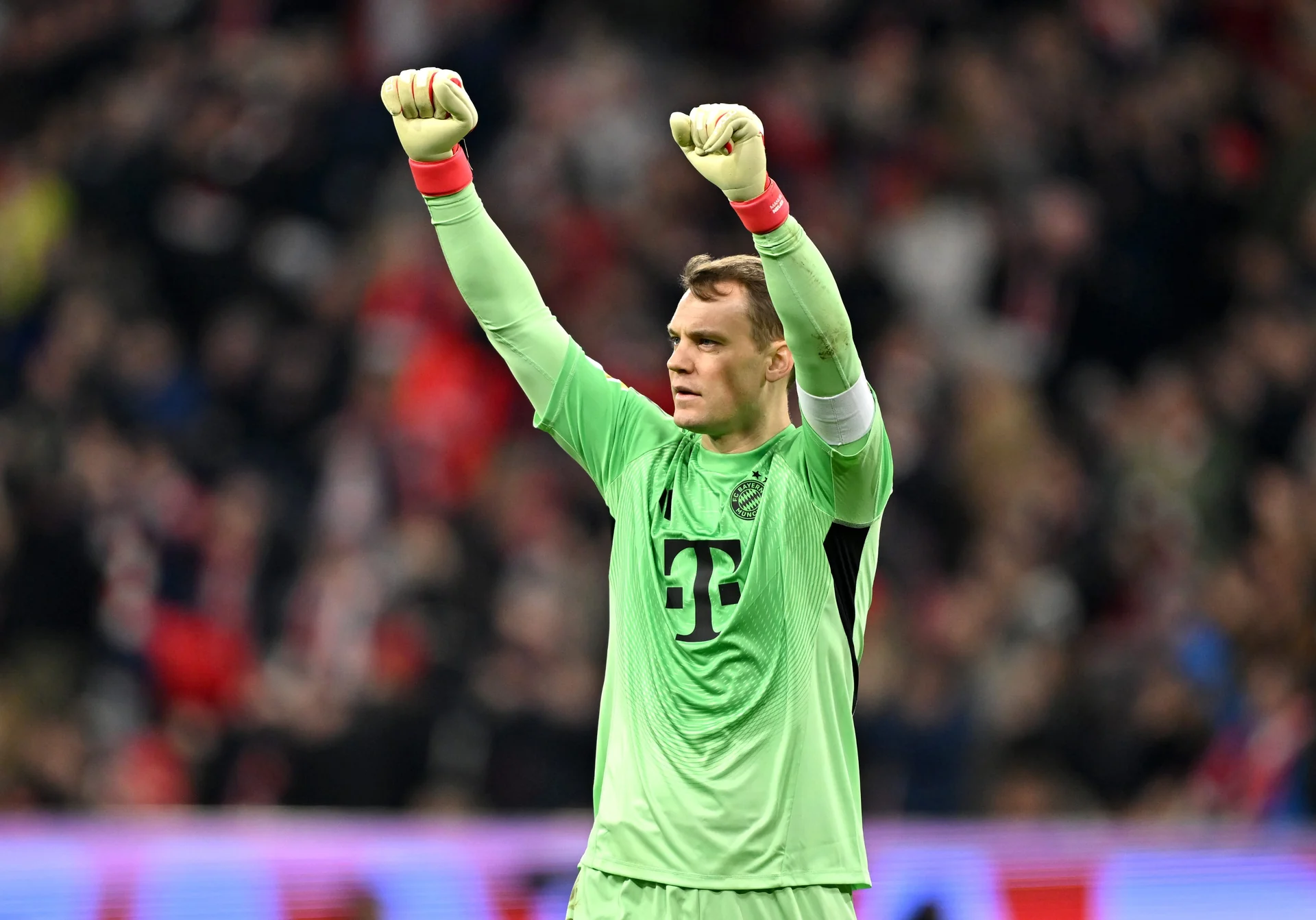
Manuel Neuer expands the goalkeeper's job by defending space behind the back line and helping Bayern begin attacks. His influence comes from combining those responsibilities with elite shot-stopping. This guide explains the anticipation, passing and risk through specific Bayern and Germany matches, rather than treating the role as a collection of spectacular clearances.
What makes Neuer a sweeper-keeper?
A sweeper-keeper helps defend the space behind his outfield teammates, rather than waiting exclusively for a shot near goal. Manuel Neuer made that expanded responsibility a defining feature of his game: he anticipates through balls, leaves the penalty area when necessary and participates in possession. The role combines prevention with the familiar work of making saves.
Anticipation before the through ball
The crucial movement often begins before the opponent completes the pass. Neuer reads the ball carrier, the runner and his own defensive line, then adjusts his starting position. That preparation can shorten the distance he must cover if a pass breaks through. A dramatic clearance is the visible finish; the earlier positioning may have made it possible.
For a supporter, watch him when the opposing midfielder looks up. Does he move as the passing lane opens, or wait until the ball is already travelling? Does his position leave a realistic route to intercept while preserving a chance to recover? These questions explain the decision more clearly than simply counting how far he ventures from goal.
The objective is to stop an attack reaching its most dangerous stage. A successful intervention may therefore produce no save at all. The striker never gets the chance to shoot, so the goalkeeper's contribution can disappear from a basic saves column even though it materially protected the team.
Using feet and head outside the penalty area
Outside his own penalty area, Neuer must solve the problem with the same restrictions as an outfield player: he cannot simply handle the ball. Clearances with feet or head are therefore fundamental to the role. Reaching the ball is only half the job; the contact must also send it somewhere that reduces the immediate danger.
His own Bayern role feature places defensive prevention and distribution within the wider goalkeeper's job. The league's analysis likewise connects his ability to sweep with his contribution on the ball. That matters because the role is not just a collection of emergency sprints. It includes calmer decisions about where to stand and what to do after winning possession.
A clearance into touch can be an excellent result when it ends a dangerous break. Keeping the ball is more valuable only when the situation supports it. Judging Neuer solely by whether an intervention looks elegant would confuse style with purpose: sometimes the safest next action is deliberately simple.
The defining idea is thus an expanded defensive area, guided by anticipation and judgment. Neuer still protects the goal, but sometimes the best way to do that is to deal with the threat before it becomes a one-on-one inside the box.
How his position supports Bayern's high defensive line
When Bayern push their defenders towards halfway, the team can compress the area in which opponents try to pass. The trade-off is the space left between that line and the goal. Neuer's advanced position helps cover part of it, giving the side another defender against a pass behind the back four.
That relationship is why sweeping belongs to a team plan. The defenders cannot hold a high line in complete independence from their goalkeeper, and the goalkeeper cannot solve the space behind them without considering pressure on the ball. If an opponent has time to look up and choose a pass, the range of possible threats is wider than when Bayern force an immediate, hurried release.
The league's analysis of Bayern under Vincent Kompany in autumn 2024 described this connection explicitly: the team operating higher also brought Neuer further forward. The advantage was support for an aggressive overall structure; the danger was that opponents could target the space around and behind his position. Aston Villa's 1–0 Champions League win supplied a concrete illustration when Jhon Durán scored from distance.
The lesson is not that advanced positioning is inherently wrong. A position can reduce the probability of one threat while increasing exposure to another. Standing closer to the defensive line shortens the route to a through ball; standing closer to goal makes recovery against a long-range attempt easier. The goalkeeper has to choose between those possibilities as the situation changes.
Communication and movement across the whole team therefore matter. A defender chasing a runner needs to know whether Neuer is coming. A midfielder pressing the passer may make an aggressive goalkeeper position more defensible by reducing the quality of the eventual delivery. Bayern's goalkeeping coach Michael Rechner treats modern goalkeeping as integrated work with the team's possession and defensive requirements, rather than a separate routine at the far end of training.
There is no single distance from goal that proves the role is being performed correctly. The ball's location, an opponent's body shape, the runners and the availability of cover all change the calculation. Watch the relationship between those factors. Neuer's position is most understandable when viewed as a response to the team and the opponent, not as a constant instruction to stand as high as possible.
Neuer as Bayern's first passer
Neuer's contribution continues after Bayern win the ball. He becomes an available passer, helping the defenders change the angle of possession and the team move beyond an opponent's first pressure. His significance is therefore both defensive and constructive: preventing a chance can be followed by starting the next attack.
Creating an extra option in build-up
In January 2026, Bayern goalkeeping coach Michael Rechner estimated that build-up play accounts for roughly 75 percent of the modern goalkeeper's game, and closer to 85 percent at Bayern. Those are the coach's assessments, not a published tracking measurement for one season. They nevertheless show how central work with the ball has become in the club's understanding of the position.
A goalkeeper available behind the center-backs gives an opponent another player to consider. If a forward presses him, a different passing route may open; if nobody goes, he may have time to choose the next delivery. The value depends on positioning and the options provided by teammates, not simply on the goalkeeper accumulating touches.
Neuer's historical numbers offer a specific illustration of technical reliability. In 2019/20, his open-play pass completion was 84.9 percent from 1,016 attempts across 33 Bundesliga appearances. That is a dated season record. It should not be presented as his current rate, or treated as proof that every completed pass moved Bayern closer to goal.
When the longer pass is the better decision
Keeping possession with a short pass is useful when the receiver can deal with the pressure. When an opponent commits heavily around the box, a longer delivery towards an available teammate can be the better way out. Playing short at all costs can turn the extra passing option into an extra danger.
The league's tactical review of Bayern's February 2025 meeting with Leverkusen highlighted that the visitors too rarely sought a longer escape, including from Neuer. It is a helpful counterexample to the idea that good distribution always means patiently continuing the same short sequence. The appropriate route can change once an opponent has closed the normal outlets.
Completion percentage needs that context. A safe sideways pass and a difficult longer ball face different risk, and a lower percentage can coexist with useful progress if the team has a plan to contest the second ball. Conversely, a high percentage can describe circulation that never escapes pressure. Judge the choice and the receiving situation as well as the final success label.
For watching Bayern, track the first two actions after Neuer receives. Which opponent moves towards him, which teammate becomes free, and can that player continue forward? That sequence shows whether the goalkeeper's involvement has changed the attack or merely returned the ball to the same problem.
Germany against Algeria in 2014: the defining match example
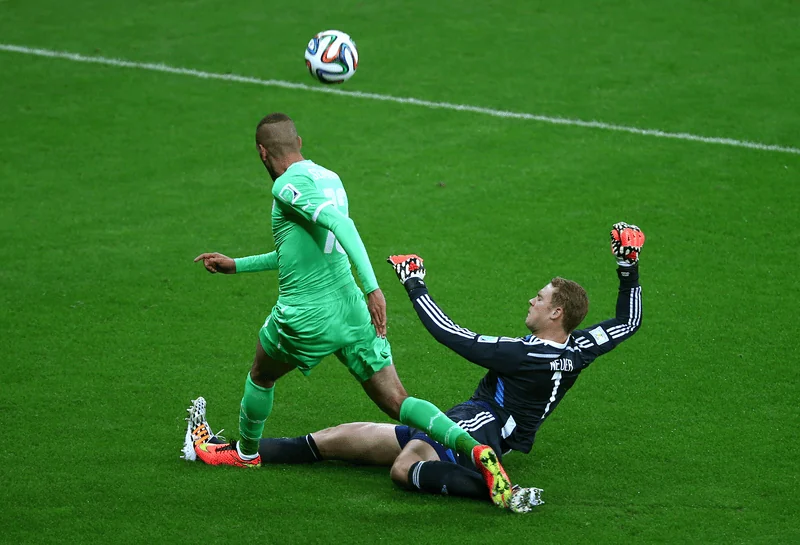
Germany's World Cup round-of-16 match against Algeria on 30 June 2014 made Neuer's expanded defensive role visible to a global audience. Germany won 2–1 after extra time in Porto Alegre, but the match remained goalless through the first 90 minutes. The eventual winner's route to the quarter-finals was far less comfortable than the final score alone might suggest.
Algeria repeatedly threatened the space behind Germany's defence. UEFA's report records Neuer intervening well outside his box to deny Islam Slimani on a break. That is the central football problem in miniature: an attacker has a route behind the defenders, and the goalkeeper must decide whether to intercept before the chance reaches the area.
His role was not to make the high defensive line magically safe. It was to respond to the particular dangers that escaped it. An early enough decision could let him meet the ball before Slimani; a delayed decision could leave both the attacker and an exposed goal in play. The performance is memorable because those judgments repeatedly became essential to Germany's survival.
André Schürrle and Mesut Özil supplied Germany's extra-time goals, with Abdelmoumene Djabou replying late for Algeria. Neuer's prevention and the outfield players' finishing therefore contributed at different stages. A keeper cannot score the goals needed to settle every tight knockout match, but he can keep the team in a position to win it.
FIFA later highlighted the Algeria performance as an instructional example of forward-thinking goalkeeping. It is useful to study because it connects the starting position, the decision to leave goal and the actual defensive contact. Watching only the last touch removes the part of the skill that involves reading the threat.
The match also prevents an overly neat description of the role. Germany did not win by avoiding every defensive problem. They needed Neuer to solve problems under pressure, then needed extra time to finish the contest. Sweeping supported the team in a difficult game; it did not eliminate the difficulty.
For a supporter revisiting the footage, follow the passes that create the emergency as well as the interventions. That reveals why the goalkeeper's responsibility expanded in that match, and why the same action would carry a different risk if the opponent's pass, runner or available cover changed.
Sweeping works only alongside elite goalkeeping basics
Neuer's expanded role is valuable because it sits alongside the goalkeeper's essential work. Starting position, balance, handling, reactions and one-on-one technique still decide matches. Leaving goal earlier can prevent some chances, but it cannot guarantee that an opponent never reaches shooting range.
That is why a good review separates defending space from defending the goal. The first concerns intercepting danger before the shot; the second concerns what happens once the attacker can finish. A goalkeeper needs both. Describing Neuer only through adventurous clearances misses the saves that allowed Bayern to trust that broader interpretation of the position.
The Paris Saint-Germain final showed the other half of the role
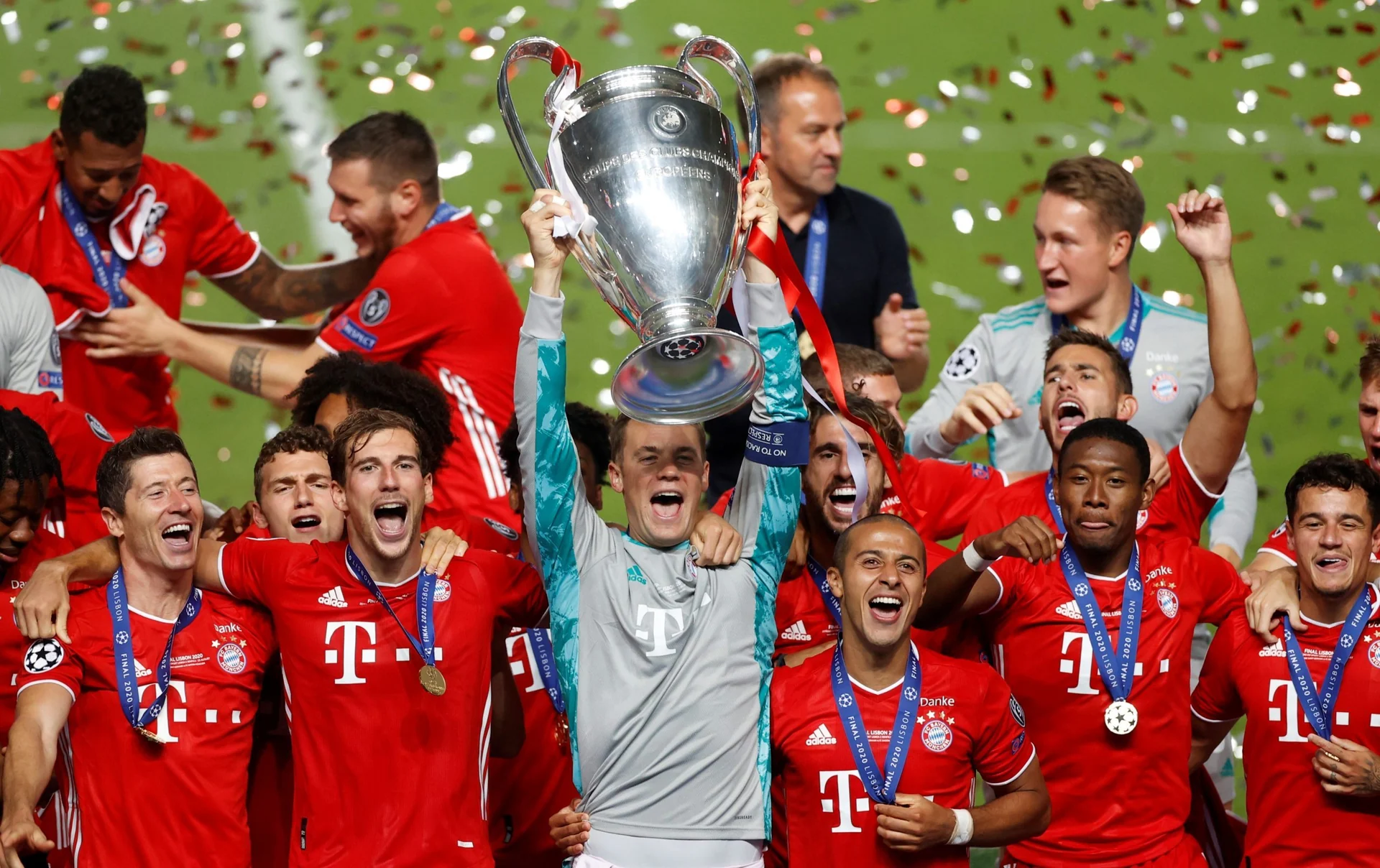
Bayern beat Paris Saint-Germain 1–0 in the Champions League final on 23 August 2020 in Lisbon. Kingsley Coman's 59th-minute header supplied the winning goal. Before that breakthrough, Neuer had denied Neymar and Kylian Mbappé in the first half; Bayern's match report also records the later stop against Marquinhos as Paris searched for an equalizer.
The example is useful because the winning margin was a single goal. Bayern still needed interventions inside the area, even with a team capable of pressing and controlling possession. Keeping the score level before Coman scored and protecting the lead afterwards were different phases of the same goalkeeping task.
For watching the saves, look at how Neuer prepares for the shot. A balanced goalkeeper can react in more than one direction; good positioning can make a difficult attempt look less spectacular. The degree of drama in the dive is therefore an unreliable measure of quality. Sometimes the skill lies in avoiding the need for a desperate movement.
Handling and the direction of a parry matter after the first contact too. Stopping the initial shot does not end the problem if the rebound falls to another attacker. The useful question is whether the intervention removes danger or simply changes where the next chance will occur.
The 2020 clean sheet was a team achievement, not evidence that Neuer acted alone. But it provides a necessary balance to the famous sweeping examples. Bayern's goalkeeper could support an ambitious style because he also remained capable of dealing with the chances that style failed to prevent.
The risks of leaving goal and how to judge the decision
Leaving goal increases the goalkeeper's responsibility for the first contact. If Neuer reaches the ball, he may end the attack immediately. If the attacker gets there first, Bayern can be left defending an exposed goal or dealing with a foul committed far from the normal goalkeeping area. The decision has to be assessed before the outcome is known.
The DFB Cup match against Leverkusen on 3 December 2024 supplies a clear negative example. Neuer rushed out and received a red card after challenging Jeremie Frimpong. Bayern played the remainder with ten men and lost 1–0. The episode shows the possible cost of a misjudged intervention without establishing that every aggressive goalkeeper action is a mistake.
The Laws of the Game provide an important boundary: outside his own penalty area, a goalkeeper faces the same handling restrictions as other players. A goalkeeper's shirt does not confer permission to use the hands wherever he stands. Fouls and disciplinary consequences also depend on the actual incident, so a missed interception should not automatically be described as a red-card offence.
Four questions make the football decision easier to read:
- Could the goalkeeper realistically reach the ball before the runner, considering the pace and direction of the pass?
- Was the passer under enough pressure to limit a different delivery or a direct attempt at goal?
- Could a defender cover the goal or recover the ball if the first intervention failed?
- Did the planned contact have a safe route to clear danger without an avoidable collision?
These questions are more useful than treating a successful clip as proof of perfect judgment and an unsuccessful one as proof that the entire role is flawed. Sometimes a difficult situation has been created earlier by the team's loss of the ball or failed pressure. The goalkeeper still has to choose among imperfect options.
Equally, shared responsibility does not remove responsibility for the final choice. Neuer's timing and technique remain part of the assessment. The aim is to explain the sequence fairly: identify the threat, the available options and the action taken, then judge whether the risk was proportionate.
That method gives supporters a way to appreciate brave goalkeeping while recognizing its limits. Sweeping can prevent dangerous chances, but it works best when courage is joined to accurate reading of the pass and realistic knowledge of the cover behind the decision.
Neuer's influence and the career context behind it
Neuer's influence comes from the completeness and visibility of the model he provided. He was not the first goalkeeper to leave his line or help with possession. Bayern coach Michael Rechner has pointed to Sepp Maier's earlier interventions away from goal. Neuer made the combination of those responsibilities particularly prominent at the highest level.
His own career began at Schalke, where he entered the youth system in 1991. He moved to Bayern in summer 2011 and became their captain in 2017. That long association allowed his interpretation of the position to operate across different coaches and team structures, rather than being remembered as one brief tactical experiment.
The major landmarks include Bayern's Champions League-winning trebles in 2013 and 2020, alongside Germany's 2014 World Cup title and his Golden Glove award at that tournament. Those achievements gave the style an unusually influential platform. The methods were visible in important games, while the results demonstrated that an expanded goalkeeper's role could coexist with elite defensive performance.
The current career context needs a date. On 15 May 2026, Bayern announced that Neuer and Sven Ulreich had extended their stays until 30 June 2027. Checked on 14 October 2026, that is the relevant club commitment. It is not a promise that age, selection or performance will remain irrelevant during the contract.
His Germany status also changed after the initially announced retirement in 2024. He returned for the 2026 World Cup, then confirmed that the defeat against Paraguay ended his international career. Bayern's updated profile records a final total of 126 appearances for Germany. A biography stopping at the 2024 retirement therefore misses the subsequent return and departure.
For supporters evaluating the legacy, the useful question is what other teams now expect from the position: defending space, being available in possession and still making the saves required close to goal. Neuer's career offers a clear, sustained example of those demands being combined, without requiring a claim that every modern goalkeeper should copy every one of his decisions.
To watch the role in a current Bayern fixture, check the Bundesliga TV schedule and the announced line-up. Follow the anticipation, the passing choices and the goalkeeping fundamentals together. That gives a fuller explanation of Neuer's importance than a highlight reel of adventurous clearances can provide on its own.
JOIN THE DISCUSSION
Comments
Sign in with Google to comment. Keep the discussion focused on Bundesliga football and respectful to other supporters. New comments are reviewed before publication.
Loading comments…