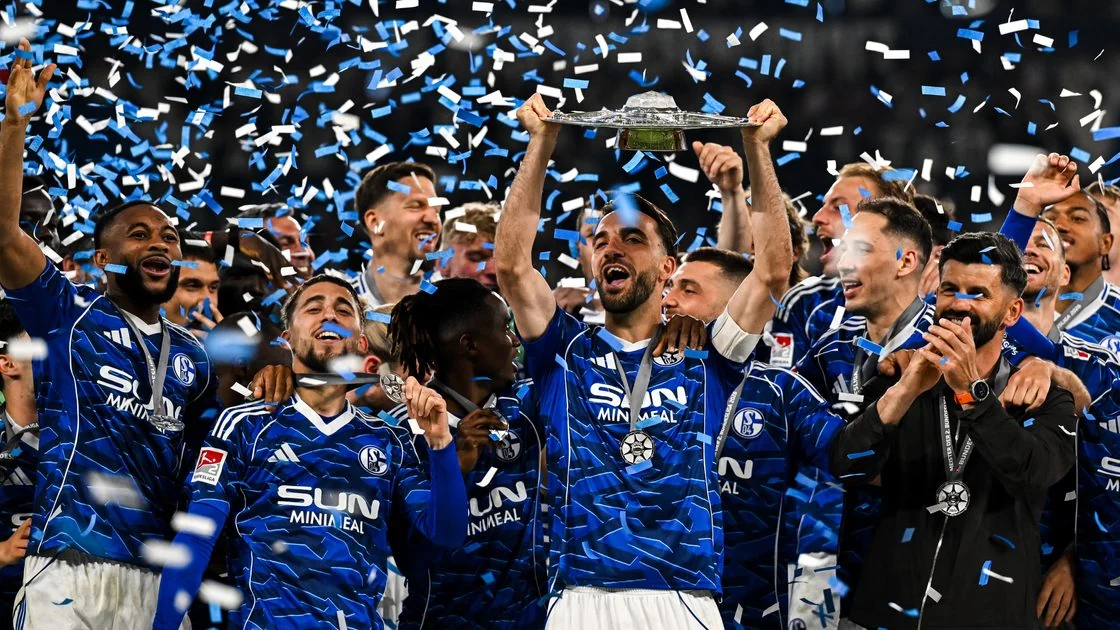
Schalke 04, SV Elversberg and SC Paderborn 07 are the three clubs promoted to the Bundesliga for 2026/27. Schalke won Bundesliga 2, Elversberg finished second to take the other automatic place, and Paderborn defeated Wolfsburg 2-1 on aggregate after extra time in the promotion/relegation play-off.
That shared destination hides three radically different journeys. Schalke bring a vast arena, major honours and the weight of a fan base that expects top-flight football. Elversberg arrive for the first Bundesliga season in club history after climbing from the regional fourth tier. Paderborn return for a third attempt, having recovered a play-off position on the final day and then survived 210 minutes against Bundesliga opposition.
This guide explains exactly how each club went up, what the final 2025/26 numbers reveal, where supporters will travel, and how to follow the newcomers through a season in which staying above 16th place is the clearest first target. Completed promotion facts are separated from changing 2026/27 form, so the profiles remain useful without pretending the next result is already known.
Which teams were promoted to the Bundesliga for 2026/27?
Schalke, SV Elversberg and SC Paderborn are the Bundesliga's three promoted teams for 2026/27. Schalke and Elversberg claimed the two automatic places from Bundesliga 2. Paderborn finished third, then earned the final top-flight berth by defeating Wolfsburg over two play-off legs.
| Club | 2025/26 finish | Promotion route | 2026/27 status |
|---|---|---|---|
| Schalke 04 | 1st, Bundesliga 2 | Champions; automatic | Return after three seasons away |
| SV Elversberg | 2nd, Bundesliga 2 | Runner-up; automatic | First Bundesliga season |
| SC Paderborn 07 | 3rd, Bundesliga 2 | Beat Wolfsburg 2-1 on aggregate after extra time | Return after six seasons away |
The distinction matters. Schalke and Elversberg could celebrate as soon as their league positions were secure. Third place only gave Paderborn a chance to go up: a 0-0 first leg in Wolfsburg left the tie open, and Laurin Curda's 100th-minute goal in the return produced a 2-1 extra-time win.
This also explains why a list published before the play-off may have shown only two confirmed promoted teams. Bundesliga 2 sends its top two up directly, but the third-placed club must take the Bundesliga's 16th-placed side's place on the pitch. Paderborn did that; it was not promoted merely for finishing third. By the morning after the second leg, all 18 participants in the new top-flight season were settled.
The three replaced St. Pauli, Heidenheim and Wolfsburg. St. Pauli and Heidenheim occupied the two automatic relegation places; Wolfsburg dropped after losing the play-off. That one-for-one movement keeps the Bundesliga at 18 clubs while creating three very different newcomer stories: a heavyweight champion, a first-time small-town arrival and a club promoted through the narrowest route.
Use the 2026/27 Bundesliga club directory for the complete field, and the relegation play-off guide when you want the two-leg format behind Paderborn's promotion.
Schalke: the 2. Bundesliga champions return after three years
Schalke return as the strongest finisher of the three promoted clubs. Miron Muslić's side secured promotion with two games left by beating Fortuna Düsseldorf 1-0, then closed the 34-match season as Bundesliga 2 champions with 70 points, 21 victories and 50 goals.
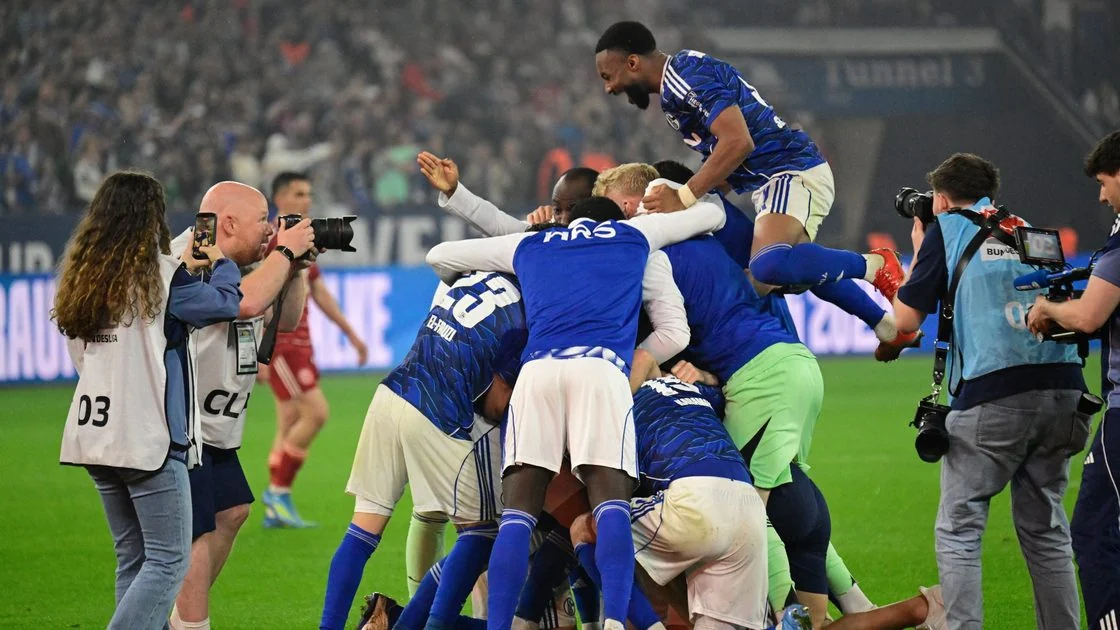
The decisive foundation was defensive. Schalke conceded 31 goals, at least eight fewer than any other team in the division. That matters because their 50 goals were not an exceptional attacking total — nine second-tier sides scored more. They won the league by limiting the number of games they had to chase, then finding enough match-winning moments. A run of five consecutive victories carried them to the top by Matchday 10, and they surrendered first place only briefly thereafter.
Schalke's promotion profile
- Finish: Bundesliga 2 champions
- Points: 70 from 34 matches
- Best marker: league-low 31 conceded
- Promotion clinched: two matches early
This was a recovery from two sobering campaigns after the 2022/23 relegation: Schalke finished 10th, then 14th, before appointing Muslić. It also restored a familiar Bundesliga presence. The Royal Blues have spent more than five decades in the modern top flight, won five DFB Cups and lifted the UEFA Cup in 1997. Their vast Gelsenkirchen support and Ruhr rivalry with Borussia Dortmund make the return culturally larger than an ordinary promotion.
History does not award survival points, however. For supporters, the useful takeaway is the repeatable part of the promotion: compact defending and the ability to protect narrow advantages. Follow the Schalke 2026/27 schedule rather than treating reputation as a result. The question is whether that second-tier defensive control travels against faster, deeper Bundesliga attacks.
Paderborn: promotion won the hard way through the play-off
Paderborn needed two separate escapes to reach the Bundesliga. Ralf Kettemann's team recovered third place on the final day of the Bundesliga 2 season by winning 2-0 at Darmstadt, finishing on 62 points. That result earned only a play-off against Bundesliga 16th-placed Wolfsburg — not promotion itself.
The 210-minute route
- Matchday 34: Darmstadt 0-2 Paderborn; third place recovered.
- First leg: Wolfsburg 0-0 Paderborn; nothing separated the teams.
- Second leg after 90 minutes: 1-1, so the tie went to extra time.
- 100th minute: Laurin Curda scored the goal that made it 2-1 on aggregate.
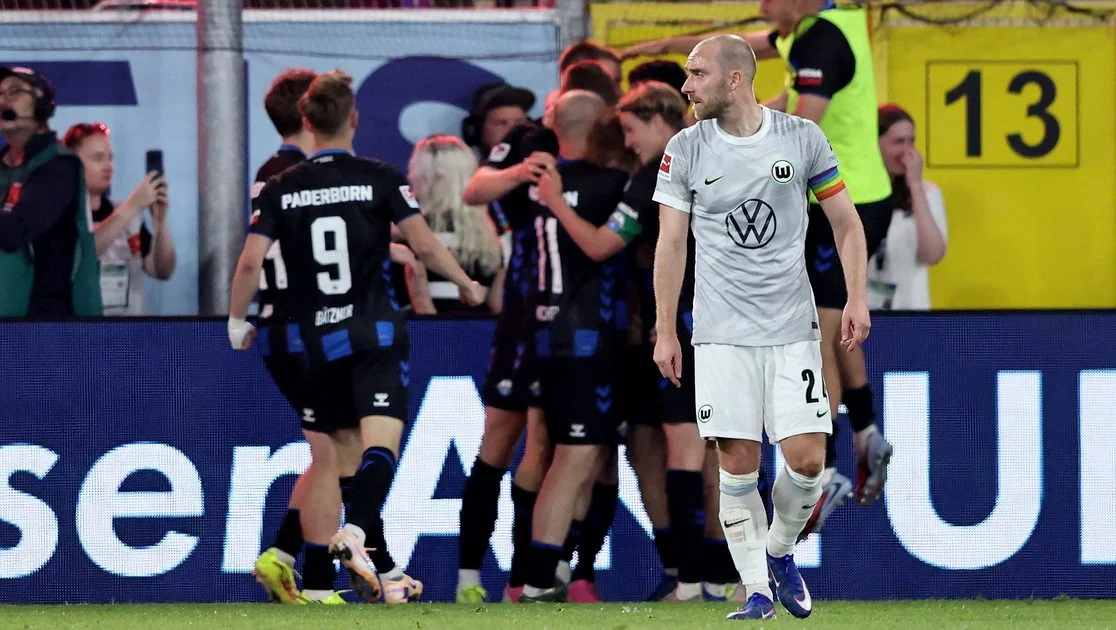
That sequence captures the club's identity better than a simple “promoted” label. Paderborn were outside the top three shortly before the finale, then survived a second leg in which Wolfsburg scored after three minutes and played from the 14th minute with ten men. Filip Bilbija levelled before Curda's back-post volley finally settled the contest. Kettemann delivered the return in his first season as the club's senior head coach.
The rise is notable, but not unprecedented for Paderborn. The present club emerged from a 1985 merger and first reached the Bundesliga in 2014. It came back in 2019 after consecutive promotions from 3. Liga and Bundesliga 2. Both top-flight visits ended in 18th place, making 2026/27 the club's third Bundesliga season and its first opportunity to turn promotion into a second consecutive year at this level.
For fans, Paderborn are the newcomer for whom the play-off context remains essential. Read the full promotion/relegation format, then follow the Paderborn 2026/27 schedule. Their route proves resilience; it does not make future results predictable.
Elversberg: the Bundesliga's 59th club completes a four-tier rise
Elversberg are not returning to the Bundesliga; they are entering it for the first time. A 3-0 final-day win over Preußen Münster secured second place on 62 points and automatic promotion, making the Saarland club the 59th different team to appear in Germany's modern top flight.
The timeline gives that debut its weight. Elversberg were in the fourth-tier Regionalliga Südwest in 2021/22, won promotion to 3. Liga, then won the third-tier title in 2022/23 to move straight into Bundesliga 2. An 11th-place first season brought stability. Third place in 2024/25 brought a top-flight play-off, but Heidenheim won 4-3 on aggregate with a late second-leg goal.
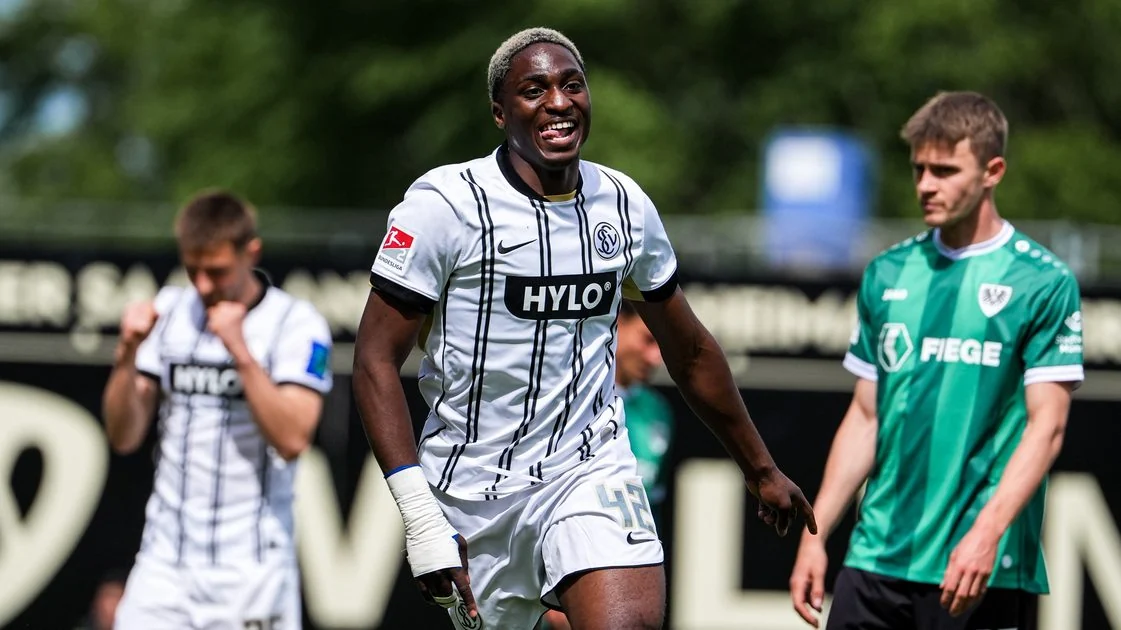
Instead of fading after that near miss, Elversberg improved their route. Vincent Wagner arrived after Horst Steffen's departure and, in his first season in charge, oversaw the most productive attack in Bundesliga 2. The team scored a league-high 64 goals. Its balance was just as important: only champions Schalke conceded fewer than Elversberg's 39. On the decisive afternoon against Münster, Bambasé Conté struck in the 10th minute before David Mokwa scored twice, removing the need for another play-off.
From regional football to the Bundesliga
2021/22: Regionalliga Südwest → 2022/23: 3. Liga champions → 2023/24–2025/26: three Bundesliga 2 seasons → 2026/27: Bundesliga debut.
The scale is extraordinary: Spiesen-Elversberg has roughly 13,000 residents. Yet “small” should not be confused with accidental. Multiple promotions, three second-tier campaigns and consecutive top-three finishes show a sustained sporting build. For supporters, the clearest introduction is fearless attacking football paired with an ability to absorb personnel change.
Follow the Elversberg 2026/27 schedule for the club's first meetings at this level. The historic label is already secure; how their approach translates over 34 Bundesliga matches remains a football question, not a fairytale conclusion.
How the three promotion campaigns compare
The final Bundesliga 2 table shows three different ways to build a promotion season. Schalke paired the most wins with the best defence. Elversberg produced the division's most goals and best goal difference. Paderborn matched Elversberg's points and win-draw-loss record, but a smaller scoring margin sent them into the play-off.
| Club | W-D-L | Goals | Goal difference | Points | Outcome |
|---|---|---|---|---|---|
| Schalke | 21-7-6 | 50-31 | +19 | 70 | Champion |
| Elversberg | 18-8-8 | 64-39 | +25 | 62 | Automatic promotion |
| Paderborn | 18-8-8 | 59-45 | +14 | 62 | Play-off, then promotion |
Schalke's numbers are the first useful contrast. Their 50 goals ranked only tenth in Bundesliga 2, yet 21 wins delivered an eight-point title margin. Conceding only 31 meant a modest attacking day did not automatically become dropped points. Elversberg reversed the emphasis: 64 goals led the league, and their +25 difference was six better than the champion's.
The sharpest line is between second and third. Elversberg and Paderborn each won 18, drew eight, lost eight and collected 62 points. Elversberg scored five more and conceded six fewer, producing an eleven-goal advantage in goal difference. That decided who rose automatically. Paderborn's late 5-1 defeat at Elversberg was especially costly before both won on the final day.
All figures in the table cover the same 34-game regular season. Paderborn's two play-off matches are deliberately excluded, because adding them would make its row incomparable with Schalke and Elversberg. The outcome column then records what the regular-season position meant and, separately, that Paderborn converted its extra opportunity.
For a supporter, the table supplies identities rather than forecasts: Schalke were hard to break down, Elversberg created the most productive attack and Paderborn survived a less forgiving route. Bundesliga opponents will test each strength at a higher speed. Use the live Bundesliga table for what happens next; do not carry these 2025/26 numbers forward as expected 2026/27 totals.
Three very different Bundesliga away days
The promoted trio stretch from one of Germany's largest football stages to its most intimate Bundesliga setting. Schalke's VELTINS-Arena holds 62,271; Paderborn's Home Deluxe Arena holds 15,000; Elversberg's URSAPHARM-Arena an der Kaiserlinde is currently listed at 10,000 while expansion work continues.
| Club | Home ground | Listed capacity | Supporter context |
|---|---|---|---|
| Schalke | VELTINS-Arena, Gelsenkirchen | 62,271 | Major arena, intense demand and Ruhr mining identity |
| Paderborn | Home Deluxe Arena, Paderborn | 15,000 | Compact 2008 ground with every place covered |
| Elversberg | URSAPHARM-Arena an der Kaiserlinde | 10,000 | Smallest setting; construction can affect access |
At Schalke, scale is part of the occasion. The arena has hosted a Champions League final, World Cup matches and Euro 2024 games, while its coal-mine-style players' tunnel connects the modern building to Gelsenkirchen's industrial heritage. A bigger capacity does not guarantee an easy seat: Schalke averaged just under 62,000 in Bundesliga 2 during the promotion season.
Paderborn offers the opposite geometry. Its 15,000-capacity stadium opened in 2008, and official venue information says all places are covered. Elversberg is tighter still. League information lists 10,000 places, with work intended to expand the ground. The club's August matchday guidance also introduced park-and-ride adjustments and cashless kiosk payment, illustrating why old travel advice can become obsolete quickly.
Check the home club's latest matchday notice before travelling, especially at Elversberg while building work continues. Buy through official channels, confirm the entrance and transport instructions attached to your ticket, and avoid assuming a smaller club means lower demand. Use the Bundesliga teams page to choose the club and the calendar tools to track fixture changes.
How to follow Schalke, Paderborn and Elversberg in 2026/27
The full 2026/27 opponent sequence is known, but precise days and kick-off times are confirmed in stages. That makes a live club schedule more useful than a date list copied into an article. The opening four matchdays received exact times in July; later rounds follow in further batches as cup and other scheduling demands become clear.
A simple supporter workflow
- 1Start with the club page: check Schalke, Paderborn or Elversberg for the next opponent and confirmed time.
- 2Build the weekend: use this weekend's fixtures to see clashes around the same relegation or mid-table race.
- 3Read result and consequence together: pair the latest results with the current table.
For all three clubs, first-season success has a concrete sporting definition. Finishing 15th or higher secures another Bundesliga season without a decider. Sixteenth means a two-legged survival play-off against Bundesliga 2's third-placed club. Seventeenth or 18th brings automatic relegation. The meaningful checkpoints are therefore the points and goal-difference gaps to 15th, 16th and 17th, not an isolated league position in September.
Recent history offers cautious encouragement. Only five of the 15 promoted clubs across the previous seven campaigns went straight back down. In other words, ten stayed up — but that combined record does not tell us which of Schalke's defence, Elversberg's attack or Paderborn's resilience will translate best.
Judge the newcomers over sequences rather than single afternoons: home performance, points against direct rivals, response after conceding and availability across congested periods. Their promotion stories explain how they arrived. The schedule, results and table show whether they are building the next chapter.
JOIN THE DISCUSSION
Comments
Sign in with Google to comment. Keep the discussion focused on Bundesliga football and respectful to other supporters. New comments are reviewed before publication.
Loading comments…