What is Oberliga Hamburg in 2026/27?
Oberliga Hamburg is a fifth-tier men's competition with 18 teams in 2026/27. Its sponsored name is Gamesright Oberliga Hamburg. For current fixtures and results, begin with the Hamburger Fußball-Verband's fixture information, which directs supporters to Fussball.de. For understanding the clubs, grounds and route upward, the local details below make that fixture list easier to use.
This is a regional league with its own identity. Searching simply for “Hamburg football” can lead toward the city's most prominent professional clubs, while an Oberliga search brings together neighborhood first teams, clubs from surrounding places and a second team. The competition name and exact squad name are therefore important parts of finding the game you mean.
The season opened with HT 16 against USC Paloma on July 24, 2026. The HFV's first-round announcement listed nine matches across the weekend, including HEBC against Niendorf and Victoria against Eintracht Norderstedt's second team. That range is a useful introduction to the league: several different local football settings share one table and one season-long contest.
The HFV's published regulations explicitly identify the Oberliga as the fifth level. Our German football pyramid guide explains the national ladder; here, the emphasis is on following this particular competition and attending its grounds.
Information in this guide was checked on November 12, 2026. Club membership refers to the season being played, while fixture appointments should always be checked for the specific match. A season introduction can remain useful after kickoff times change, provided it directs you back to the competition and club sources that confirm the current details.
Choose a club because its location, ground or sporting story interests you, then follow its results in the common Hamburg table. That gives an occasional visit some continuity: the next opponent becomes part of a recognizable league race, and a familiar venue becomes a place to understand the wider local game.
Which teams are playing this season?
The following alphabetical directory identifies the 18 participants in the HFV's actual 2026/27 fixture program. It is a membership list rather than a prediction or a table order. Short labels in official match listings can look different from a club's longer public name.
| Club or team | Label to recognize in fixtures |
|---|---|
| Altona 93 | Altona 93 1.Hr. |
| TSV Buchholz 08 | Buchholz 1.Hr. |
| Concordia Hamburg | Concordia 1.Hr. |
| TuS Dassendorf | Dassendorf 1.Hr. |
| Eintracht Norderstedt II | Eintracht Norderstedt 2.Hr. |
| ETSV Hamburg | ETSV Hamburg 1.Hr. |
| TuRa Harksheide | Harksheide 1.Hr. |
| HEBC Hamburg | HEBC 1.Hr. |
| HT 16 | HT 16 1.Hr. |
| Niendorfer TSV | Niendorf 1.Hr. |
| FK Nikola Tesla | Nikola Tesla 1.Hr. |
| USC Paloma | Paloma 1.Hr. |
| TSV Sasel | Sasel 1.Hr. |
| FC Süderelbe | Süderelbe 1.Hr. |
| TBS Pinneberg | TBS Pinneberg 1.Hr. |
| FC Teutonia 05 Ottensen | Teutonia 05 1.Hr. |
| SC Victoria Hamburg | Victoria 1.Hr. |
| SC Vorwärts-Wacker Billstedt | Vorw. Wacker 1.Hr. |
Use the current official competition schedule to move from a name to its matches. It groups these teams in the same season and makes the squad designation visible. If you save a club to follow, save the particular team rather than relying on a search for its badge.
Older allocation announcements deserve care. The HFV's June publication still described alternative arrangements depending on St. Pauli II's position. The actual season fixture program is the useful reference for the field now being played. A provisional list can explain the planning process without remaining the correct current directory.
Recognize the first team and the second team
The German abbreviation “Hr.” refers to the men's team designation in these listings. “1.Hr.” identifies the first men's team and “2.Hr.” the second. The Roman numeral II serves the same basic squad-identification purpose. Eintracht Norderstedt II is therefore a second team in this competition, rather than a reference to Germany's second division.
This distinction prevents two common reading errors. A result for Norderstedt's first team does not update its second team's Oberliga points, and a first-team fixture does not necessarily tell you when the second team plays. Keep the full designation when comparing a match notice with a results page.
The directory also gives you a practical way to explore unfamiliar names. Choose one club and read its next home match, then look at the opponent's place in the same table. A local visit becomes easier to follow when the teams are recognized as part of a shared season rather than as isolated names on a weekend listings page.
Three grounds that explain Hamburg's local football
Altona, Victoria and HEBC offer three concrete starting points for exploring the competition. They are examples rather than a ranking of the best clubs or the largest crowds. Each links a current Oberliga team with a recognizable physical setting, and each rewards checking the actual ground rather than following only the club name.
Altona 93 and the Adolf-Jäger-Kampfbahn
Altona's official arrival page identifies the Adolf-Jäger-Kampfbahn, often shortened to AJK, at Griegstraße 62 in Hamburg's Altona district. The same page lists Sportpark Bahrenfeld at Baurstraße 9 for other club activity. Those are different destinations. A map search for the club can be correct about the organization while still pointing toward the wrong site for your match.
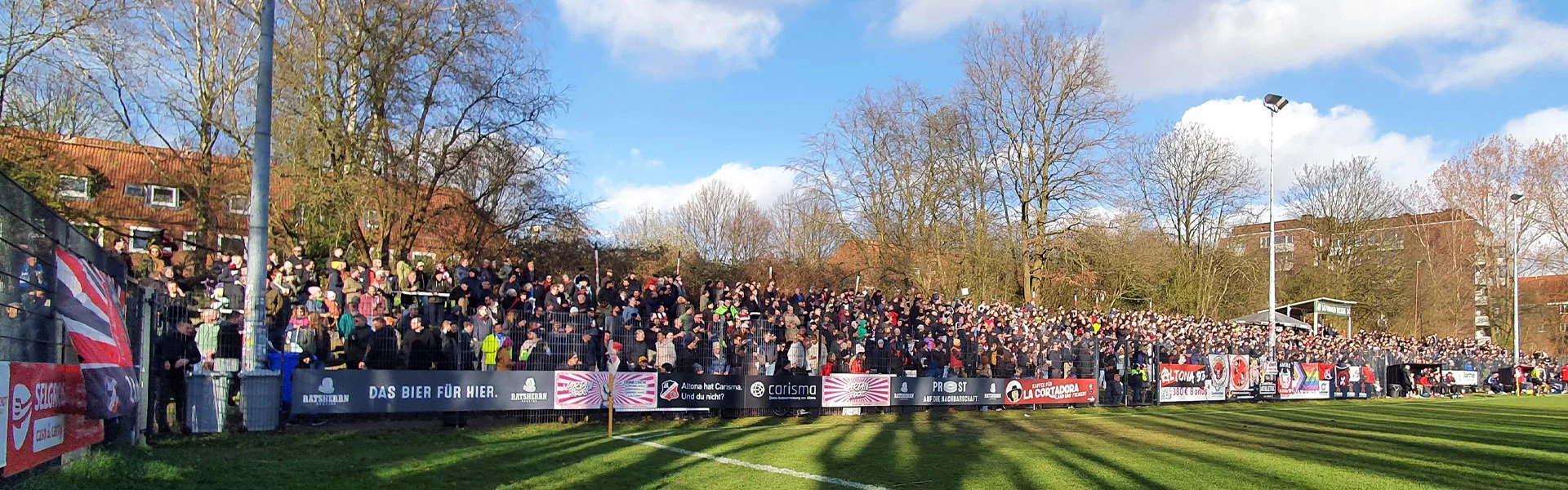
The AJK gives a visitor a clear visual introduction to local football: open terracing, supporters close to the field and the surrounding trees visible above the boundary. The club's stadium photograph records that setting without needing an attendance estimate or an invented claim about which current fixture it shows.
Start with the home match's stadium field, then compare it with Altona's own match information. This is especially useful when reading an away fixture: the opponent's ground is the destination. On November 12, the club's next-match display named Victoria and Stadion Hoheluft for the following evening. Following the Altona name toward Griegstraße would therefore have missed the match entirely.
The distinction is also useful for anyone interested in the club beyond the senior team. Training, youth football and other activities can use a different part of the club's facilities. Matchground and club address are related information, but they answer different visitor questions.
SC Victoria at Stadion Hoheluft
Victoria's facilities page identifies Stadion Hoheluft at Lokstedter Steindamm 87 and links to the dedicated stadium website. It also lists other sports sites, including Area 52. Keep the stadium name and street number together when selecting the senior football destination.
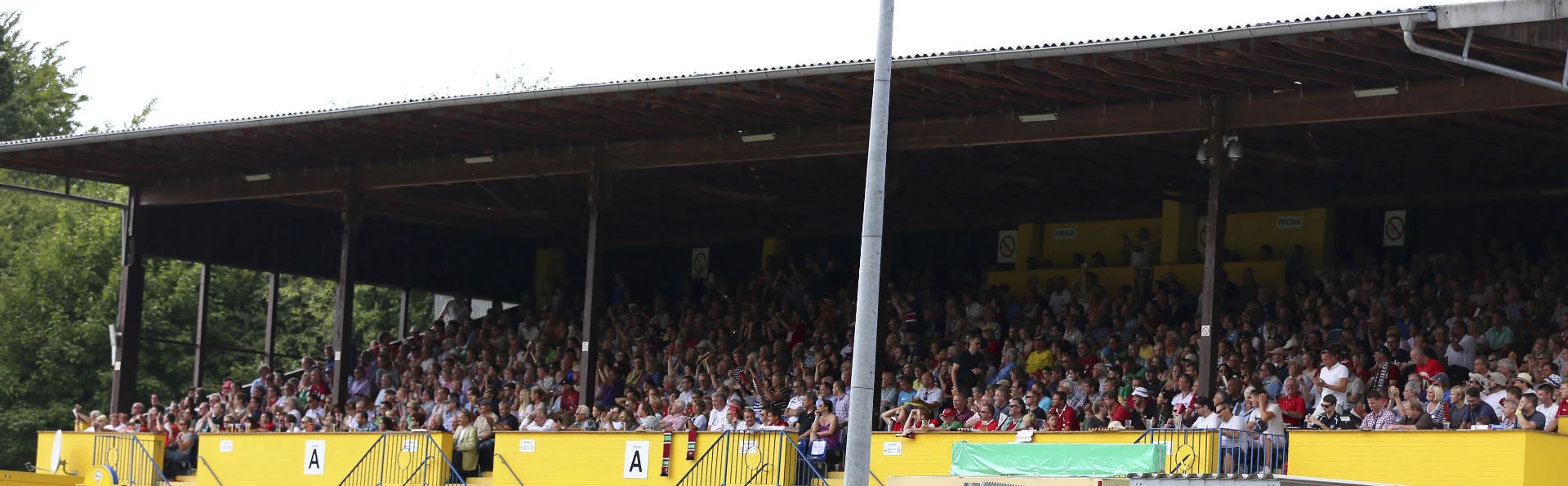
The stadium operator dates the covered grandstand's inauguration to October 15, 1911. That provides a specific reason for a visitor interested in football architecture to look up from the game. The roof and supporting structure are part of the ground's character, rather than a generic background that could belong to any new stadium.
Use the operator's arrival information to locate the entrance area and then a current journey planner for the day's transport. Older venue pages can retain superseded train-service examples even when the stadium address remains correct. For a visitor, the reliable combination is the named destination, a current route and the specific fixture appointment.
Hoheluft is an appealing starting point if the ground itself is part of the attraction. The football still supplies the occasion: confirm that the event is Victoria's men's Oberliga match, rather than assuming every event at a shared stadium belongs to the same team or competition.
HEBC at the Reinmüller-Platz
HEBC's clubhouse project page locates its long-established home at the Professor-Reinmüller-Platz on Tornquiststraße in central Eimsbüttel. The club's contact address is Tornquiststraße 79. Here the contrast with a large arena is immediately visible: housing, trees and local streets surround a heavily used football space.
A 2024 DOSB report describes the ground's community role and its position between Fruchtallee and Osterstraße. The report discusses open football provision and the club's integration work. That context helps explain why the site matters beyond the senior team's place in an Oberliga table.
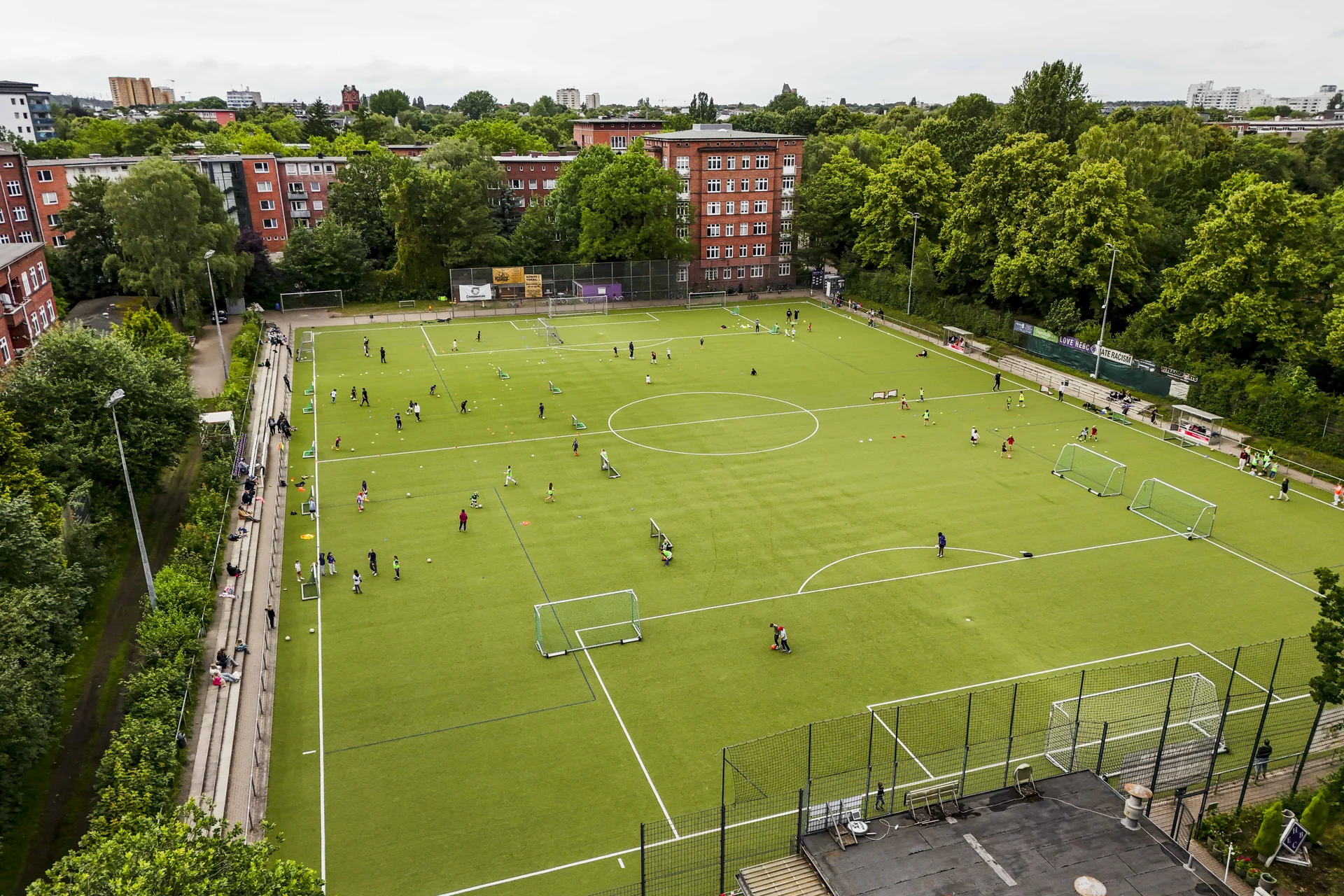
HEBC also describes work on its clubhouse facilities. Read the latest club notice for any effect on access or matchday arrangements, rather than interpreting an archive photograph as a promise that every corner of the site looks the same today. The pitch's location is useful orientation; current visitor arrangements belong to the current match.
For someone comparing these three outings, HEBC offers a particularly direct view of football inside an urban neighborhood. Altona's terracing and Victoria's grandstand offer different settings within the same competition. Choosing among them is a choice of location and experience, while the shared league table supplies the sporting connection.
Find the right fixture and understand the table
The 2026/27 competition schedule on Fussball.de is the direct starting point for the fixture list. Check that its heading says Gamesright Oberliga Hamburg and that the season selector is correct. Then select the named team and match. This avoids mixing an Oberliga fixture with a youth, cup or second-team game elsewhere in the club.
A published round is different from a confirmed kickoff
The HFV's schedule announcement explains that binding times for individual weekends are entered about four weeks before the relevant round. A season-long calendar can therefore identify opponents before every exact appointment has been settled. Use it to understand the sequence of games, then check the specific fixture again when planning attendance.
The league also offers more than one matchday rhythm. Its opening weekend included a Friday evening, Saturday appointments and Sunday morning and afternoon games. That variety can make local football fit into different parts of a weekend, but it does not establish a permanent kickoff slot for every club.
Once a game is selected, compare five details: the full team names, home side, date, kickoff and ground. A club's next-match notice can provide a clear final cross-check. As the Altona example above shows, an away fixture means using the opponent's stadium even when you began your search on your preferred club's website.
Keep the German local appointment separate from a time converted by a results app. An international visitor copying a calendar entry should establish which time zone the service displays. Allow time for the final walk and entry rather than treating the advertised kickoff as the time to reach the nearest station.
Read games played before judging the gap
For a readable alternative view, NDR's Hamburg results page combines results and the table with season and matchday selection. Its round-15 snapshot following November 6–8, 2026 provides a useful example: Dassendorf and Victoria both had 29 points, but Dassendorf had played 14 matches and Victoria 15.
Equal points therefore did not mean equal schedules. Dassendorf had an additional match opportunity relative to Victoria. That match could produce zero, one or three points; none had been earned merely because the fixture remained unplayed. Describing a game in hand accurately is more useful than adding imagined points to a club's total.
The same method helps with the rest of the table. Read games played, wins, draws, losses and goals alongside points, then open the remaining fixtures. A narrow gap can have different practical meanings when one team has a postponed match or a more compressed upcoming program.
Finally, keep a selected matchday table distinct from the latest full-season standings. An archive is useful for asking what the race looked like after a particular weekend; the current table answers where teams stand now. Checking the date and selector makes both views useful without confusing one for the other.
How promotion and relegation work in 2026/27
The Hamburg table is part of a wider northern system. Finishing high creates a sporting opportunity, while admission decisions and the promotion competition determine whether that opportunity becomes a place in Regionalliga Nord. At the other end, movement from above can affect how many clubs leave the Oberliga.
The route toward Regionalliga Nord
The HFV's 2026/27 implementation regulations, section 3.4.1, give the promotion or playoff right to the best-placed club admitted by the NFV that is outside the final three table positions. The current regulations are available through the HFV referees' organization. The important distinction is between winning a place in the table and meeting the requirements to take the next step.
The NFV's competition explanation describes a northern promotion round involving the representatives from Hamburg, Bremen and Schleswig-Holstein and the runner-up from Lower Saxony. That round determines two promotion places. Lower Saxony's champion has a separate direct route. Hamburg's title therefore does not by itself mean automatic entry into Regionalliga Nord.
A recent completed example makes the process concrete. In June 2026, Eimsbütteler TV and SV Todesfelde secured the two places through the promotion round; the NFV reported the outcome before the current season began. That explains one route through which a familiar Hamburg club moved upward. It does not identify who will represent Hamburg at the end of 2026/27.
Follow the stages separately as the race develops: first the sporting position, then the club's admission and participation status, then the confirmed promotion-round appointments and results. A leader can be the most interesting team to follow without every later administrative or sporting step having already been completed.
Why the bottom three are only the starting point
The HFV's published 2026/27 movement framework starts with the final three teams dropping to the sixth level. Additional relegations can be necessary when incoming clubs from higher competitions would push the field above its specified size of 18. The document's scenario tables show how upward and downward movement interact.
| Hamburg club promoted upward | Incoming Regionalliga clubs | Total Oberliga relegations in the scenario |
|---|---|---|
| No | Two | Four: three baseline plus one additional |
| Yes | Two | Three |
These are conditional examples, not forecasts of which clubs will move. Their value is to show why a survival discussion can depend on games outside the Oberliga. With the same two incoming teams, an outgoing Hamburg promotion changes the number of places that must be cleared.
The document also flags an April 22, 2027 HFV congress decision concerning implementation and qualification arrangements. Read its published framework together with later official decisions as the season develops. A table's colored rows are useful orientation, but the federation's final applicable rules and confirmed movements establish the outcome.
For a supporter, this adds a second layer to the season without replacing the immediate football. You can follow a local club's points each weekend while understanding why admission news, the northern promotion round and relegations from above become more significant toward the finish. Keep those decisions attached to their actual dates, and the league race remains much easier to interpret.
JOIN THE DISCUSSION
Comments
Sign in with Google to comment. Keep the discussion focused on Bundesliga football and respectful to other supporters. New comments are reviewed before publication.
Loading comments…