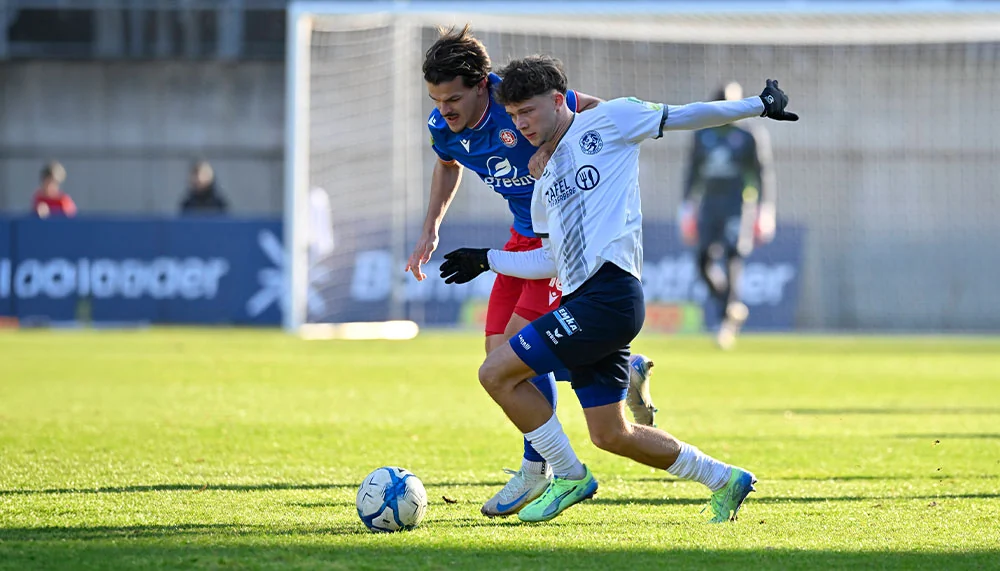
The 18 clubs and the geography of the league
The Oberliga Niederrhein is the highest men's league of the Fußballverband Niederrhein, or FVN, and sits at Germany's fifth level. Its 2026/27 field has 18 clubs. The competition reaches from the Lower Rhine into the Düsseldorf, Essen and Bergisches Land areas. It is a separate league from the Mittelrheinliga, despite both offering a route to Regionalliga West.
The reference below follows the FVN's season field, with clubs alphabetized rather than ranked. Town and neighborhood names help distinguish several entries that can otherwise blur together in an English search.
| Club | Location to recognize |
|---|---|
| 1. FC Monheim | Monheim am Rhein |
| 1. Spvg. Solingen-Wald 03 | Solingen-Wald |
| Blau-Weiß Dingden | Hamminkeln-Dingden |
| ETB Schwarz-Weiß Essen | Essen |
| FC Büderich | Meerbusch-Büderich |
| Fortuna Düsseldorf II | Düsseldorf |
| Holzheimer SG | Neuss-Holzheim |
| KFC Uerdingen 05 | Krefeld |
| Ratingen 04/19 | Ratingen |
| SC St. Tönis 11/20 | Tönisvorst |
| Sportfreunde Baumberg | Monheim-Baumberg |
| SpVg Schonnebeck | Essen-Schonnebeck |
| SSVg Velbert | Velbert |
| SV Scherpenberg | Moers-Scherpenberg |
| SV Sonsbeck | Sonsbeck |
| TSV Meerbusch | Meerbusch |
| VfL Viktoria Jüchen-Garzweiler | Jüchen |
| Wuppertaler SV | Wuppertal |
Three clubs arriving from Regionalliga West
Fortuna Düsseldorf II, Wuppertaler SV and SSVg Velbert came down from Regionalliga West. Their arrival creates several recognizable matchups without making any one club the automatic promotion winner. Wuppertal and Velbert met each other on the opening matchday, immediately putting two of the relegated sides into direct competition for points.
Fortuna's side appears as both “II” and “U23” in listings. Here those names refer to the club's second team. The first team's schedule belongs to a different division, so include that identifier when searching for a home game. For the wider place of reserve teams and regional leagues, our German football league system guide supplies the national context.
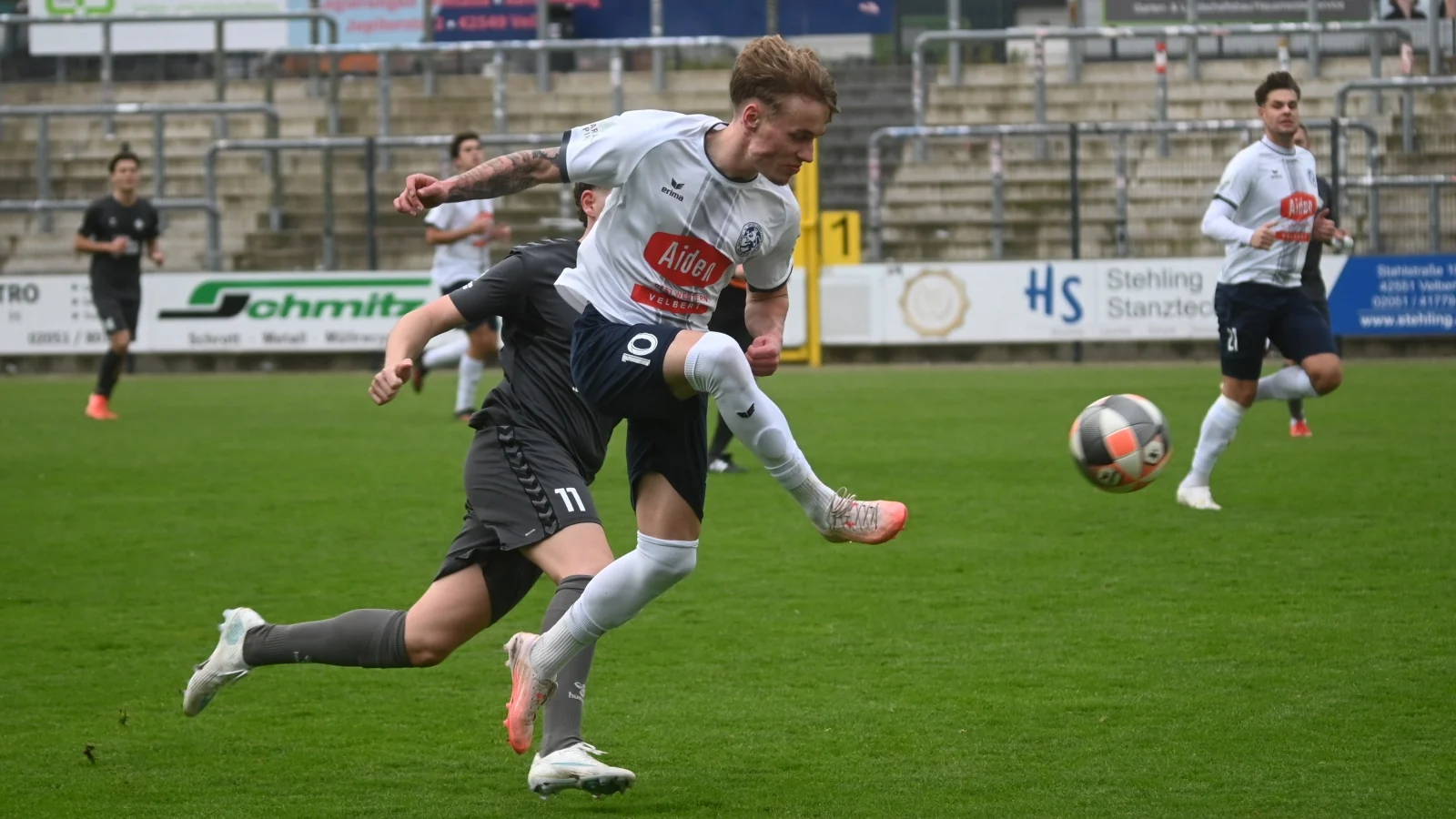
Scherpenberg and Solingen join from the Landesliga
SV Scherpenberg and 1. Spvg. Solingen-Wald 03 are the two promoted newcomers. Their route came from the Landesliga rather than the fourth tier, completing a five-club intake alongside the three Regionalliga arrivals. At the other end of the previous campaign, VfB Hilden earned promotion and is consequently outside this season's Oberliga field. Reading an older Hilden fixture list will send you to a different competition.
Several local distinctions matter for choosing a game. FC Büderich and TSV Meerbusch are separate teams; so are Baumberg and Monheim. Essen has both ETB Schwarz-Weiß and Schonnebeck. A city-based search can find more than one valid result, so keep the club's full name attached to the fixture. The FVN's published 2026/27 fixture document provides a useful membership reference, while the current match entry supplies any later scheduling changes.
Following the official table and match records
Use the 2026/27 competition page on FUSSBALL.DE for the league's table and match records. Check the season and full league name before selecting a matchday. The page also offers other table views, so make sure you are reading the overall competition when assessing the title race rather than a home-only or away-only record.
The table retrieved on November 12 showed Schonnebeck with 32 points from 12 games, followed by Velbert on 28 and Fortuna Düsseldorf II on 24. Schonnebeck's ten wins and two draws account for its total. That snapshot explains the reading method; the linked competition page supplies the updated standings. Read games played alongside points, because a rearrangement can leave two clubs with different numbers of opportunities to collect them.
For an individual result, open the match record and identify both teams, the competition and the date. For an upcoming fixture, add the ground and confirmed kickoff to that check. A seasonal PDF helps locate the pairing, while the current entry and the club's match notice are better places to confirm later alterations. Treat a provisional appointment or an unresolved match status as information still requiring an update.
Read the head-to-head rule before comparing equal points
The FVN's 2026/27 competition instructions make a specific distinction for positions deciding promotion or relegation. If teams finish level on points at such a boundary, their direct meetings are compared first, including the goals in those games. With three or more tied teams, the relevant comparison uses their matches against one another. If that comparison still leaves equality, the rules provide for deciding games.
Suppose two clubs reach the final round with the same points total around a decisive line. Comparing only their season-wide goal differences would skip the first check required by that rule. Read their direct results and the federation's final classification. During autumn, when the return meeting has yet to take place, a displayed order cannot settle that end-of-season comparison in advance.
This also explains why a score app's color shading should be read with the regulations. The table shows accumulated results; promotion eligibility and the applicable relegation scenario determine what those positions ultimately mean. Keep those questions separate when discussing who is leading, who can go up and who is safe. Each has a clear place to check: the competition record, the admission rules and the FVN's season-specific movement plan.
The 2026/27 calendar and its winter interval
The 18-club format produces 34 league games per team, split into 17 home and 17 away fixtures. Across the competition, that is 306 matches. The season began on August 14, 2026 and the framework puts the final round on the June 11–13, 2027 weekend. Use that overall span to understand the campaign, then check individual appointments for the days and times you need.
The FVN's season calendar includes several competition sizes side by side. For this Oberliga, follow the FVN 18-team column. It puts round 17 on December 18–20, completing the scheduled first half before Christmas. Round 18 follows on February 12–14, starting the return fixtures after the winter interval. The neighboring 16-team column belongs to a different schedule and would give the wrong interpretation.
| Oberliga season point | Framework window |
|---|---|
| Round 1 | August 14–16, 2026 |
| Round 17, before winter | December 18–20, 2026 |
| Round 18, return fixtures begin | February 12–14, 2027 |
| Round 34 | June 11–13, 2027 |
A blank regular-round cell does not necessarily mean every club is inactive. The calendar contains catch-up windows, marked “NHS,” and teams may have cup games or friendlies alongside the league. Conversely, an international break in the professional calendar does not automatically stop this division. In November, for example, the Oberliga's framework includes round 13 on the November 13–15 weekend. Look at this competition's column rather than transferring the Bundesliga's rhythm to it.
The opening round demonstrates why an export and a final appointment are different things. July's published list put Scherpenberg's home game against ETB Essen on Sunday. The FVN's later August 13 announcement moved the opening description to Friday evening in both Düsseldorf and Moers. Both documents describe the same season, but the later notice changes the practical itinerary. A saved preseason PDF should therefore be followed by a current match check.
The league also uses more than one weekend slot. Friday evening, Saturday and Sunday games all appear in the fixture document, with different afternoon starts among the clubs. For an away visit, include the return journey after the selected kickoff in the plan. When looking beyond one game, keep the framework's round number and the match's confirmed date together; that avoids treating an old weekend label as a fixed appointment.
One promotion place, with an admission process
The March 2027 application deadline
The FVN supplies one promotion place to Regionalliga West. The champion is sportingly qualified, but admission is a separate step. The published 2026/27 movement rules require a complete, correctly submitted application to reach the WDFV by March 15, 2027 at 15:30 local time. A positive admission decision must follow before the club can take its place in the fourth tier.
This deadline falls well before June's final league round. A club chasing the title therefore has to prepare for a possible promotion while the sporting outcome remains open. For supporters, an announcement that a club has applied is a useful milestone, but it does not settle either the title or admission. Financial, technical, organizational and safety requirements sit alongside the points race.
If the champion has not applied, declines promotion or fails admission, the right passes in order to the next two clubs, subject to their eligibility and admission. Fourth place is outside that route. There is consequently a reason to follow the leading three even when one has a substantial points advantage, but the runner-up does not hold an additional automatic promotion berth. The final eligible representative comes from the prescribed sequence.
Fortuna Düsseldorf II and the parent-team condition
Fortuna's second team adds a specific eligibility question. Second teams of third-division clubs cannot play in Regionalliga West. Fortuna's own opening-weekend report explains that the first team's relegation from the 2. Bundesliga also forced the U23 out of the Regionalliga and into this Oberliga season.
For the U23 to return, the first team would need to move back into the licensed divisions, removing that parent-team restriction. The U23 would still need its own qualifying finish and a successful admission process. Promotion by the first team alone would not lift the reserve side automatically. Likewise, a high Oberliga finish alone cannot remove the restriction if the first team remains in the 3. Liga.
The reserve's results continue to count in the competition, so distinguish its position from its ability to occupy the promotion place. When following the final rounds, check both Fortuna campaigns and the association's eligibility decisions. That concrete connection between two teams is more useful than assuming that all reserve sides share one promotion rule, or that every club displayed in the top three can take the available place under the same conditions.
Why the relegation line can move
The FVN's 2026/27 plan provides for three, four or five Oberliga clubs to drop into the Landesliga. The outcome depends on the movement above them: how many Niederrhein clubs come down from Regionalliga West and whether an Oberliga club takes the promotion place. The fourth tier's relegations are assigned by association, so a club heading toward Mittelrhein or Westfalen does not enter this league's incoming count.
Under the published matrix, three clubs go down in the first five scenarios, four in scenarios six and seven, and five in the remaining three. For a supporter following a team near the bottom, the relevant task is to identify which scenario applies as the higher-league outcomes and admission decisions settle. A table's current color boundary can only be an aid to that calculation.
Consider two cases with an Oberliga club going up. If two Niederrhein clubs arrive from Regionalliga West, the matrix has three Oberliga relegations and two Landesliga promotions. If three arrive instead, it has four relegations and two Landesliga promotions. The extra incoming club changes the required downward movement even though the promotion outcome is the same.
There is also a published case in which four Niederrhein clubs come down and none goes up. It gives five Oberliga relegations, two Landesliga promotions and a 19-team field for the following season. Most matrix cases return the division to 18, but that exceptional row shows why the target size should not be turned into an assumption that every conceivable outcome produces an identical field.
The regulations separately address teams leaving the competition under specified provisions of the playing rules. Those teams count as relegated and move to the bottom, reducing the number of clubs relegated purely through sporting position accordingly. Read any confirmed association decision before interpreting the final table; a withdrawal and an ordinary defeat affect the calculation in different ways.
For the run-in, keep three records together: your club's points and remaining fixtures, the relevant Niederrhein clubs in Regionalliga West, and the official admission or withdrawal decisions. Then apply the published matrix. A late win can improve a club's position immediately, while the exact safety line may still depend on another competition. This is a season-specific explanation of the mechanism, rather than a forecast that any particular club will fall into one of those cases.
Three grounds that give the league its local character
Krefeld: the Grotenburg
For a KFC Uerdingen home game, the destination is Krefeld's Grotenburg beside the zoo, at Tiergartenstraße 165. The club's guide for visiting groundhoppers connects the distinctive stands with its football history, including the famous 1986 European comeback against Dynamo Dresden when the club played as Bayer Uerdingen. A present-day Oberliga fixture takes place in a setting with a much longer sporting memory.
The same guide gives a practical instruction that can affect an afternoon's plans: the stadium operates without cash payments, including the ticket counter and catering. Arrange a suitable payment method and use the official ticket route for the spectator area you want. Read the current match notice for entrances and allocations; an architectural overview of the whole ground does not establish which sections are open for your game.
Essen: the Uhlenkrug
ETB Schwarz-Weiß Essen plays at the Uhlenkrug, with the club address at Am Uhlenkrug 40. This is a different destination from Rot-Weiss Essen's Hafenstraße and Schonnebeck's Schettersbusch. Essen offers several football choices, but selecting the city without the club and ground can produce the wrong itinerary. Check the home team before setting off from the station.
The ETB's stadium history dates the ground to 1922 and records modernization in 2023/24, including work on the pitch, track, stands and adjacent playing area. That combination of a long-established venue and recent work makes the current club information more useful for a visit than an old capacity figure or an undated visitor review. Choose your viewing area from the tickets actually offered for the match.
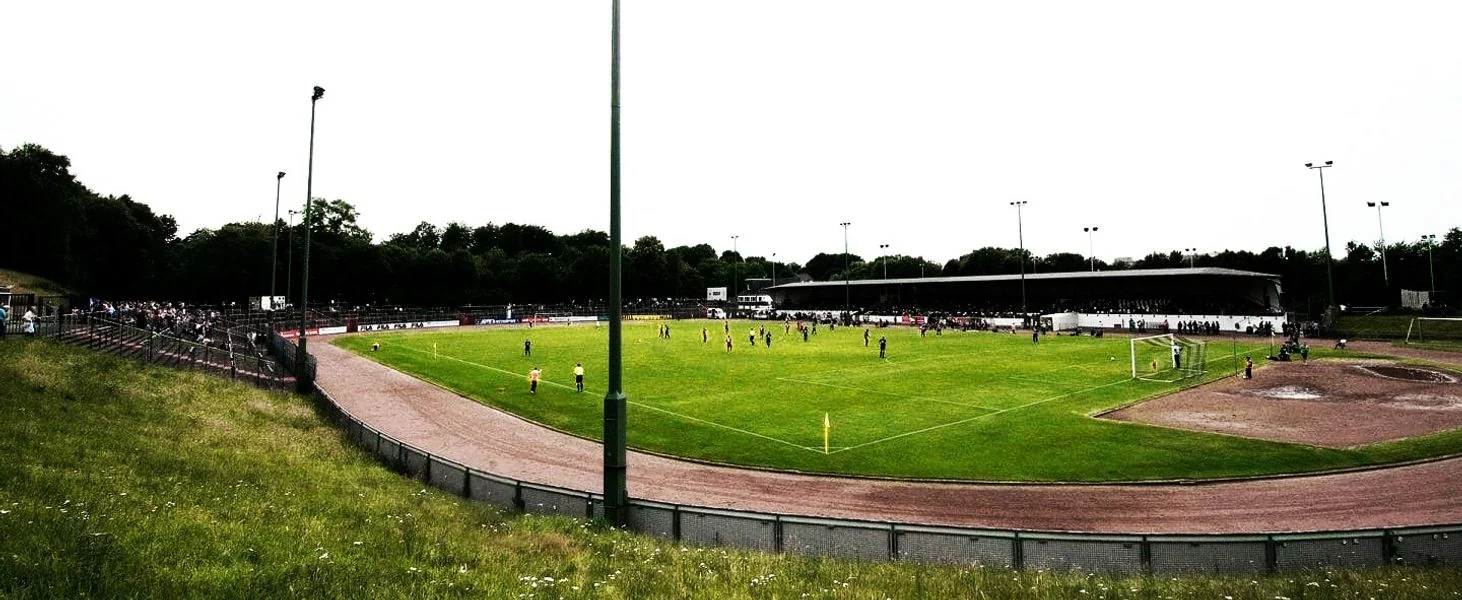
Wuppertal: Stadion am Zoo
Wuppertal's Stadion am Zoo brings another distinctive arrival option. The WSV's directions describe taking the Schwebebahn from the main-station area toward Vohwinkel and leaving at Zoo/Stadion. They also identify Wuppertal-Sonnborn and Wuppertal-Zoologischer Garten as rail approaches with a walk to the ground. Check the current transport service for the date and kickoff you select.
Keep “Wuppertal” attached to that station search: both this ground and Krefeld's Grotenburg have a zoo connection, but they are in different cities. A Friday evening fixture also calls for a different return plan from a Sunday afternoon game. Confirm the match appointment first, then connect the outward and return journeys to it.
These three venues illustrate the range within one regional league: Krefeld's imposing stands, Essen's established Uhlenkrug setting and Wuppertal's suspended-railway approach. Choose the experience that interests you, then use the host club's current match information to turn it into a specific visit. The club, ground and appointment together are the useful unit for planning an Oberliga afternoon.
JOIN THE DISCUSSION
Comments
Sign in with Google to comment. Keep the discussion focused on Bundesliga football and respectful to other supporters. New comments are reviewed before publication.
Loading comments…