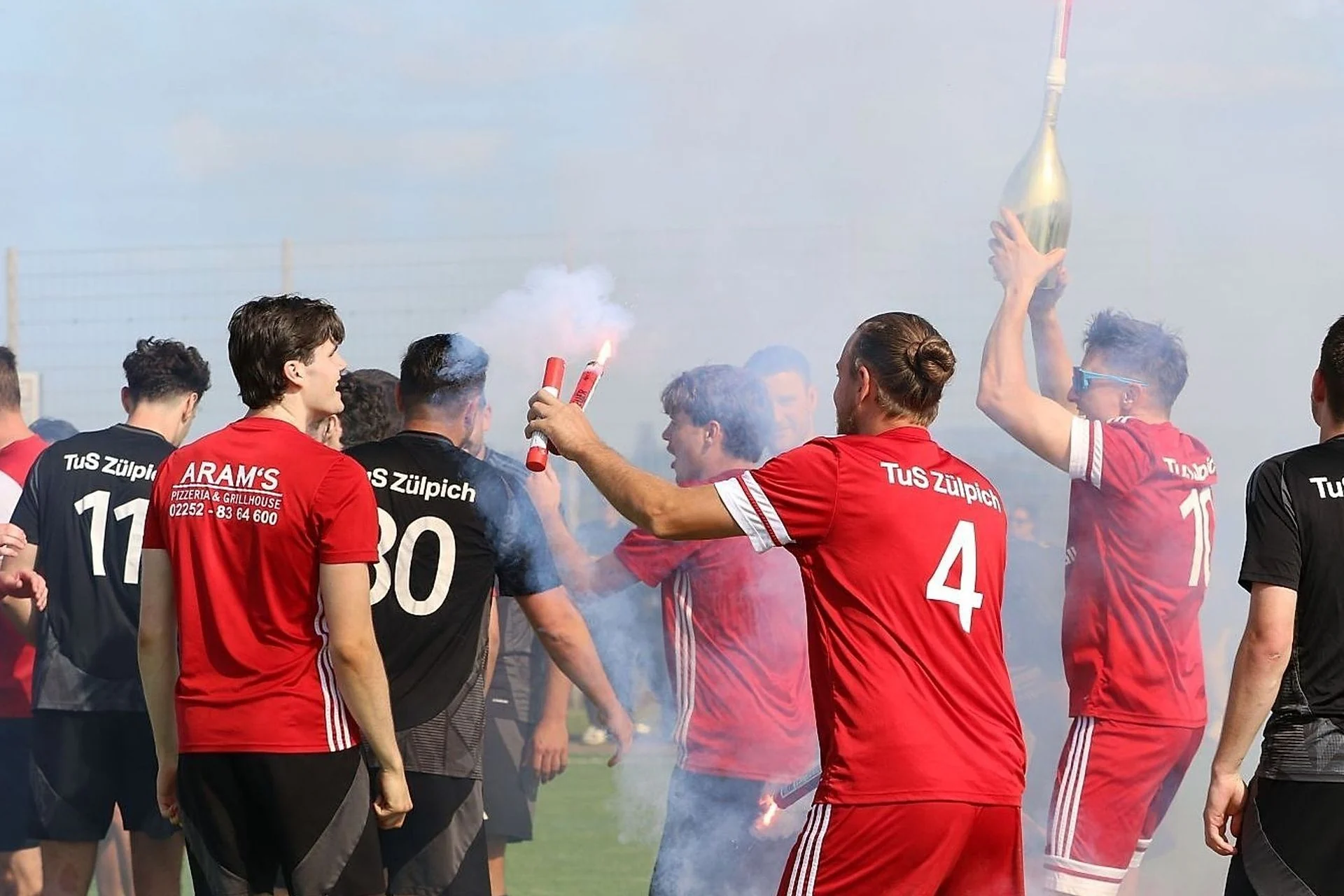
What the Mittelrheinliga name tells you
The Mittelrheinliga is the fifth-tier men's league run by the Fußball-Verband Mittelrhein, usually shortened to FVM. Its 2026/27 field contains 16 clubs. It is a regional competition in western Germany, with a route upward to Regionalliga West and the Landesliga beneath it. If you have searched for “Bundesliga 5,” this is one of the regional leagues you may have meant; there is no single national fifth-division Bundesliga table.
The FVM's men's competition guide describes the Mittelrheinliga as its highest league. English score services may list it as Oberliga Mittelrhein. Both labels point toward the same competition here. A federation fixture export adds another wrinkle: its header calls the administrative Spielklasse “Verbandsliga” while naming the Staffel, or competition group, Mittelrheinliga. Read the season and full competition name together rather than deciding the level from one database label.
Mittelrhein and Niederrhein are separate associations and separate leagues. A result for a Niederrhein club does not belong in this table simply because both competitions are in North Rhine-Westphalia and feed the same fourth-tier region. Likewise, the Mittelrheinliga should not be confused with a youth league, a women's competition or one of the FVM's Landesliga groups. Check that a listing says men's football, Mittelrhein and 2026/27 before using it to plan a game.
For a new supporter, the most useful way into the league is through its clubs and places. Some names identify a city, others a smaller community or neighborhood; the “II” on Fortuna Köln identifies a second team. Those details affect which fixture, squad and ground you are looking at. This guide uses the current season's published field, then explains where to find updated matches and how to interpret movement between divisions.
For the wider national structure, our German football league system guide puts the level in context. Here, the practical focus is local: choosing the right team, understanding the season's rhythm and finding the governing competition record. The FVM's general information page also contains older season-opening reports, so a date in its news section should always be checked before treating that report as a description of the present campaign.
The 16 clubs in the 2026/27 field
The FVM's July 2026 staff allocation and season fixture list agree on the 16 participants below. This is a membership reference, arranged alphabetically rather than as a standings table. It keeps club identity separate from results that change each weekend.
| Club | Place to recognize |
|---|---|
| 1. FC Düren | Düren |
| FC Hennef 05 | Hennef |
| FC Hürth | Hürth |
| FC Wegberg-Beeck | Wegberg-Beeck |
| FSV Neunkirchen-Seelscheid | Neunkirchen-Seelscheid |
| SC Borussia Lindenthal-Hohenlind | Cologne |
| SC Fortuna Köln II | Cologne |
| Siegburger SV 04 | Siegburg |
| SpVg Frechen 20 | Frechen |
| SpVg Porz | Cologne |
| SSV Bornheim | Bornheim |
| SSV Merten | Bornheim-Merten |
| SV Eintracht Hohkeppel | Lindlar-Hohkeppel |
| TuS Blau-Weiß Königsdorf | Frechen-Königsdorf |
| TuS Chlodwig Zülpich | Zülpich |
| VfL 08 Vichttal | Stolberg |
Cologne clubs and the surrounding towns
Cologne has three entries: Fortuna's second team, Porz and Borussia Lindenthal-Hohenlind. The city's name alone is therefore too broad for a useful match search. Fortuna Köln II is also a different team from the club's first side in the 3. Liga. Include the “II” when opening a schedule or checking a result; otherwise a search may send you to an entirely different competition.
Frechen, Königsdorf and Hürth give the western edge of the Cologne area several further options. Bornheim and Merten are separate league entries even though Merten is part of the same municipality. Farther east, the field includes Siegburg, Hennef, Neunkirchen-Seelscheid and Hohkeppel. Toward the west are Düren and Vichttal, whose home is in Stolberg, while Wegberg-Beeck extends the competition toward the Heinsberg area. These place names provide a starting point for a route search; the actual match record supplies the destination.
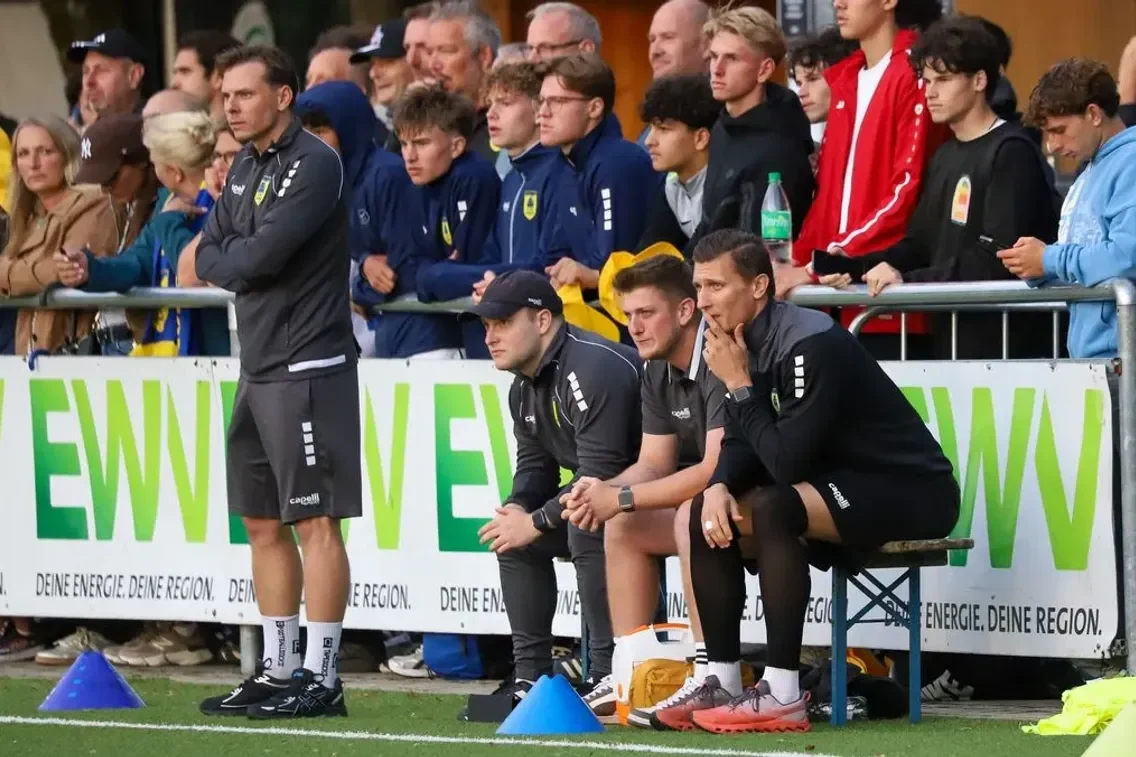
Four arrivals from the Landesliga
The incoming quartet consists of FSV Neunkirchen-Seelscheid, Borussia Lindenthal-Hohenlind, TuS Chlodwig Zülpich and FC Hürth. Neunkirchen-Seelscheid and Zülpich won their respective Landesliga groups; Lindenthal-Hohenlind and Hürth entered as the runners-up. The two-group origin matters when comparing their previous-season records: they were not four teams in one common table. Their new campaign puts them against the same Mittelrheinliga opponents.
At the upward end of the previous campaign, Bergisch Gladbach 09 left for Regionalliga West. It is consequently absent from this season's 16-club list. Another easy mix-up is Düren: 1. FC Düren remains here, while Sportfreunde Düren was among the clubs leaving the division. Keep the full name when reading an old report. The FVM's season-specific downloads provide the allocation and fixture documents needed to check membership independently of a club's reputation or previous league.
Following the season from August to June
A 16-club home-and-away competition gives each team 30 league matches: 15 at home and 15 away, making 240 fixtures across the division. The 2026/27 campaign opened with Vichttal against Düren on Friday, August 28. The remaining first-round games followed that weekend. The published league schedule runs through June 13, 2027, considerably later than the end of the Bundesliga campaign.
The winter pause and February return
The FVM's association-wide calendar announcement places the last regular prewinter weekend on December 12–13. In the Mittelrheinliga fixture export, that is round 14. The league resumes with round 15 on the February 13–14 weekend, completing the first half of the schedule. Round 16, the start of the return fixtures, follows on February 21 in the published list.
That sequence matters when comparing a team's form “before the break” with its first-half record. They are different samples: a scheduled first-half fixture still remains after the winter pause. A club may also advertise preparation games during the interval. Check the competition label before adding one to a league itinerary or counting its result toward the table. The women's competition and individual district leagues have their own restart dates; their calendar announcements cannot establish the men's Mittelrheinliga return.
| Season point | Published 2026/27 window |
|---|---|
| Opening weekend | August 28–30, 2026 |
| Last regular weekend before winter | December 12–13, 2026 |
| First-half conclusion after winter | February 13–14, 2027 |
| Final league weekend | June 12–13, 2027 |
League dates and cup dates
The Bitburger Pokal sits alongside the league. Its opening round was scheduled before the league season, with specific earlier dates for the affected Regionalliga and DFB-Pokal participants. The framework places the cup final on May 29, 2027. That date is not the last Mittelrheinliga matchday, and reaching a cup round does not itself add points to the league standings.
The fixture list also shows why “Sunday afternoon” is only a starting point for planning. Published appointments include 15:00, 15:15, 15:30 and 15:45 starts, with some winter fixtures earlier. Use the season document to understand the overall rhythm, then open the current match entry for the game you want. The federation explicitly directs supporters to FUSSBALL.DE for current appointments. Its framework also allows catch-up games outside ordinary rounds, so a blank regular weekend does not establish that a club has no competitive fixture.
Finding the right table and match record
The federation directs supporters to FUSSBALL.DE for current appointments. Its 2026/27 Mittelrheinliga competition page combines the matchday list and standings. Check the season at the top, then choose the overall table rather than a home-only, away-only or half-season view. Those other views can be useful for comparing performances, but they answer a different question from the league's full ranking.
Read Spiele as matches played and Punkte as points. The table retrieved on November 12 showed ten games played for each club: Wegberg-Beeck had 25 points, Merten 22 and Fortuna Köln II 19. Wegberg's eight wins and one draw explain its total. This is a dated reading example, not a live table embedded in this article. Open the competition page for the latest position, and check whether the clubs you are comparing still have equal numbers of completed fixtures.
For a particular match, use “Zum Spiel” to open its record. Confirm the competition and both teams, then read the date, kickoff and venue together. The full-season schedule is useful for locating an opponent; the individual entry is the better final check for an appointment. A rearranged match may appear outside the ordinary matchday block, so restricting your search to a single round can miss it. Keep league fixtures separate from a club's friendly or cup list.
The page's status legend is also worth reading. A double asterisk indicates a kickoff that is unknown or not yet fixed. A cancellation, an abandoned game and a confirmed administrative ruling are different statuses, with different implications for what happens next. A displayed provisional fixture needs its release confirmed before it becomes the basis for a trip. If a score service and the club disagree, first check whether they are showing the same season, match and update time.
For following one team over several weeks, save its team page as well as the league page. The former helps track its next opponent and match notices; the latter keeps that club's record in the context of all 16 teams. Together they give a more complete picture than a search result displaying a score without the competition, date or status attached.
The route to Regionalliga West and the relegation question
Promotion requires sporting and admission checks
The Mittelrheinliga has one promotion place to Regionalliga West. The champion holds the sporting right, provided it is eligible, wants to take that right and meets the admission requirements. The FVM's August 14 rules for 2026/27 provide for the runner-up and then the third-placed club to be considered if the champion cannot or does not go up. Clubs below third are outside that replacement route.
Finishing second therefore has a specific possible consequence, but it is not a second automatic promotion place. The association must establish which eligible club takes the available place. The rules require the eligible champion to declare its intention by the Wednesday following the final scheduled league game, with further deadlines set for the next clubs if needed. Follow the federation's decision alongside the final table when the race reaches that stage.
Reserve status also matters. Regionalliga West does not admit second teams of third-division clubs. That is relevant to Fortuna Köln II while its first team is in the 3. Liga; the parent club's division for the following season must be considered. It is a different rule from saying that every reserve side is barred from the fourth tier. Second teams of licensed Bundesliga or 2. Bundesliga clubs operate under a different parent-club position.
Why the number of relegated clubs can change
For 2026/27, the FVM's binding scenario table allows between three and five Mittelrheinliga relegations. The calculation depends on whether an FVM club moves up to Regionalliga West and how many FVM clubs come down from it. Regionalliga West also contains clubs from Niederrhein and Westfalen: its relegated teams do not all enter the Mittelrheinliga.
Two examples show the mechanism. If one Mittelrheinliga club goes up and no FVM club comes down from Regionalliga West, the matrix provides three relegations and four incoming Landesliga clubs. If no Mittelrheinliga club goes up and three FVM clubs come down, it provides five relegations and two Landesliga promotions. Both scenarios return the league to 16 teams. They are published cases, not predictions of this season's outcome.
For the Landesliga, the two group champions form the basic promotion intake; particular scenarios add a third or fourth club. That is why the four arrivals seen at the start of this campaign should not be treated as a permanent annual quota. Near the bottom of the Mittelrheinliga, follow the applicable scenario and official decisions as well as the points gap. The FVM counts incoming Regionalliga clubs under its rules whether their drop follows sporting results or another qualifying decision, so the final allocation requires more than counting the red rows on a score app.
Choosing a local match to attend
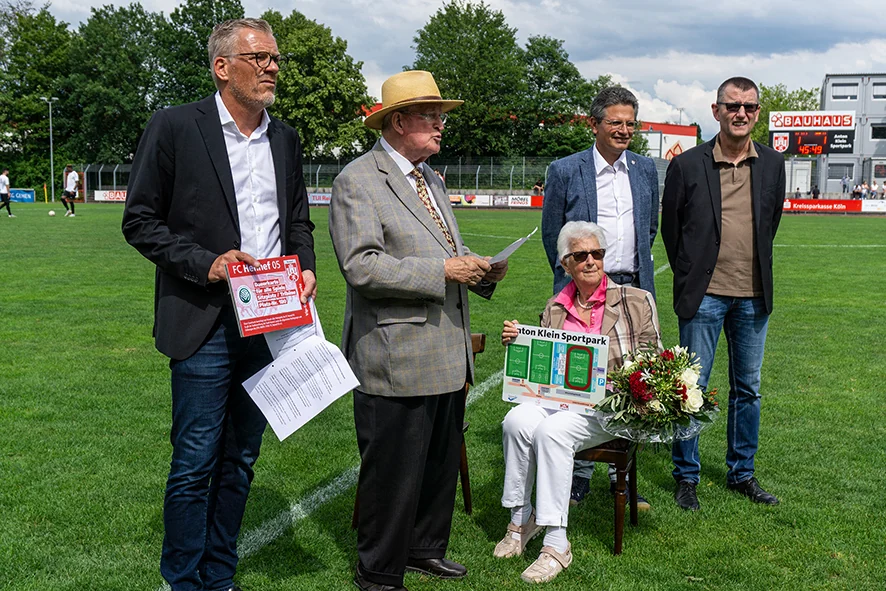
Hennef and the Anton Klein Sportpark
For FC Hennef 05, use the Anton Klein Sportpark on Fritz-Jacobi-Straße. The club's contact page gives number 24 for the ground, while separately listing a business address elsewhere. The FVM's Sportschule in Hennef is another different destination. Enter the match venue into your route planner, rather than assuming that every address connected with the club or association leads to the stadium.
The name has a local history: the sports complex was dedicated to Anton Klein in 2019 in recognition of his support for the club and community. Older reports can therefore refer to the previous school-and-sports-center name. The club's account of the naming ceremony connects those descriptions to the same place, which helps when an archived ground guide uses an unfamiliar title.
Wegberg-Beeck and the Waldstadion
Wegberg-Beeck's Waldstadion is at Kiefernweg 87. A recent Alemannia Aachen visitor notice for the November 11, 2026 friendly identifies the Beecker Wald stop on bus line 017 as one public-transport approach, with a walk to the ground. Use that as a route-search starting point and obtain the service times for your own date. The notice specifically discussed the last return connection, showing why an evening visit needs more planning than finding the outward bus.
That friendly also opened particular spectator areas while leaving the regular away section closed. It is a useful example of match-specific arrangements: a familiar stadium can operate differently for a friendly, a league game or another event. Read the current host or visiting club notice for entrance information, seating and ticket sales. A price or gate-opening time from the 2024 season opener describes that event, rather than establishing the terms for your next visit.
Check the matchday service before setting off
Choose the fixture first, then confirm the offered spectator area and the official purchase route. At a sports complex, also check which pitch is listed; a club can host several teams across an afternoon. Keep the full team name and competition in the booking details, especially for second teams or when a youth fixture appears alongside a men's game.
If you are following remotely, look for the service named for that match. A live ticker supplies text updates; a stream supplies video; a later highlights clip serves another purpose again. Aachen's November visitor notice offered its own ticker for the friendly, which says nothing about a season-long Mittelrheinliga video package. Use the league record for results and the clubs' current announcements for any available match coverage. That combination keeps the local matchday information attached to the game you actually intend to follow.
JOIN THE DISCUSSION
Comments
Sign in with Google to comment. Keep the discussion focused on Bundesliga football and respectful to other supporters. New comments are reviewed before publication.
Loading comments…