The short answer: Bayern Munich are still the team to beat in the 2026/27 Bundesliga, while Dortmund lead the pursuit and Leverkusen, Leipzig and Stuttgart begin with credible but distinct routes into the argument. Schalke, Elversberg and Paderborn are the three promoted clubs. The tightest drama may come below the title race, where European qualification and survival involve deep groups of teams.
This guide was checked on 14 September 2026, after Matchday 3. Early results inform the examples, but they do not turn three games into a season verdict. Instead, the guide explains the confirmed calendar, competitive baselines and fixtures that can test each claim. For live scores, positions and exact kick-off updates, use the linked schedule and table tools throughout the campaign.
The 2026/27 Bundesliga at a Glance
The 2026/27 Bundesliga is an 18-club, 34-matchday race that began on 28 August 2026 and ends on 22 May 2027. Every club plays 17 opponents home and away, producing 306 league matches. That familiar framework matters because this is not a season in which a slow starter can hide behind a long calendar: the post-World Cup launch has pushed the opening three rounds into a compact late-summer window.
Opening round
28–30 August 2026
Winter pause begins
After Matchday 14
League resumes
8 January 2027
Final matchday
22 May 2027
A Later Start and a Compressed Autumn
The top flight started a week later than in 2025/26 because the FIFA World Cup concluded on 19 July. Most clubs had barely five or six weeks to bring internationals back, integrate signings and move from conditioning work into competitive football. The autumn rhythm is different too: there are two international windows rather than three, with a 16-day interruption from late September into early October and another nine-day break in November.
For supporters, the practical lesson is to check the current Bundesliga schedule rather than rely on a pre-season screenshot. Pairings are known, but later kick-off details are confirmed in stages around UEFA and DFB-Pokal commitments. The December stop arrives after Matchday 14 on 18–20 December, and the league returns on 8 January, so the Hinrunde straddles the winter break.
The Format That Shapes Every Race
Three points are awarded for a win and one for a draw, with goal difference the first major separator when teams finish level on points. That makes margin meaningful at both ends: a late goal in September can influence a European place or survival calculation in May. Use the live Bundesliga table to follow that context rather than treating rank alone as the story.
The bottom two clubs go down automatically. The team in 16th enters a two-legged playoff against third place in Bundesliga 2; there is no away-goals rule, and a level aggregate tie can proceed to extra time and penalties. Paderborn's route into this season is a timely warning that 16th is a lifeline, not safety. The complete list of Bundesliga clubs is the cleanest reference as squads and team pages evolve.
Why Bayern Remain the Team to Beat
Bayern Munich begin 2026/27 as the clear benchmark because their advantage is structural, not merely reputational. They can win in several ways, carry elite scorers across multiple positions and survive an ordinary performance more often than any rival. A genuine title race therefore requires two things at once: Bayern must surrender more points than last season, and at least one challenger must build a far higher weekly floor.
The Champion’s Margin for Error
Vincent Kompany's side won 28 of 34 league matches in 2025/26, lost only once and finished 16 points above Dortmund. Their 122 goals set a Bundesliga single-season record, 21 beyond the previous mark. Harry Kane, Michael Olise and Luis Díaz alone combined for 104 league goals and assists. Those numbers explain why “stop Bayern” cannot simply mean containing Kane for one afternoon; opponents must also defend runners, cut off supply and still threaten enough to prevent Bayern from camping around the penalty area.
Opta's 10,000 pre-season simulations assigned Bayern a 76.7 percent title chance. That is a useful baseline, not a verdict. The more revealing supporter test is points dropped in supposedly routine fixtures. Bayern lost only to Augsburg last season and drew five times. If that total does not rise, a challenger may need a near-historic campaign.
Dortmund and Leverkusen Have Different Routes to a Challenge
Dortmund's case starts with continuity. They finished second, improved by 17 points from 2024/25 and conceded fewer league goals than anyone in 2025/26. Niko Kovač has been candid about the size of the task: a 16-point gap requires Dortmund to outperform their previous level while Bayern fall below theirs. The attacking question is whether a younger creative group can turn control into enough goals without weakening that defensive platform.
Leverkusen's path is a reset. Sixth place took them out of the Champions League positions, and Carles Martínez arrived with a two-year contract and a stated emphasis on intensity, precision and player development. His squad has talent, but a new coach and a younger leadership group create more variance. A return to the top four is the sensible first target; entering the title argument requires proving that the new structure can repeat strong performances through winter and Europa League weeks.
Leipzig, Stuttgart and the Outsider Test
RB Leipzig and Stuttgart sit in the next tier. The pre-season Opta model separated their title chances by only 0.04 percentage points—2.71 to 2.67—which is better read as “credible outsiders” than as a meaningful ranking. Leipzig began another coaching cycle under Martín Demichelis, while Stuttgart entered from a fourth-place finish and must balance domestic ambition with Europe.
For either to graduate from outsider to contender, direct meetings are decisive. Taking points from Bayern changes two totals at once; dropping points immediately after a European night gives the advantage back. That is why the live table should be read alongside strength of schedule. In September, a small points gap may mostly reflect opponents faced. By the winter pause, repeated results against the top six tell a much stronger story.
Meet the Three Promoted Clubs
Schalke, Elversberg and Paderborn all earned Bundesliga places in 2025/26, but they arrive with sharply different resources and football identities. Recent history offers them more hope than the usual “straight back down” cliché: only five of the 15 promoted clubs across the previous seven seasons were immediately relegated. Survival is possible; copying one another is not.

| Club | Promotion route | Defining evidence | Survival question |
|---|---|---|---|
| Schalke | 2. Bundesliga champions | 31 goals conceded | Can control survive against faster attacks? |
| Elversberg | Automatic promotion, second | League-high 64 goals | Can the development model keep creating? |
| Paderborn | Playoff winner | Beat Wolfsburg 2-1 on aggregate | Can bold football become top-flight points? |
Schalke Return With Scale and Defensive Foundations
Schalke ended a three-year absence by winning Bundesliga 2 under Miron Muslić. Their foundation was the division's best defence: 31 goals conceded, at least eight fewer than any rival. The attacking output was modest—nine clubs scored more than Schalke's 50—so the top-flight question is whether Kenan Karaman, Edin Džeko and the supporting cast can convert fewer chances without stretching that compact base.
The Veltins-Arena and a huge support give Schalke emotional scale unmatched by most promoted teams, yet noise does not close space in transition. Staying disciplined when a home crowd demands pursuit may be as important as any signing.
Elversberg Bring a Bundesliga First
Elversberg are the Bundesliga's 59th different club and the first representative of a municipality of roughly 13,000 people. Their rise is not a novelty act. Vincent Wagner's side scored a second-tier-best 64 goals, conceded 39 and recovered from losing both a previous playoff and influential personnel. That repeated regeneration is their competitive edge.
The challenge is scale: opponents will punish risky build-up and restrict the transition moments that fuelled promotion. Elversberg's answer should still be recognisably theirs—smart loans, young players and coordinated aggression—because abandoning that identity would remove the very advantage that brought them here.
Paderborn Arrive Through the Playoff Door
Paderborn reached third only on the final Bundesliga 2 matchday, then eliminated Wolfsburg 2-1 on aggregate. The second leg went to extra time before Laurin Curda scored in the 100th minute. That experience matters: this group already knows how to play with Bundesliga status balanced on one action.
History supplies the warning. Paderborn's 2014/15 and 2019/20 top-flight campaigns both ended in immediate relegation. Ralf Kettemann's young side must turn brave football into repeatable defending, especially away from home. For updated squads and club schedules, use the Bundesliga teams hub; the comparison above is the starting profile, not a season-long verdict.
The European Race Could Be the Best Contest
Even if Bayern remain clear title favourites, the fight immediately behind them has far less separation. In 2025/26, only three points divided Stuttgart in fourth, Hoffenheim in fifth and Leverkusen in sixth. That is one win across a 34-match season, and it is why the Champions League chase may produce the Bundesliga's most persistent tension.
The useful benchmark: fourth to sixth was a 62–61–59-point squeeze last season.
A draw rescued or conceded in April can be worth an entire tier of European competition.
The Top-Four Bottleneck
Bayern, Dortmund, Leipzig and Stuttgart entered this campaign as Germany's Champions League representatives. Hoffenheim and Leverkusen qualified for the Europa League, while Freiburg reached the Conference League through qualifying. Those labels describe last season's achievement, not a fixed domestic hierarchy.
Dortmund have the strongest recent points base, but Leverkusen, Stuttgart and Leipzig all have a plausible top-four case. Hoffenheim proved they could sustain a challenge until the final day, and Freiburg have now paired consecutive European qualifications with a run to the 2026 Europa League final. Mainz are the type of well-organised challenger that can enter the conversation if a wealthier club loses consistency. The current table will tell you who occupies fourth; results against direct rivals and bottom-half opponents tell you who can keep it.
Europe Can Reshape a Bundesliga Weekend
Continental football is both the prize and the complication. UEFA league-phase travel reduces training time, tests bench depth and can turn a Sunday away match into a tactical exercise in energy management. A contender that beats a major European opponent on Thursday and then drops two league points on Sunday has not enjoyed a perfect week—it has paid for one target with another.
This also explains why every kick-off is not fixed in July. The league waits for UEFA dates and DFB-Pokal progress, generally preserving at least two free days around international matches. Matchdays 5–11 were detailed on 10 September; the next block was scheduled for confirmation after the cup's round-of-16 draw. Before planning a trip, use the confirmed fixtures this weekend, not the matchday pairing alone.
Relegation Is More Than a Promoted-Clubs Story
The promoted trio are obvious survival candidates, but treating relegation as their private contest ignores the lesson of 2025/26. Köln and Werder Bremen finished on 32 points, only three above 16th-placed Wolfsburg. Hamburg, Union Berlin and Borussia Mönchengladbach were separated from that group by only a handful more. A poor month can pull an established club into the same calculation.
The mechanism makes the danger unusually layered. Seventeenth and 18th go directly to Bundesliga 2; 16th plays the second tier's third-placed team over two legs. That place is a chance, not protection. Wolfsburg won on the final day to reach 29 points and escape automatic relegation, then lost 2-1 on aggregate to Paderborn after extra time. There is no away-goals rule, so one late moment can decide a club's division.
What to watch before the table settles
- Chance creation: a low-scoring side cannot rely on converting every half-chance for 34 rounds.
- Defensive repeatability: compactness must survive away matches and game states in which the team falls behind.
- Six-pointers: results against the surrounding cluster matter more than a respectable loss to Bayern.
- Response to bad runs: St. Pauli took seven points from their first three games in 2025/26, then lost nine in succession.
Schalke's defensive base and Elversberg's attacking identity give each a credible survival route. Paderborn bring playoff nerve but have gone straight back down after both previous Bundesliga promotions. Köln and Bremen must raise a 32-point floor; Hamburg need to convert first-year survival into progress; Union cannot assume prior top-flight status creates a buffer.
The fairest way to read the race is to follow the live survival line while judging performances over blocks of five or six matches. If 16th becomes relevant in spring, the Bundesliga relegation playoff guide explains the route and confirmed dates.
Fixtures That Will Test the Big Storylines
A fixture becomes important when it can change our understanding of a team. The dates below are not a miniature schedule; they are checkpoints for the title hierarchy, the promoted clubs and the effect of a condensed calendar. Always confirm later rounds close to matchday because detailed scheduling continues in blocks.
Autumn Measuring Sticks for the Contenders
Bayern host Leipzig on Matchday 6, Saturday 17 October at 6:30pm CEST. Bayern won the two league meetings last season 6-0 and 5-1, so the useful Leipzig target is not simply avoiding another heavy score. Martín Demichelis's side must show they can escape pressure, protect transitions and create enough threat to prevent a one-way match.
Two rounds later, Bayern welcome Dortmund on Matchday 8, Saturday 31 October at 6:30pm CET. Dortmund took points from three of the five league Klassikers before this season, despite Bayern winning both in 2025/26. If BVB want a title race, this is the kind of six-point swing they cannot leave entirely to spring.
The Revierderby and Nordderby Restore Missing Emotion
Werder Bremen host Hamburg on Matchday 10, Sunday 22 November at 5:30pm CET. Both clubs were close enough to the bottom last season for the Nordderby to carry points pressure as well as regional pride. The home teams won the two 2025/26 meetings, 3-2 in Hamburg and 3-1 in Bremen.
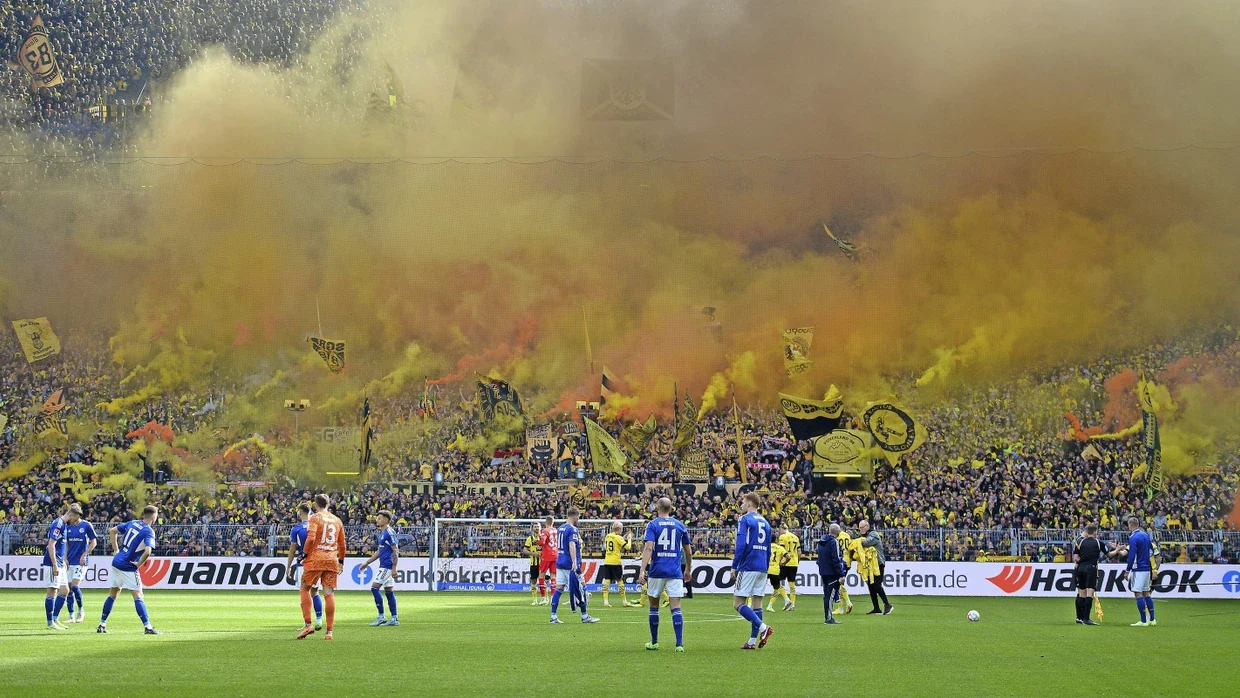
The greater return is Schalke against Dortmund on Matchday 12, 4–6 December. It will be the 101st Bundesliga Revierderby and the first since a 2-2 draw on 11 March 2023. As of 14 September, that round had no exact day or kick-off. The stakes reach beyond rivalry: Schalke must control the occasion while Dortmund must handle a hostile away match like a contender.
Winter and the Spring Midweek Squeeze
The Bundesliga pauses after Matchday 14 on 18–20 December and resumes on 8 January, leaving three Hinrunde rounds for the new year. A full midweek round follows on 2–4 March because no league matches will be played on the weekend of 1 May. That disruption may favour deeper squads but also gives organised teams a chance against rotated opponents.
Matchday 34 is Saturday 22 May, with the relegation playoff beginning on 27 or 28 May. Add key rounds to the Bundesliga calendar, then revisit confirmed times before booking travel. The calendar is fixed at matchday level; the detailed clock is deliberately a living document.
How to Follow the Season Without Overreacting
Three matches represent only 8.8 percent of a 34-match Bundesliga season. They can reveal tactical choices and fitness levels, but they cannot settle a title, European place or relegation verdict. The smartest way to follow 2026/27 is to update your view at meaningful checkpoints while preserving the context behind each score.
1. Start with the result, then inspect the game state.
Freiburg's 5-0 win over Gladbach on Matchday 3 was impressive, but Gladbach were reduced to 10 men in the 52nd minute. Score and context can both be true.
2. Compare equivalent opponents.
Home wins against promoted sides and away points against European contenders test different qualities. Use the table by matchday to compare progress at the same stage.
3. Account for workload and rotation.
Dortmund made four changes after a midweek Champions League match before beating Paderborn 3-0; two late goals made the margin look more comfortable. Consult the calendar before judging a Sunday performance.
4. Separate a forecast from evidence.
Opta's 10,000 simulations were dated 25 August. A model is a probability snapshot built from available information, not a promise. Results should change the view gradually.
Good review points are the October international pause, the winter break after Matchday 14, the end of the Hinrunde and the final 10 rounds. Between them, follow the latest Bundesliga results and look for repeatable patterns: chance quality, control after taking the lead, away resilience and depth during European weeks.
For offline planning, the schedule download is useful, but check exact times again after each official scheduling update. That discipline keeps this season guide useful: the competitive questions remain stable while the evidence changes every weekend.
JOIN THE DISCUSSION
Comments
Sign in with Google to comment. Keep the discussion focused on Bundesliga football and respectful to other supporters. New comments are reviewed before publication.
Loading comments…