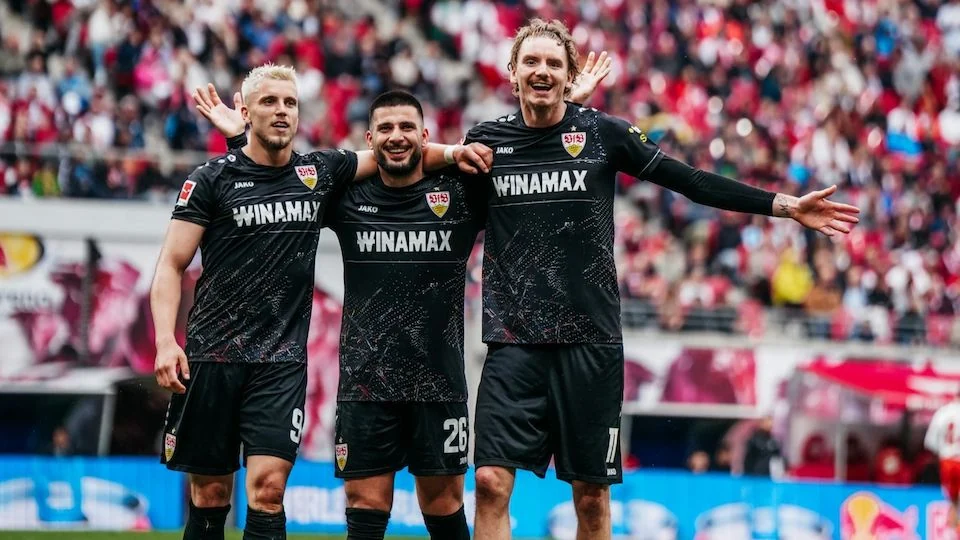
Deniz Undav is a Stuttgart striker who combines sharp finishing with quick link play. His first Bundesliga season brought 18 goals, and his deeper movement makes him useful beside another forward as well as at the front of the attack. This guide connects his career, match examples and partnerships to the role supporters see on the pitch.
Undav's route from lower-league football to Stuttgart
Deniz Undav reached Stuttgart through a career that took him well beyond the usual academy-to-Bundesliga shortcut. He played senior football in Germany's lower divisions, moved to Belgium, joined Brighton and then returned to Germany on loan before becoming a permanent VfB player. The sequence matters because his reputation was built in several different competitive settings.
Undav spent part of his youth development at Werder Bremen before continuing through SC Weyhe and TSV Havelse. At Havelse he stepped into senior Regionalliga football. Later stages included Eintracht Braunschweig and Meppen, with the latter offering a platform in 3. Liga. These were substantial parts of his development, rather than minor footnotes to an inevitable top-flight arrival.
The move to Union Saint-Gilloise in 2020 brought another change of country and level. Brighton signed him in January 2022, with Undav remaining in Belgium on loan for the rest of that campaign. The arrangement is worth reading carefully: signing for a new club and immediately playing for it are not always the same event in a career timeline.
Stuttgart brought him in on loan in August 2023. His first Bundesliga season then supplied the evidence that made a longer association attractive. On 9 August 2024, VfB announced the permanent signing from Brighton. That chronology separates the original opportunity from the decision to keep him after seeing how he fitted the side.
It also cautions against interpreting every transfer as a simple verdict on a player's ability. Different clubs need different combinations of skills, and a forward's contribution depends on the players around him. Stuttgart offered a context in which Undav's scoring and combination play could both be visible. That is an explanation of fit, rather than a claim that any previous institution was incapable of recognizing talent.
The official Bundesliga profile, checked on 14 October 2026, lists him as Stuttgart's number 26 and a striker. Born on 19 July 1996, he is 30 at the time of this guide. His later emergence at the highest level is a useful reminder that development does not end at a single academy decision or follow one age schedule.
For a supporter, the career route helps frame the right question. Instead of asking only when Undav became famous, ask which parts of his game travel between systems and which become more valuable in a particular partnership. The following sections focus on that distinction: where he receives the ball, how quickly he connects with teammates, and how those actions turn into chances inside the penalty area.
What kind of striker is Deniz Undav?
Undav combines a scorer's instinct with the ability to connect an attack. He can lead the line or work slightly deeper beside another forward, and the useful distinction is between his starting position and what he does once the ball moves. A formation graphic may place him centrally; it cannot show every exchange of position that follows.
Receiving between the lines and combining quickly
Sebastian Hoeneß's January 2026 assessment emphasized that Undav should not be reduced to his goals. The coach described a player capable of helping much deeper in possession to find the free teammate. That is strong evidence for treating combination play as part of his role, rather than an occasional departure from his job as a striker.
Tactically, a deeper reception can create a decision for the opposing center-back. Following the forward may leave space behind; staying in the defensive line may allow him to turn or connect a pass. The value of Undav's movement depends on Stuttgart using the next action quickly. Simply receiving far from goal is not enough if the rest of the attack remains static.
Watch the receiver after the first pass too. A striker who lays the ball off can move again before the defender resets, producing a new passing angle or arriving behind the midfield screen. This is one reason a player can contribute to chance creation without being credited with the final assist. The initial connection can make the later decisive pass possible.
At 1.79 meters, Undav does not fit the most obvious physical picture of a towering target forward. Hoeneß likewise distinguished him from that conventional type while stressing his ability to perform the central role. That is a description of how he solves the position, not a suggestion that a striker must meet one height requirement.
Turning short movements into shooting chances
The league's analysis highlights Undav's positional intelligence and ability to separate from an opponent before the ball arrives. For a supporter, the important action may happen just before the camera follows the pass. A small adjustment can move him out of a defender's line of sight or change the angle at which he meets a cutback.
His completed 2025/26 Bundesliga season provides a concrete measure of the threat: 19 goals, six assists and 121 attempts on goal from 29 appearances. The attempt total was the league's highest. Those figures establish sustained involvement in chance production, rather than relying only on a compilation of his best finishes.
They do not mean every movement works or that every future shot will become a goal. A useful match review separates the chance from its outcome. Did he reach a dangerous position? Was the pass playable? Did the defender force him into a difficult finish? Asking those questions helps explain a goalless performance without assuming it contained no good attacking work.
The combined profile is therefore broader than “penalty-box finisher.” Undav can help create the path to goal and then become the player who finishes it. The best way to recognize that contribution is to follow his movement through an entire possession, rather than start watching only when Stuttgart deliver the final ball.
The 2023/24 season that established his Bundesliga reputation
Undav's first Bundesliga season was both individually productive and part of a dramatic collective advance. Stuttgart finished second in 2023/24 with 73 points, ahead of Bayern Munich. His output mattered because it contributed to a team reaching that level over a full campaign, rather than only producing a memorable month.
Goals and assists in a second-place team
Opta's season record lists 30 league appearances, 18 goals and nine assists for Undav. The assist figure follows Opta's definition; credited assists can differ between statistical records. The important football point is that he combined finishing with the ability to supply teammates, giving Stuttgart more than one route to turn an attacking possession into a chance.
Serhou Guirassy scored 28 Bundesliga goals in the same season. That separate contribution is essential context. Undav's success did not happen in an attack where every threat and every chance had to pass through one player. Defenders had to manage multiple dangerous movements, and Stuttgart could vary which forward finished a particular sequence.
At team level, second place also carried a Champions League return. The scale of that achievement helps distinguish a good striker season from a productive role in an unusually successful side. It would still be too simple to assign the whole change to Undav: midfield progression, wide play, coaching and defensive structure supplied the conditions in which the forwards could thrive.
For reviewing his individual performance, the combined record is a better starting point than goals alone. A forward who can score and set up others can remain useful when an opponent concentrates on denying him direct shots. His contribution can shift within the match, allowing a teammate to become the beneficiary of the space or pass he creates.
The hat-trick against RB Leipzig
The clearest single-game landmark came on 27 January 2024, when Stuttgart beat Leipzig 5–2 at home. Undav scored three times, his first Bundesliga hat-trick. The club also recorded the result as Stuttgart's first Bundesliga victory over Leipzig, making the afternoon a team breakthrough as well as a personal one.
His goals came in the 30th, 56th and 75th minutes. The distribution matters: this was not a late flurry after the contest had already become irrelevant. Stuttgart needed to answer an opponent capable of scoring back, and Undav's contribution kept extending the home side's advantage as the match developed.
The club's retrospective emphasized his awareness of situations near goal and readiness to finish quickly. Those are concrete qualities to look for in the action. Instead of focusing only on the eventual shot, follow when he identifies the opening and how few touches he needs once the chance appears.
A hat-trick should still be put back into the full season. It explains why the performance became a landmark and illustrates his scoring methods; it does not mean he scored three every week or carried Stuttgart alone. The useful combination is the broad season record and the detailed match example: one establishes sustained impact, while the other shows what that impact looked like.
Why the striker beside him changes his job
Undav's role is easier to understand as a relationship than as an isolated label. A forward who comes towards the ball needs teammates to occupy other spaces; a forward who runs behind needs someone to deliver the pass. The most useful partnership allows those responsibilities to change without leaving the attack empty where it needs a threat.
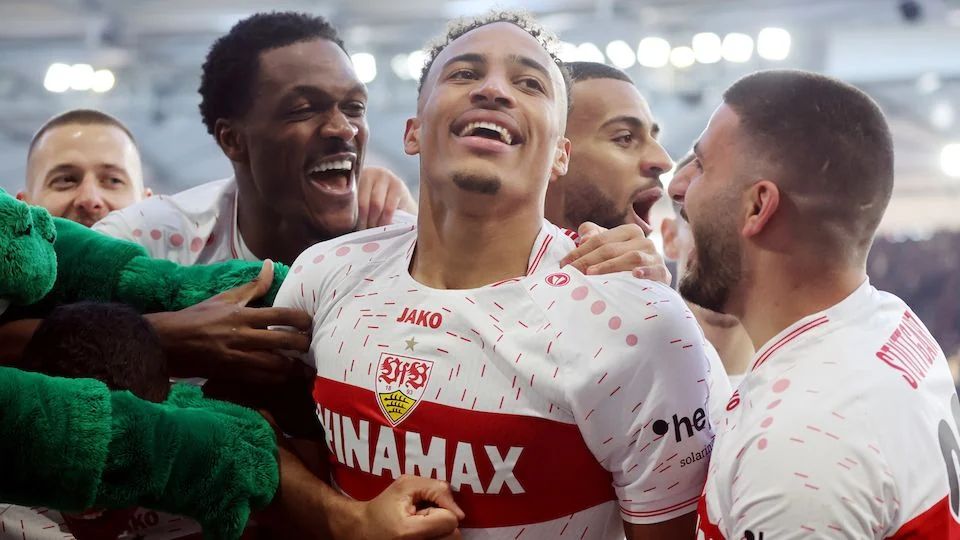
The 2023/24 combination with Guirassy produced 46 Bundesliga goals between them: 28 for Guirassy and 18 for Undav. That output does not describe every possession, but it demonstrates that Stuttgart could sustain two major scoring sources. Undav's ability to connect an attack did not remove his own finishing responsibility, and Guirassy's scoring did not make the other forward a passive assistant.
Once Guirassy moved on, the attacking context changed. Stuttgart's account of the end of 2024/25 highlighted Undav, Ermedin Demirović and Nick Woltemade together after the 3–2 win in Leipzig. All three scored that afternoon. It was a different attacking group, with different movement and integration problems to solve, rather than a simple replacement of one name on an unchanged team sheet.
Undav ended that league season with nine goals, below his 18 from the previous campaign. The change should not be explained automatically through one teammate's departure. Availability, minutes, opposition and the wider attacking structure all affect output. The more careful conclusion is that his goals varied while Stuttgart continued developing combinations among its forwards.
The club's retrospective emphasized the process of integrating new players and combining in possession rather than relying only on long deliveries. Demirović's later official interview also described the connection he had built with Undav. Those accounts support a partnership-based reading: understanding where another forward will move can make a short pass or a delayed run more valuable.
When watching the pair, check who occupies the central defenders and who becomes available behind midfield. If both move towards the same pocket, a defender may be able to close two options at once. If one attracts pressure while the other moves into the space it leaves, Stuttgart can turn a routine pass into a more dangerous next action. These are viewing clues, not claims that one pattern appears in every game.
Also follow the wide players and midfielders. A two-forward relationship cannot solve the attack on its own if there is no width or nobody prepared to pass through the first line. Undav's position may make more sense once a full-back advances or a midfielder carries the ball, because those actions change which space needs filling.
For the next fixture, use the announced line-up as the starting point and the actual movement as the explanation. Historical partnerships help identify Undav's skills, but they should not be treated as a promise that an old starting eleven remains in place. The stable feature is his capacity to combine and finish; the exact division of work depends on the team selected around him.
Undav for Germany and what to watch in his next match
Undav's place in Stuttgart has acquired responsibility as well as recognition. VfB announced a contract extension to 2029, with an additional-year option, in June 2026; on 24 August they named him the new captain. Those confirmed decisions give useful current context to a guide checked on 14 October 2026. They indicate the club's commitment without guaranteeing selection for every individual fixture.
For watching Stuttgart, begin with the actual line-up and then follow three parts of his role: the position in which he receives, the next movement after a short pass, and his arrival when the final delivery comes. The goals are the visible end of that sequence. Understanding the earlier actions makes a performance easier to assess when the finishing outcome varies.
International opportunities are a separate selection question
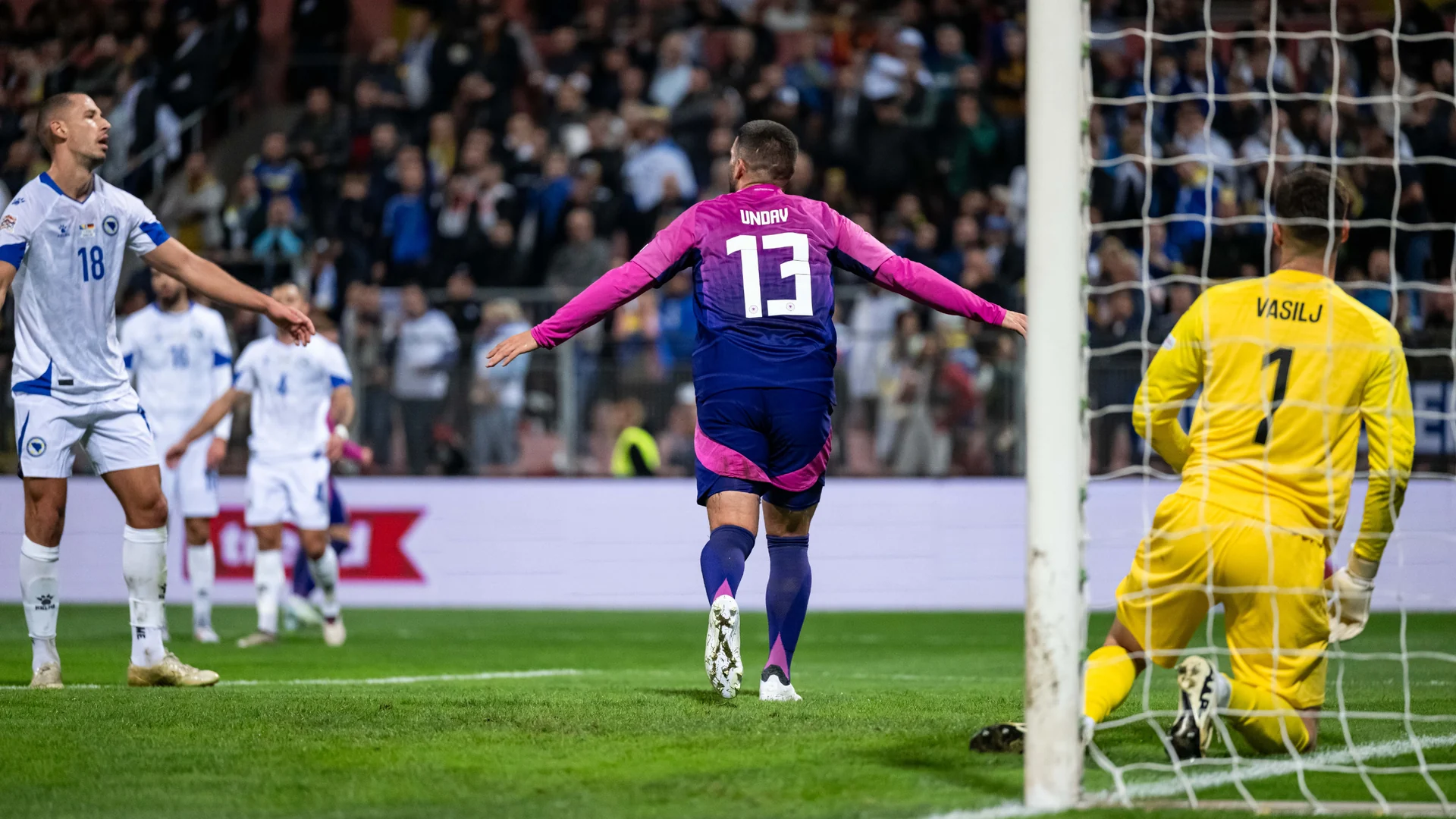
Undav made his senior Germany debut against France on 23 March 2024. One of his early scoring landmarks followed on 11 October, when his two goals earned a 2–1 away win against Bosnia and Herzegovina in the Nations League. It was a clear example of club-level finishing ability transferring into a different team environment.
At the 2026 World Cup, another double helped Germany beat Côte d'Ivoire 2–1 in the group stage. These are specific international contributions, rather than a projection that a productive Stuttgart season must always result in a national-team starting place. International selection has its own opponents, squad balance and match plans.
A player can consequently be central to his club and used differently by his country. That need not be read as a contradiction. A national coach may require a different starting profile or see a forward's scoring and combination skills as particularly useful after the match has changed. The important assessment is what job the player is asked to perform and whether the actions suit that job.
The Bosnia example is helpful precisely because it is concrete. Two goals settled an away game, but that performance should not be converted into a promise about every later selection. Likewise, a World Cup brace demonstrates decisive impact under tournament pressure without proving that the role will remain identical in the next international window.
When Undav appears as a substitute, adjust the comparison. A short late spell may involve more direct attacking, fewer settled build-up phases and an opponent defending a lead. Comparing it mechanically with a full Stuttgart start can hide those circumstances. Look at the state of the game when he enters and at the space available around the defenders.
To follow the next club opportunity, use the Bundesliga weekend schedule and check the confirmed match team. His career, scoring records and partnerships establish the skill set; the particular fixture determines where those skills are needed. Watching both the combinations and the finishing gives the fullest picture of a forward whose value extends beyond the moment his name appears on the scoresheet.
JOIN THE DISCUSSION
Comments
Sign in with Google to comment. Keep the discussion focused on Bundesliga football and respectful to other supporters. New comments are reviewed before publication.
Loading comments…