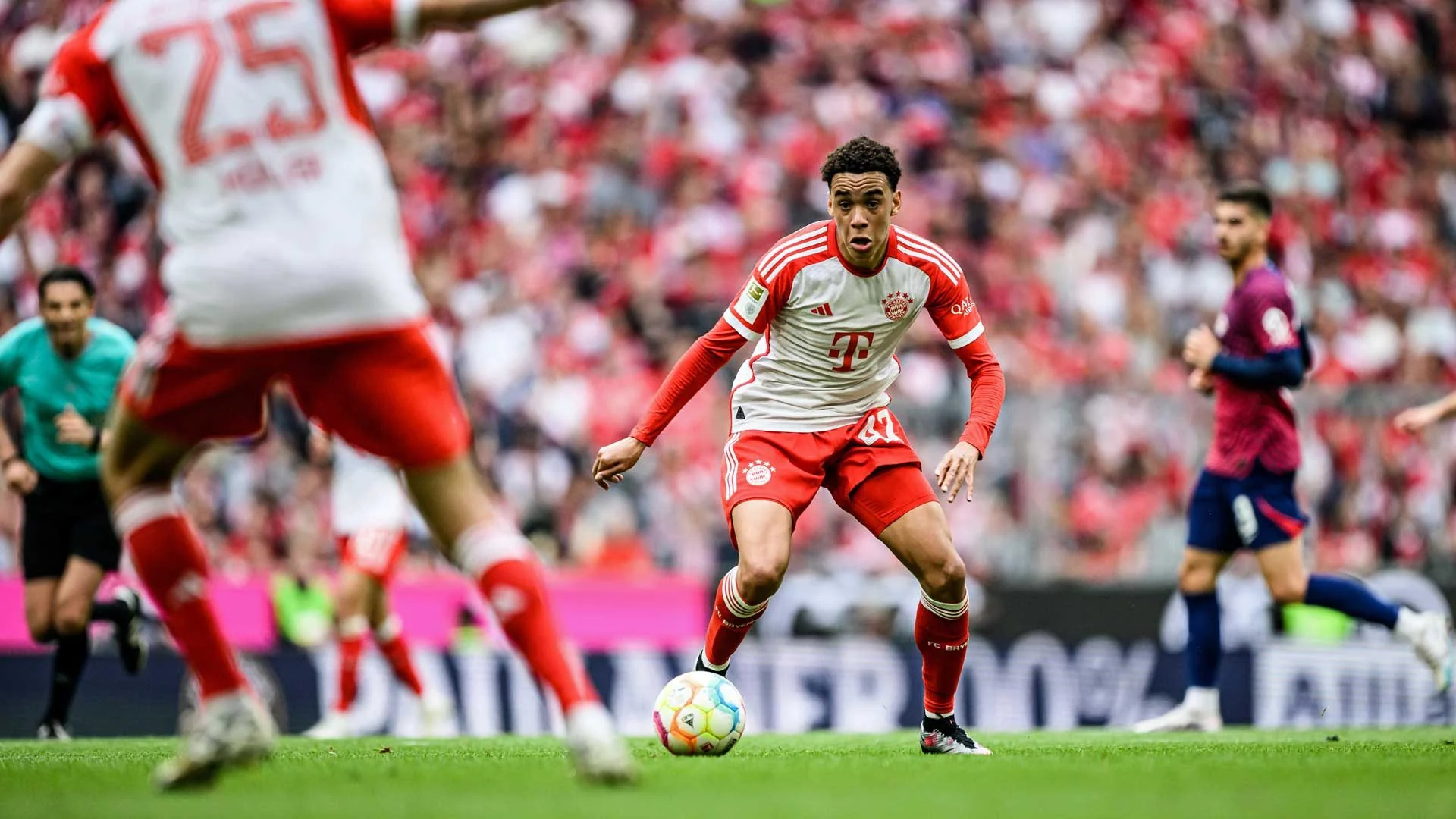
Jamal Musiala plays an attacking midfield role for Bayern, combining close control with movement across central and wide areas. This guide explains how he receives, dribbles, connects with teammates and arrives to finish, using verified Bayern and Germany match examples to make the role clear.
What position does Musiala play for Bayern?
Jamal Musiala is best understood as an attacking midfielder whose responsibilities extend across the centre and the wide areas. Bayern's official profile places him in midfield, while the club's February 2026 role feature describes his movement between different attacking spaces under Vincent Kompany. A position label gives a starting point; the way he receives and advances the ball explains the role.
He wears Bayern's No. 10, having taken over that shirt number in July 2025. The change should not be confused with a rule requiring him to stand in one particular location. His job involves finding places where he can influence an attack, whether he receives between midfield and defence or moves towards a flank to combine with a teammate.
A central role with room to move wide
Receiving between the lines means offering a pass beyond the opponent's midfield but in front of its defensive line. If Musiala can receive there facing forward, he brings the ball closer to goal and asks the defenders to respond. If he receives under pressure, his first touch and body position determine whether he can turn, protect possession or return the pass.
Moving wider can change that problem. He may find a different angle to receive, draw a marker away from the centre or create a combination near the touchline. The value lies in what the movement does for the next action. A wider position can be useful preparation for returning inside with the ball or helping a teammate advance.
For supporters, watch where he is when a Bayern midfielder looks ready to pass. Does he offer a visible lane beyond the first line of pressure? Is a defender following him, or handing him over to another player? Is there room for a teammate to enter the space he has left? These observations give more information than a formation graphic alone.
His attacking freedom works within a team structure. When he moves towards one area, Bayern still need options elsewhere and enough support behind the ball. The freedom is therefore about creating useful relationships between players, rather than occupying random positions or demanding every pass.
Bayern confirmed on 14 February 2025 that his contract runs until 30 June 2030. He had joined from Chelsea's academy in summer 2019. Those career details establish the club context; they do not determine the selection or exact position for his next match.
The verified foundations are the official player profile, Bayern's February 2026 role feature and its contract announcement.
Why his dribbling works in crowded spaces
Musiala can advance an attack through an area that initially looks closed. His close control lets him change the direction of the ball while keeping the next touch available. The result is particularly valuable near the penalty area, where defenders are close together and a large touch may surrender possession before the attacker can reach it again.
Close touches and changes of direction
A short touch preserves several possible next actions. Musiala can continue forward, move sideways, turn back or release a teammate. A defender therefore has to respond to a player who still has options, rather than simply chase a ball pushed into open space. The useful advantage is control over the next decision.
His goal away at Freiburg in March 2024 provides a clear example. Bayern's retrospective describes him receiving on the left, using a body feint and a change of direction near the corner of the penalty area, then finding a route past further defenders before finishing towards the far corner. The sequence combined the dribble with a shot; it was not an isolated skills display.
Watch the defender's balance as well as Musiala's feet. If the defender commits towards one direction, a change in the other can create a brief opening. Musiala then needs to use that opening before another opponent closes it. The rhythm of the touches matters because the gap may last only long enough for one action.
Close control also changes the type of challenge a defender can attempt. Reaching for a ball near the attacker's feet is different from intercepting a long touch. That does not make Musiala impossible to tackle, but it helps explain why the timing of the defender's decision becomes so important.
Turning a beaten defender into a team advantage
The dribble's purpose is to improve Bayern's next action. If Musiala draws a second defender towards him, a teammate may become available. If he opens a shooting lane, he can finish. If the route closes, a controlled pass can preserve the attack rather than force another duel.
Bayern's March 2025 feature emphasises that he scans the positions of teammates and opponents before carrying the ball. That detail connects the visible technique with preparation: he is looking for a useful destination, not merely reacting to the first defender in front of him.
For viewers, follow the teammate who becomes available after the first opponent is beaten. Does Musiala release the ball at a moment when the receiver can use the advantage? Does he keep carrying because a direct route to goal remains open? The quality of that decision determines whether the dribble becomes a chance.
The specific examples and preparation are supported by Bayern's February 2025 match retrospective and March 2025 feature. They explain the technique without requiring an arbitrary ranking of the greatest dribblers in football history.
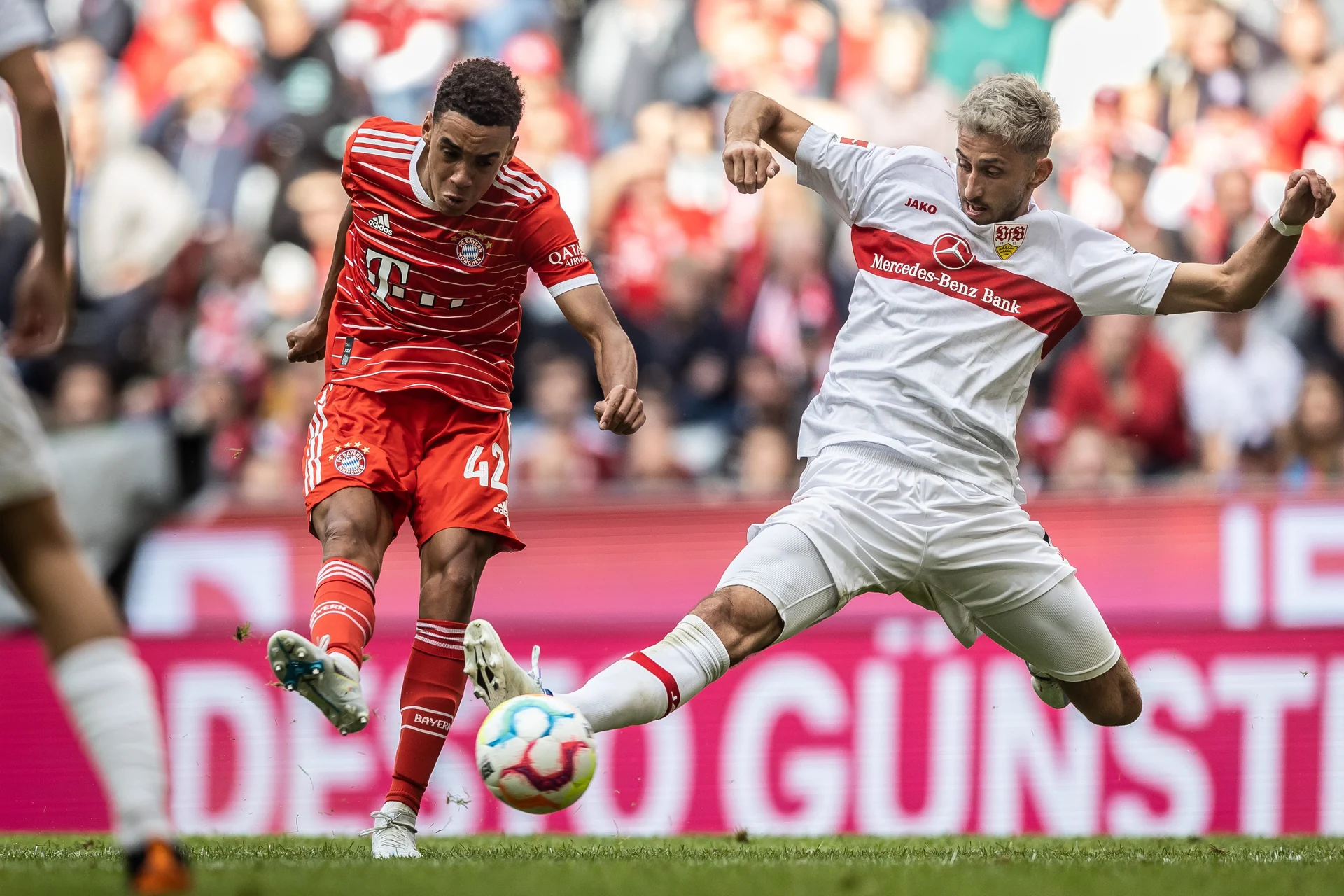
How Musiala connects with Bayern's other attackers
Musiala's dribbling is most useful when it operates alongside other attacking options. A central striker can occupy the defensive line, a wide player can offer a different passing angle, and a midfielder can support behind the ball. Those relationships give Musiala somewhere to pass when pressure arrives and someone to combine with when he reaches a dangerous area.
A compact exchange against Schalke on 12 November 2022 illustrates the value of choosing the pass. Musiala returned the ball to Serge Gnabry with a backheel for Bayern's opening goal in a 2-0 win. He also helped set up Eric Maxim Choupo-Moting's second. These were historical examples of making teammates more dangerous, rather than insisting on completing every attack himself.
In a one-two, the first pass and the return run need to fit together. The receiver may only have time for one touch before a defender reaches him. A pass into a usable position allows the attack to continue quickly; a pass that leaves the teammate stretching or facing backwards can remove the advantage. Musiala's control helps him make that choice while opponents are close.
Harry Kane adds another kind of relationship to Bayern's attack. When the centre-forward comes towards the ball, another attacker can threaten the space farther forward. When Kane stays on the defensive line, Musiala can look for a reception in front of it. The important point is that the players' movements complement each other; both arriving in the same crowded spot can make possession harder.
UEFA's technical analysis of Bayern's March 2025 home win over Leverkusen highlighted Kane receiving in midfield and switching the ball to Michael Olise on the right. The sequence shows how a central reception can change the point of attack. Musiala operates within that wider network of options, rather than carrying sole responsibility for every route into the box.
For viewers, watch what happens when Musiala draws a defender inside. Is the wide teammate still available? Does the striker offer a forward option? Is there a safe pass behind him if the direct route closes? The availability of those choices affects how confidently he can turn or carry the ball.
These principles can remain useful as lineups change. They describe functions in an attack, not a permanent list of starters. Bayern's Schalke match report and UEFA's Leverkusen analysis offer concrete examples of the connections. Musiala's individual technique then helps him use whichever option the team creates.
Finishing makes him more than a ball carrier
Musiala's role includes being available to score after Bayern have advanced the ball. Sometimes he creates the shooting opportunity himself; sometimes the crucial work is arriving at the right place for a delivery or a loose ball. That distinction matters because an attacking midfielder's goal threat can exist without a long dribble beforehand.
The Cologne title-winning goal in 2023
On 27 May 2023, Musiala scored the 89th-minute winner in Bayern's 2-1 victory away at Cologne. Dortmund drew 2-2 at home to Mainz, and Bayern took the Bundesliga title on goal difference. The league's report records Musiala as a late substitute who supplied the decisive finish.
The match is memorable for its stakes, but it also offers a useful technical example. With very little time remaining, the attack needed a player ready to receive near the edge of the penalty area and turn that reception into a shot. The finish demonstrated the connection between control, preparation and scoring rather than requiring an elaborate sequence of tricks.
It is also important to preserve the other match's place in the story. Bayern's win was necessary, while Dortmund's dropped points made the title change possible. Musiala's goal decided Bayern's match; the combination of both results decided the championship. That is why the evening belongs to both individual finishing and league context.
See the official Cologne match report for the final-day sequence and the title outcome.
The Mainz hat-trick and a growing scoring responsibility
On 30 October 2024, Musiala scored a first-half hat-trick in Bayern's 4-0 win away at Mainz in the DFB Cup second round. This was a cup performance, so those three goals should not be added to his Bundesliga total for the season. It nevertheless shows the attacking midfielder repeatedly becoming the player who completes the attack.
His league record also demonstrates a sustained scoring contribution. Opta lists 12 goals in 33 appearances in 2022/23, ten in 24 in 2023/24 and 12 in 25 in 2024/25. Those totals do not rise in a straight line each year. They show that Bayern have received a meaningful finishing threat from midfield across several completed campaigns.
For viewers, the next useful observation is his movement when someone else has the ball. Does he arrive beyond the opponent's midfield as the cross becomes possible? Is he ready if the goalkeeper cannot hold the delivery? Does his body position allow an early shot? These actions can explain a goal that looks simple when seen only from its final touch.
Scoring responsibility also brings choices. Carrying closer to goal can improve an angle, but delaying too long can allow defenders to recover. Passing can create a better chance for a teammate. Musiala's finishing threat gives defenders another reason to react to him; the decision between shot and pass remains part of the same attacking job.
The Mainz cup report and Opta's competition-separated career record provide the verified match and season figures.
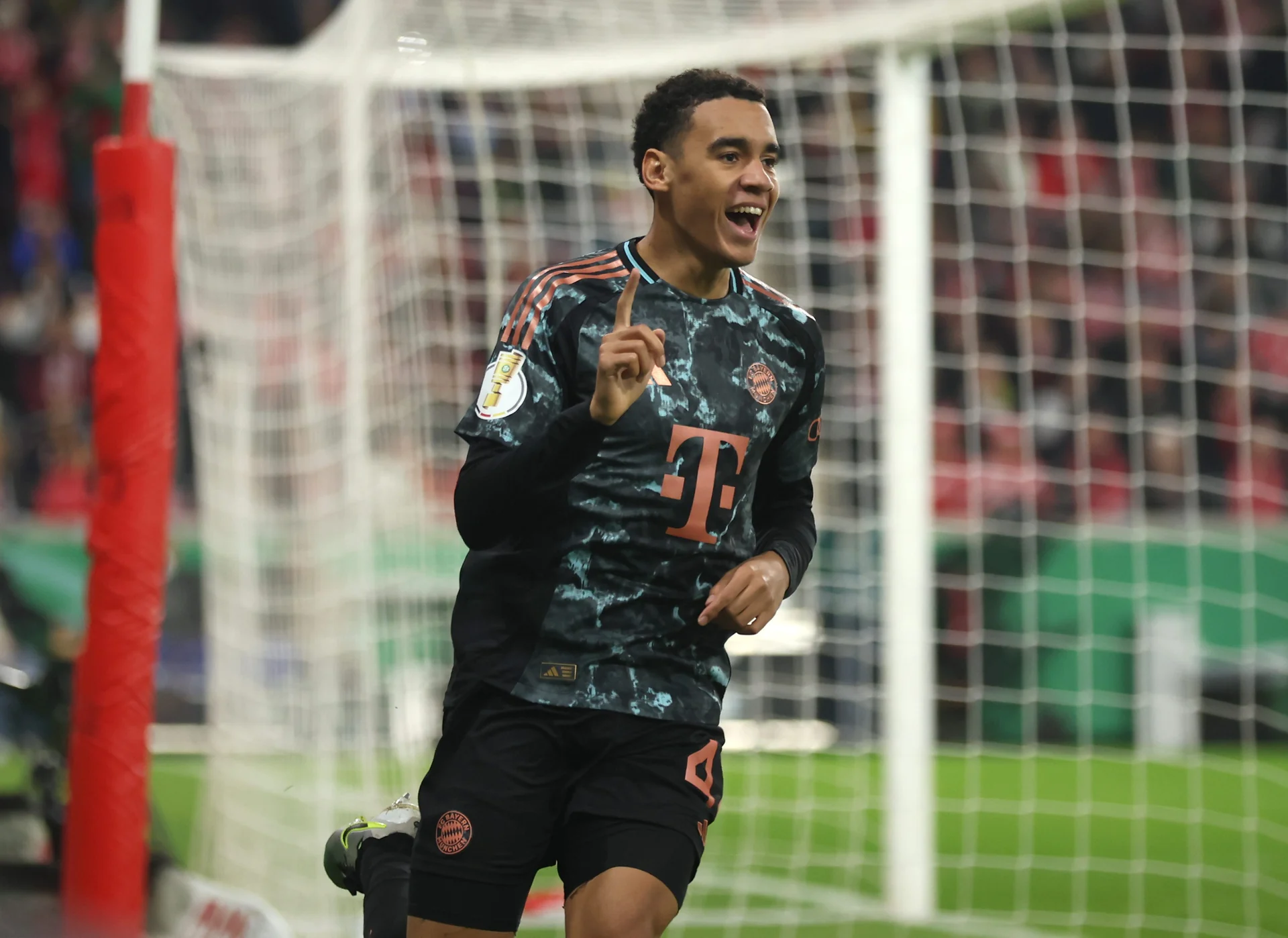
Musiala's role with Germany
Musiala brings the same close control and attacking instincts to Germany, but the surrounding relationships differ from those at Bayern. The national team have their own midfield balance, striker movements and wide options. His technique remains recognisable while the route to a useful reception changes with the players around him.
That distinction helps explain why club and international performances should be assessed in their own context. A familiar player can receive in a different area or be asked to make a different supporting run. The important question remains how his action helps the team progress towards a chance.
EURO 2024: three goals from attacking midfield
Musiala scored three goals at EURO 2024, against Scotland, Hungary and Denmark. He shared the top of the final scoring ranking with Cody Gakpo, Harry Kane, Georges Mikautadze, Dani Olmo and Ivan Schranz. Six players finished on three; he was not the tournament's sole leading scorer.
Germany's opening 5-1 victory over Scotland offered a particularly useful example of coordinated movement. UEFA's technical analysis describes Musiala moving towards his own half and drawing Jack Hendry upfield, creating space behind for Kai Havertz. The attack developed through midfield, and Havertz then supplied Musiala for Germany's second goal. The scorer had helped create the space earlier in the sequence.
That is a different contribution from simply waiting for a pass in front of goal. It shows how a movement towards the ball can prepare a teammate's run away from it. The sequence becomes effective because the players respond to each other, with Musiala returning to a position from which he can finish.
Germany eventually lost 2-1 after extra time to Spain in the quarter-finals. The individual scoring achievement therefore belongs alongside that team outcome, rather than replacing it. Tournament goals describe his contribution in that competition; they should remain separate from his Bayern league totals.
For the confirmed details, see UEFA's final scorer ranking, the Scotland tactical analysis and the Spain quarter-final analysis.
Defensive work and what to watch in his next match
Musiala's attacking role also places him near important defensive moments. When Bayern lose the ball in a crowded central area, the nearest players have a chance to delay the opponent's next pass. Their response can determine whether the opposition escape into space or have to play a less comfortable ball.
The Bundesliga's analysis of the November 2024 Klassiker describes Musiala moving up to form a front two when Bayern pressed. That is a concrete example of his defensive position differing from his attacking position. A midfielder on the team sheet can become part of the first line of pressure when the opponent have possession.
The purpose of that pressure is collective. Approaching a defender from a useful angle can restrict one passing option, while a teammate prepares to contest another. If the players behind the first presser are too far away, the opponent may pass around him. If the distances are coordinated, the same action can help Bayern win the ball closer to goal.
There is a risk as well as a reward. Committing players forward can leave space if the opponent escape the first challenge. The league's early Kompany analysis discusses that trade-off within Bayern's aggressive approach. Musiala's contribution should therefore be viewed as part of the team's response, rather than judged by whether he personally makes every tackle.
When watching a future match, begin with his reception. Notice whether he can face forward, which defender responds and what options remain beside him. Then follow the end of the action: did the dribble produce a better pass or shot, did the combination bring a teammate into play, and did he move again after releasing the ball?
If possession is lost, keep watching for a few seconds. Does he help close the immediate passing lane? Do nearby Bayern players react with him? Does the opponent have to go backwards, or find an easy route beyond the pressure? This short continuation often reveals work that disappears from a highlight clip focused only on attacking touches.
Raw totals remain useful within their limits. Goals identify completed finishes, while dribble counts describe one type of action. Neither tells the whole story of a reception, a decoy run or the quality of the next pass. Combining the figures with those sequences gives a clearer account of Musiala's position and playing style.
Use the Bundesliga fixture schedule to find Bayern's next league match, and the league table for its competitive context. The Klassiker tactical analysis and Kompany system analysis provide dated examples of the defensive structure surrounding him.
JOIN THE DISCUSSION
Comments
Sign in with Google to comment. Keep the discussion focused on Bundesliga football and respectful to other supporters. New comments are reviewed before publication.
Loading comments…