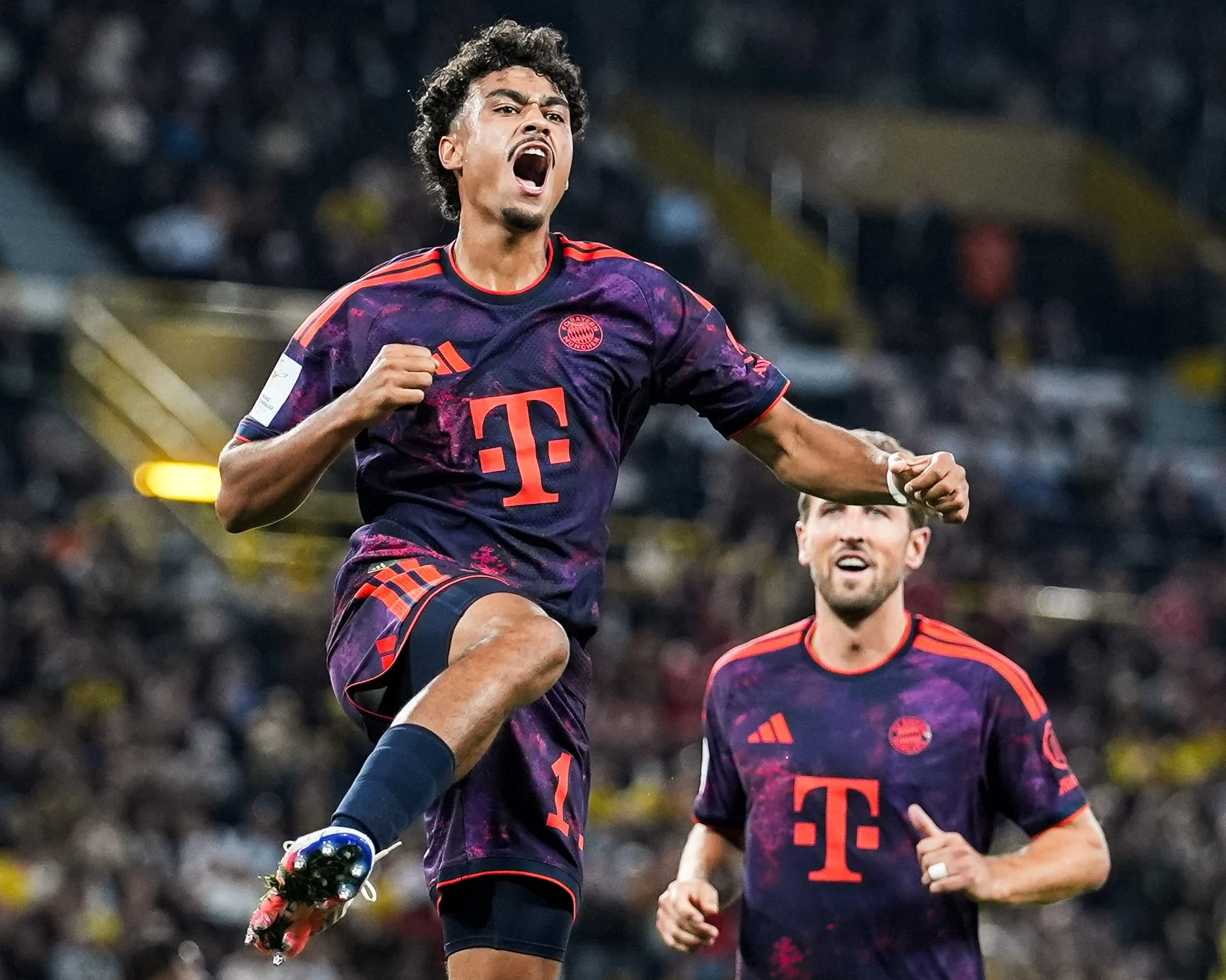
Nathaniel Brown was a No. 10 in Nürnberg’s under-17s before an injury shortage led his coach to try him at left-back. He turned that chance into 59 Bundesliga appearances for Frankfurt and a Bayern move in July 2026. By the end of Bayern’s first four 2026/27 league matches he had three starts, but two were at No. 10 and only one was a confirmed left-back start. Alphonso Davies started at left-back in the other three games.
Brown is already an important Bayern option and has been described as Germany’s first-choice left-back. Those are different selection questions. His route from attacking midfield explains his versatility; the early match record shows why calling him Bayern’s settled first choice would be premature. Here is the development story, the properly labeled Frankfurt numbers and the evidence supporters can use as the Bayern competition continues.
The No. 10 detour that created a left-back
Nathaniel Brown's route to Bayern's left side did not begin with a childhood plan to defend. In Bayern's September 2026 interview, he explained that he had been a No. 10 in Nürnberg's under-17 team. He saw the competition for an attacking midfield place and questioned whether he would play enough there. Then two left-backs were unavailable, and youth coach Peter Gaydarov asked Brown to fill the gap. Brown did well enough to be trusted there again. That is the turning point behind the headline, according to the player himself.
An injury opening in Nürnberg’s under-17s
The change is a useful reminder of how a player's position can be discovered. A coach had an immediate shortage; a technically able youngster had a reason to try something new; and subsequent selections gave him time to learn. Brown credits Gaydarov for the decision and says it helped make his later Bayern move possible. Nürnberg's own youth records identify Gaydarov as a coach of its under-17s, while Bayern later employed him in its academy. Neither source gives an exact date for the first experimental match, so the honest timeline is the under-17 phase rather than a falsely precise fixture.
The switch was more than moving an attacking midfielder a few metres deeper on a team sheet. A left-back has to face runners, judge when to step out, guard the space behind an advancing winger and recover after the ball is lost. A No. 10 usually receives between opposition midfield and defence with a different picture of the pitch. Brown's account does not claim he learned all those defensive tasks at once. The important evidence is that Gaydarov continued to select him after the emergency had passed. His development into a senior full-back came through later seasons, not from one clever youth-game improvisation alone.
What stayed with Brown from his attacking years
Brown has not described his old position as wasted time. Asked what kind of footballer he is now, he said he thinks offensively and wants to influence a game whether playing deeper or higher. That helps explain why Bayern list him as a defender with attacking instinct and the versatility to play as a full-back or wing-back. It is an interpretation of his style, not proof that he will always be given a free attacking role: at Bayern, the freedom of a full-back depends on the opponent, his teammates' positions and what the coach asks him to protect.
He also identifies a change in confidence. Brown recalled being nervous when he first joined senior training at 18 and sometimes regretting that he had not asked for the ball more often. He now tries to stay involved even if a mistake is possible. For a Bayern supporter, that mindset matters because a left-sided defender often receives under pressure in a team expected to build attacks. The underlying lesson is concrete: his attacking background can help him offer a passing option, but the left-back role still demands defensive timing. His youth story explains his tools; it does not by itself decide whether he starts ahead of anyone else in Munich.
Frankfurt proved the change could work at senior level
The clearest proof that Brown had become more than a converted youth midfielder came at Eintracht Frankfurt. He moved there from Nürnberg in summer 2024, debuted for the Eagles in a DFB Cup tie against Braunschweig and made his Bundesliga debut later that autumn at Union Berlin. His first league start, against Bochum on 2 November 2024, brought a goal in a 7–2 victory. A debut goal is a vivid moment, but his two-season workload tells the stronger story: Frankfurt kept using him through league, cup and European matches.
The beginning was not an instant place in the team. The Bundesliga's contemporary rookie report says Brown did not make the league squad until Matchday 5 and entered late against Union on Matchday 8. By November he was starting regularly, sometimes as a left-back and sometimes one line higher. The league named him its rookie of the month in both November and December 2024. That path matters to a new Bayern signing because it shows a player who had already handled a period of waiting, earned a place and then been asked to solve different left-sided problems.
Frankfurt's use of him also changed with the shape of the defence. A Bundesliga analysis in March 2025 described his earlier left wing-back work in front of a three-player defence and his later defending on the left of a back four. In the latter role, coach Dino Toppmöller praised how Brown dealt with Stuttgart's Jamie Leweling. That is a more useful sign for Bayern's defensive needs than goals alone: a wing-back with support behind him and a back-four full-back with a larger share of the defensive channel have related but different responsibilities. Brown had evidence of both before he reached Munich.
League numbers and all-competition numbers are different
The official club records need their labels. Frankfurt says Brown played 75 competitive matches, with seven goals and 13 assists for the Eagles. Bayern's player biography gives 59 Bundesliga appearances, seven goals and ten assists during those same two Frankfurt seasons. Both can be correct: the first includes domestic cup and European games; the second is league-only. Frankfurt breaks the league appearances into 26 in 2024/25 and 33 of a possible 34 in 2025/26. The associated European and cup outings account for the additional 16 appearances in the broader total.
| Frankfurt measure | Appearances | Goals | Assists |
|---|---|---|---|
| Bundesliga, 2024–26 | 59 | 7 | 10 |
| All competitive matches, 2024–26 | 75 | 7 | 13 |
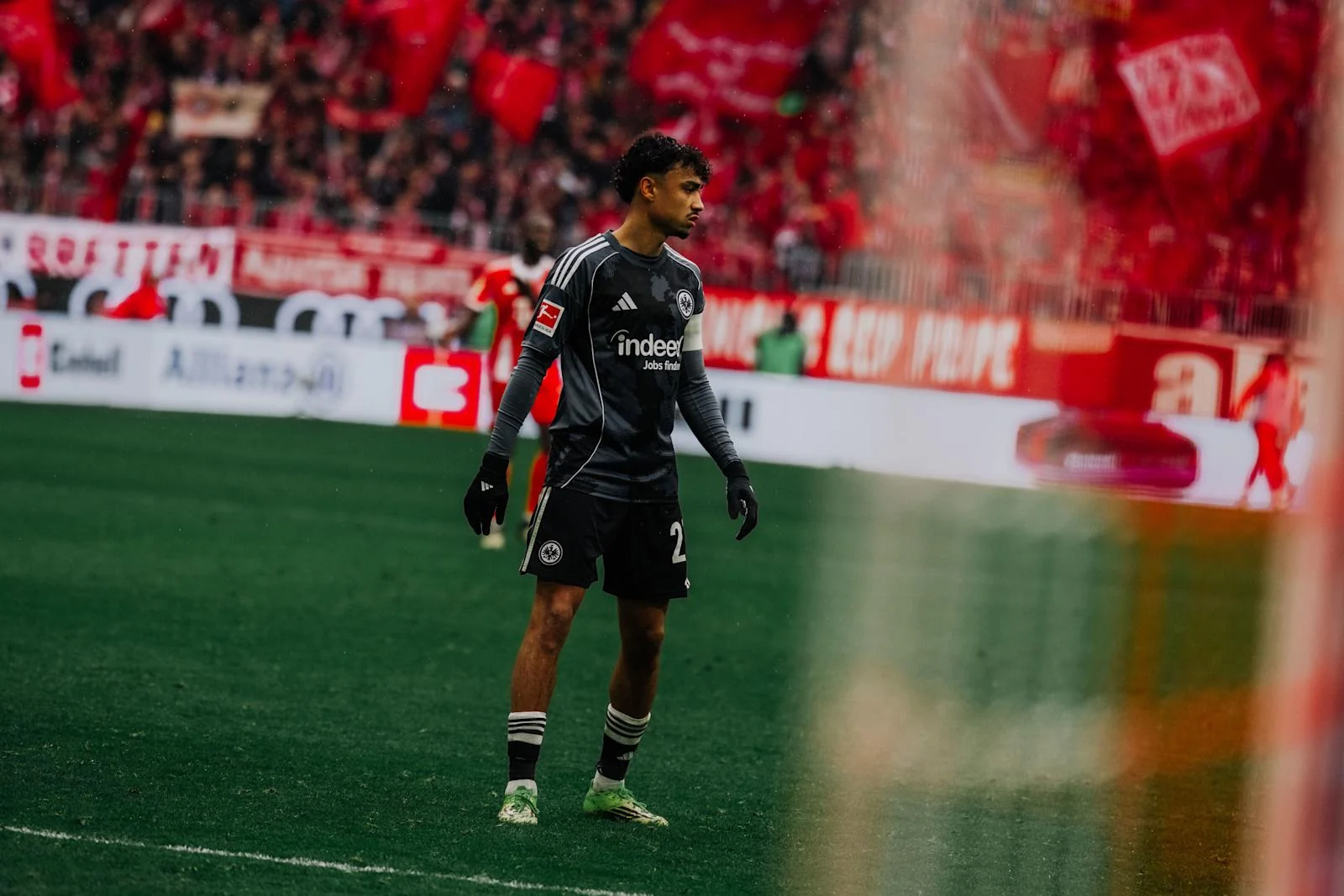
Neither column should be used to promise a certain number of goals or assists at Bayern. Roles, teammates and opposition differ. The point is that Brown arrived with 59 Bundesliga games behind him, not only an attractive under-17 backstory. The 33 league appearances in his final Frankfurt season suggest real availability and trust, while the positional shifts show why an attacking left-footer could be useful in more than one Bayern setup. Those are reasons for Bayern's interest; selection at a deeper squad still has to be won.
What Bayern actually signed in July 2026
Bayern announced Brown's arrival from Frankfurt on 3 July 2026 and gave him a contract through 30 June 2031. That is a significant commitment to a 23-year-old who had already played regularly in the Bundesliga and for Germany. The club's language, however, matters more than any guess based on the length of the deal. Max Eberl said the signing would expand Bayern's options in defence and midfield; Christoph Freund emphasized Brown's speed out wide and his ability to operate in different positions. Neither executive announced him as a guaranteed left-back starter.
The official player profile supplies the simplest description of the tools Bayern bought. Brown is a left-footed defender listed at 1.76 metres, comfortable at full-back on either side and as a more advanced wing-back. Left-back is his established position, but a coach can use the same player differently according to the shape of the side. As a conventional full-back, he must balance his forward runs with protection of the defensive line. As a wing-back, he may start higher and have another defender behind him. Shifting him into midfield changes his reference points again. A flexible profile gives Kompany options; it does not mean Brown is equally experienced in every role.
There is on-pitch evidence behind the attacking label. The Bundesliga's pre-season analysis points to a Champions League move against Barcelona for Frankfurt: Brown won the ball from Lamine Yamal, carried it upfield and released Ansgar Knauff to score. That sequence is more informative than a vague claim that he is “offensive.” It shows recovery, carrying and decision-making in one transition. It was a European match, so it should not be added to any Bundesliga goal or assist total. The article also notes that Brown provided four goals and four assists in the German league in 2025/26, though those numbers alone do not measure his defensive choices.
Why spend on a left-sided player when Alphonso Davies is already at Bayern? The league's July transfer coverage framed Brown as competition and a way to widen the coach's choices. Davies had experienced injury interruptions, while Bayern had used Konrad Laimer, Josip Stanišić, Tom Bischof and others on that flank. Some are more naturally deployed elsewhere. Brown supplied a natural left-footer with recent senior full-back experience and the capacity to play higher. The answer is squad depth and tactical choice, with the potential for Brown to earn more, rather than a confirmed handover of the position.
His own reaction adds a useful limit to transfer narratives. Brown told Bayern that the interest surprised him, but that discussions with the club and Vincent Kompany convinced him quickly. He described ambition to win major titles and develop. Those are a player's aims, not a coach's published selection plan. The first meaningful test of the signing was what happened after competitive matches began, when Bayern had to choose an actual line-up against actual opponents. That evidence belongs to the opening 2026/27 fixtures, not to the July unveiling.
Four league games show trust, not a settled hierarchy
By 30 September 2026, Brown had appeared in all four of Bayern's opening Bundesliga matches and started three, according to the league. That is a strong beginning for a summer arrival. Yet the number is often read too quickly. Match reports show that two of those three starts were at No. 10, not at left-back. His third start was on the left of Bayern's back four at Elversberg. Against Union Berlin, Alphonso Davies started there and Brown came on late. The evidence supports “trusted and versatile”; it does not establish a permanent first-choice Bayern left-back.
Three starts and four appearances
| League match | Brown's use | Result |
|---|---|---|
| Stuttgart, 28 Aug | Started at No. 10 | Bayern 5–1 Stuttgart |
| Schalke, 5 Sep | Started at No. 10; off at half-time | Schalke 0–0 Bayern |
| Elversberg, 13 Sep | Started at left-back; Davies replaced him | Elversberg 1–2 Bayern |
| Union Berlin, 18 Sep | Replaced left-back Davies late | Bayern 7–0 Union |
The Elversberg selection is the clearest left-back start in this four-game set. Bayern's own match report puts Brown in the back four with Stanišić, Upamecano and Minjae Kim, then records Davies taking his place after the hosts equalised. A week later, Davies began the Union match and Brown took over late when Bayern were already far ahead. This is direct evidence of competition and rotation, not enough to decide which player will start the next demanding match. Team scores alone cannot judge a full-back's performance, either: the 2–1 at Elversberg had a very different match state from the 7–0 against Union.
The No. 10 starts tell a different story
Brown's return to the position of his youth is one of the season's most interesting details. Before the league began, he started Bayern's Franz Beckenbauer Supercup win against Borussia Dortmund as an attacking midfielder and scored the opening goal. The Supercup is a separate competition, so that finish is not a Bundesliga goal. On Matchday 1, the Bundesliga reported him again starting behind the striker against Stuttgart, and goalkeeper Fabian Bredlow saved one of his first-half efforts. The result was a 5–1 Bayern win, but the start demonstrates Kompany's use of Brown as an attacking option as much as it demonstrates trust in the player.
At Schalke on Matchday 2, Brown again occupied the No. 10 space. The league's live account notes a chance saved by Loris Karius and a pass that put Luis Díaz into the box. Bayern did not score, and Harry Kane replaced Brown at half-time as the attack was reshuffled. A single substitution is not proof of a coach losing faith; it is one tactical decision in a goalless game. Nor does Brown's Supercup goal make his September league tally one: the league player page lists zero Bundesliga goals and assists through the first four rounds.

This is why the position column matters more than a quick “three starts” headline. Brown has been useful enough to enter every league game, while Kompany has used him to solve two different selection questions. Supporters following later Bundesliga results should check not only whether his name appears, but where he played and who occupied left-back. Only a run of choices under comparable conditions can settle a claim that the role is his.
Brown and Davies remain a live Bayern selection question
Calling Brown Bayern's first-choice left-back in September 2026 would go further than the evidence. Alphonso Davies started on the left of the back four against Stuttgart, Schalke and Union Berlin; Brown started there against Elversberg. Brown's other two starts were higher up the pitch. He then replaced Davies late against Union. Those choices can change as fixtures and opponents change, but they make a simple distinction today: Brown has earned Bayern minutes, while Davies has taken most of the opening league left-back starts.
Bayern had reasons to seek another serious option. The Bundesliga's July analysis counted only 32 Davies league appearances across the two previous seasons because injuries interrupted his availability. Kompany had also used players whose usual jobs lie elsewhere on the left side. Brown's Frankfurt experience provided a left-footer with both full-back and wing-back minutes. That context explains the signing without suggesting Davies had been displaced. In fact, Davies' three starts in the first four rounds show he remained a major part of the immediate plan when selected. The club can need reliable depth and still have real competition for the same role.
This is also a tactical choice, not only an attendance contest. Davies' pace and recovery ability have shaped Bayern's left flank for years. Brown has his own record of carrying the ball, joining attacks and moving between defensive and attacking roles. The coaching staff may ask one player to stretch the touchline, another to step inside, or choose based on the balance with the left winger and centre-backs. Those possible uses are editorial analysis, not a report of an announced Kompany pecking order. The best available test is who starts at left-back over a longer run when both are selectable.
Germany’s first-choice label belongs to Germany
The phrase that can cause confusion comes from Brown's international rise. The Bundesliga described him on 29 September as Germany's first-choice left-back ahead of David Raum. Germany's World Cup choices explain the description: Brown started on the left against Curaçao and returned to the starting side for the knockout match with Paraguay. Raum started the group game against Ecuador, with the league reporting that Brown was dealing with a muscular issue. The picture is selection under Julian Nagelsmann for Germany, against a different rival, in a different team.
A player can be the preferred international option and still have to compete for a club place. Germany did not have Davies in its squad; Bayern does. Brown's World Cup experience strengthens his case to Kompany because it shows trust in high-profile matches, but it is not a club selection announcement. Even the international label should be read as a dated description of recent line-ups rather than a permanent guarantee. Coaches change systems, opponents pose different problems and fitness matters. The clean supporter reading is that Brown arrived at Bayern with a legitimate Germany claim and now faces a genuine, unresolved Bayern decision.
What supporters should watch as the season develops
The next stage of Brown's Bayern story should be judged through repeated selection and specific actions, not through a premature label. Bayern's match report after the Union win listed a trip to Augsburg on 10 October as their next Bundesliga game following the international break. That scheduled return offers another data point, but no single line-up can settle the season. Kompany may rotate after national-team travel, choose for the opponent or put Brown in a different role. The useful question is whether a pattern emerges once more matches are played.
First, note where Brown starts. A team sheet showing him among the first eleven is not proof that he has beaten Davies for left-back; the Stuttgart and Schalke starts demonstrated the difference. If he starts in the back four when Davies is available, that is stronger evidence for the specific left-back case. If he plays at No. 10 while Davies starts behind him, it may reveal trust in his attacking intelligence but says something else about the defensive hierarchy. Substitutions should be read in their match context rather than treated as an automatic demotion or promotion.
Second, watch the phases either side of a Bayern attack. Can Brown receive under pressure and move the ball into a useful space, as he says he now tries to do? When he advances, who guards the channel behind him, and how quickly does he recover when Bayern lose possession? A spectacular carry can be valuable, but a left-back must also stop opponents turning that space into a counterattack. The demands will be sharper against opponents that attack Bayern's left flank than in a late cameo when the result is already secure. This is the part that scoring highlights often leave out.
Third, compare chance creation with the role he actually plays. The Bundesliga noted that Brown supplied three of his four league assists for Frankfurt in 2025/26 from ten starts as a more advanced wing-back. It also credited him with seven clear-cut chances created from left-sided defensive roles, with only David Raum and Maximilian Mittelstädt above him among comparable defenders. Those Frankfurt figures show why Bayern value his forward contribution, but they are a baseline from another system. At Munich, the relevant evidence will be the quality of his passes and runs, his decisions with Luis Díaz or another left-sided attacker, and whether those actions survive higher-level opposition.
The fair conclusion as of 30 September is deliberately narrower than a transfer-story prediction. Brown has a contract through 2031, a German international résumé and four Bundesliga appearances for Bayern already. He has shown he can contribute in attacking midfield and has one confirmed league start at left-back. Davies still has the larger share of early left-back starts. Supporters can follow the Bundesliga fixture list and judge whether Brown's left-back starts, defending and attacking contribution build together. His youth No. 10 past may keep opening doors; earning the Bayern left-back shirt over a season remains a question answered on the pitch.
JOIN THE DISCUSSION
Comments
Sign in with Google to comment. Keep the discussion focused on Bundesliga football and respectful to other supporters. New comments are reviewed before publication.
Loading comments…