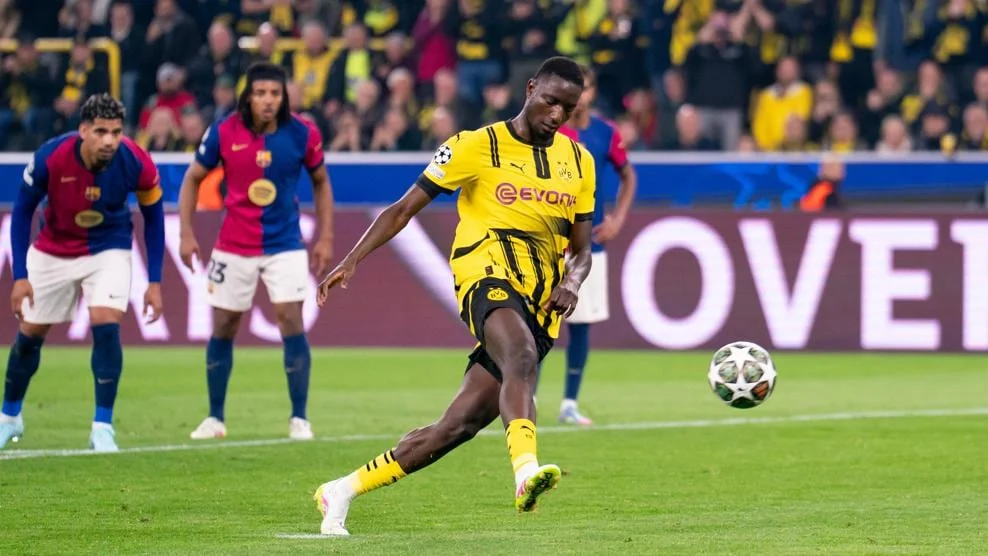
Serhou Guirassy gives Borussia Dortmund a central scoring threat through well-timed movement, varied finishing and the ability to connect with teammates. This guide explains his No. 9 role using verified Bundesliga records and specific match sequences, including the four-goal display against Union Berlin and his Champions League hat-trick against Barcelona.
Why Dortmund signed Guirassy
Serhou Guirassy gives Borussia Dortmund a central striker who can finish attacks and help connect them. His July 2024 move from Stuttgart followed a Bundesliga season of 28 goals in 28 appearances. That was an exceptional scoring record, but Dortmund's recruitment announcement also emphasised his contribution to closing down opponents. The club's stated interest extended beyond the final touch.
The Guinea international was born in Arles, France, and arrived at Stuttgart from Rennes in 2022. Dortmund then signed him on a contract running until 30 June 2028, a detail confirmed in the club's annual report. These are the useful foundations for understanding his Dortmund story: an established striker arriving after a major breakthrough, rather than a prospect being asked to learn the position from scratch.
From a tactical perspective, the attraction of a central reference point is straightforward. Wide players and attacking midfielders need someone who makes the penalty area a meaningful destination for their passes. If the striker can occupy a centre-back, receive a difficult ball and then attack the next delivery, the team gains several routes towards goal. Guirassy's role can be understood through that combination of presence and movement.
Presence does not require standing still. A centre-forward can hold a position long enough to affect a defender, then change it when a teammate is ready to pass. That sequence is particularly useful for supporters to follow because the decisive action may come before Guirassy touches the ball. His run can determine which passing lane opens and how much time a teammate has to use it.
There is also a practical distinction between the club's recruitment rationale and any single formation. Calling Guirassy a No. 9 describes his principal attacking responsibility; it does not mean every Dortmund attack must be a cross, or that he must remain between the same two defenders throughout a match. The position gives the team a focal point while leaving room for combinations, channel runs and changes in the direction of the attack.
The most useful way to assess the signing is therefore to watch the whole attacking sequence. Look at where he starts, whether he offers a playable pass, and how quickly he becomes available again after releasing the ball. A shot or goal is the outcome of those decisions. The following sections explain the movement, finishing and support around him that make the outcome more likely.
For the confirmed recruitment details, see Dortmund's signing announcement and the 2023/24 annual report. Neither a reported fee nor a salary estimate is needed to explain his footballing role.
How he creates space inside the penalty area
Guirassy's penalty-area work is easier to understand by watching his relationship with the nearest defender and the teammate delivering the ball. The useful question is where a playable gap will appear. Reaching that gap at the right moment matters more than running continuously or making the longest possible sprint.
Moving across a defender's blind side
A defender dealing with a cross must monitor both the ball and the striker. When Guirassy moves beyond that defender's immediate field of view, the defender has to turn or check his position again. A small separation can be enough for the striker to reach the delivery first. This is the principle behind watching the blind side: the advantage comes from the changing relationship between two players, not simply an empty patch of grass.
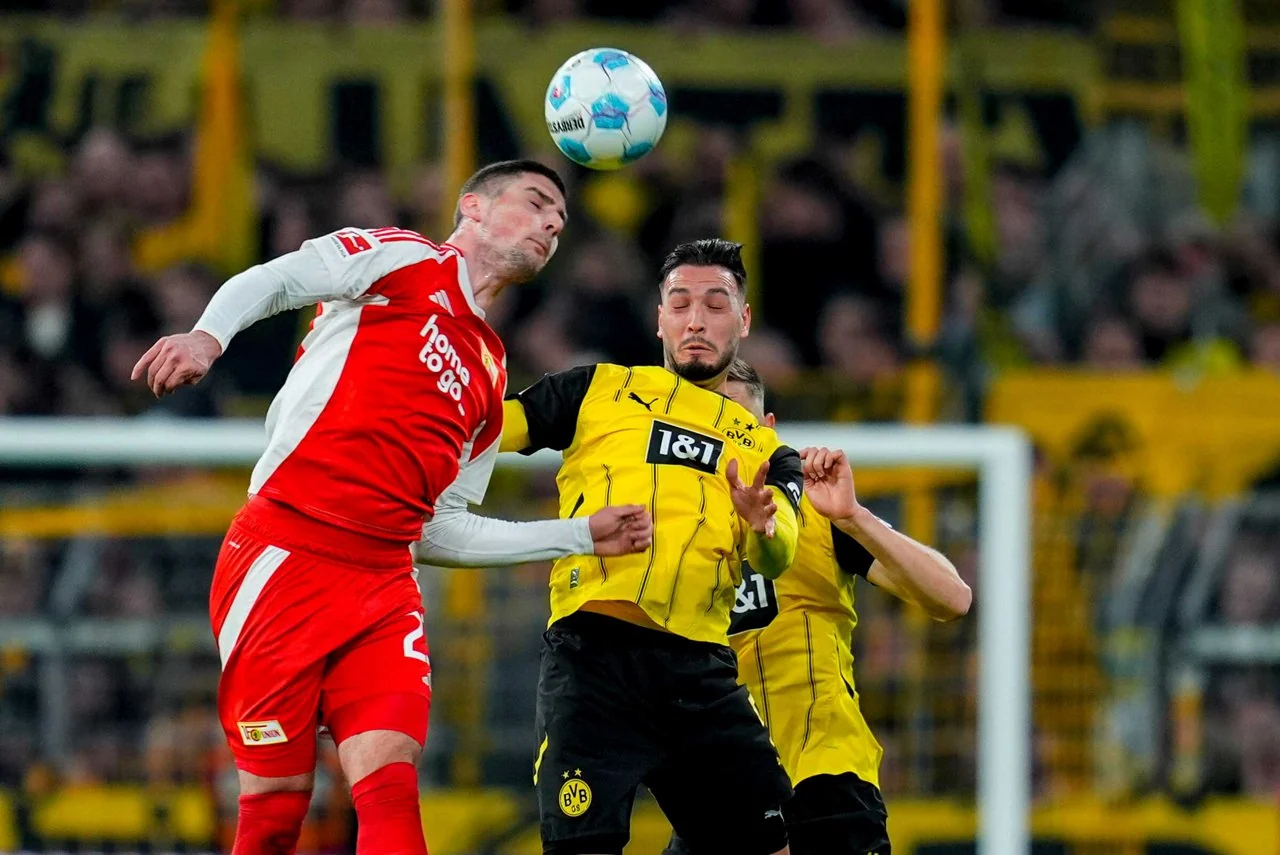
Consider the far-post header that put Dortmund 2-0 ahead against Union Berlin on 22 February 2025. Pascal Gross delivered from the left and Guirassy finished from close range. The destination of the cross is important: Dortmund did not need him to receive beside the ball carrier. They needed him to become available across the goalmouth, where the delivery could bypass the immediate pressure.
As a viewing exercise, follow the striker before the cross is struck. Is he close enough to affect a defender's position? Does he pause while the passer prepares the ball, then move as the defender turns towards it? Does another attacker occupy the near-post space? Those observations help explain how a close-range finish can still involve significant work before contact.
This is an interpretation of the movement principles, rather than a claim that every Guirassy goal uses one identical run. Some attacks require him to attack the near post; others leave space centrally or at the back post. The delivery and the defensive line determine which destination is valuable.
Matching the finish to the delivery
The same Union match demonstrated several different finishing situations. Guirassy scored four times in Dortmund's 6-0 victory. Alongside the far-post header, he converted after Gross returned a rebound, finished a delivery from Maximilian Beier in the middle, and added another header from a Gross cross. These were distinct chances within one outstanding performance.
A headed finish requires him to meet the flight of the ball while competing for position. A lower delivery asks for different preparation: a stable body shape, a foot ready to make contact and enough control to direct the ball before a defender intervenes. A rebound adds another demand because the striker must respond to a second phase rather than assume the first shot has ended the attack.
The practical lesson is to look for readiness as well as technique. Does Guirassy remain available after an initial attempt is blocked? Can he adjust when the cross arrives at a different height? Does he choose a compact finish when there is little time? These questions are more useful than expecting every chance to produce a spectacular strike.
The goal sequences are documented in BVB's Union match report. The broader Bundesliga striker analysis provides context for the combination of ball skills and finishing.
A reference point for Dortmund's combinations
Guirassy can help an attack progress before becoming its finisher. The Bundesliga's November 2024 analysis describes his ability to drop towards the ball, resist a defender's pressure and connect with advancing teammates. Its December feature on Dortmund's attack also identifies link-up play as an important contribution beyond his goals. Those descriptions explain why a centre-forward's useful work cannot be reduced to touches inside the six-yard box.
The value of receiving with a defender close behind is that it gives a teammate a stable destination for the pass. Guirassy does not necessarily have to turn immediately. A controlled lay-off can return the ball to a player facing the goal, allowing that player to continue the attack with a clearer view of the runners. The striker has helped change the direction and angle of the play.
For the defence, that creates a choice. Following the striker towards the ball can open space behind the centre-back. Holding the defensive line can give him more time to receive. The effect depends on the surrounding players: a forward dropping short is much more useful when another teammate threatens the space he has vacated. Without that second movement, the same reception may simply bring everyone into a crowded area.
Linking play without abandoning the scoring zone
The next movement is essential. Once Guirassy releases the ball, Dortmund still need a central attacker available for the eventual chance. A successful combination therefore involves both the pass and the striker's return towards a scoring position. He can link an attack without spending the whole possession far from goal.
Imagine a simple sequence in which a midfielder passes into him, Guirassy lays the ball off, and a wide teammate then receives facing the box. The lay-off has done its job only if the team can use the new angle. Guirassy may then attack the cross while another runner occupies a different part of the penalty area. This example illustrates the principle; it is not a claim about a compulsory Dortmund pattern in every match.
Supporters can assess the sequence by looking at the quality of the next action. Did the lay-off reach the teammate's usable foot? Did it allow the receiver to play forward quickly? Did the striker move again while the defence was adjusting? The pass need not be an assist to have made a real contribution.
His central role also differs from that of a midfielder organising the entire possession phase. A few deeper receptions do not automatically turn the team into a false-nine system. The meaningful distinction is what happens afterwards: Guirassy's finishing threat remains a major destination of the attack, even when he helps create the route to it.
The league's striker comparison and December 2024 attacking analysis support this broader reading of his role. Their match context is historical; the combination principles help explain what to watch in subsequent Dortmund games.
What his scoring record tells us
Guirassy's scoring record provides evidence that the finishing threat travelled with him from Stuttgart to Dortmund. To read that evidence properly, keep the season, competition and number of appearances together. A league total, a Champions League total and a calendar-year total answer different questions and should not be treated as interchangeable.
Stuttgart's 28-goal season and Dortmund's league return
In the 2023/24 Bundesliga, Guirassy scored 28 times in 28 appearances for Stuttgart. Opta's career record lists four of those goals as penalties. In his first Dortmund league season, 2024/25, he scored 21 in 30 appearances, including three penalties. The official Bundesliga ranking places him level with Patrik Schick on 21, behind Harry Kane's 26.
For the next completed league season, 2025/26, Opta records 17 goals in 33 appearances. Stating that separately preserves the difference between the breakthrough Stuttgart campaign and his subsequent Dortmund output. These totals also avoid presenting an old in-season snapshot as a final figure.
The progression shows sustained league production across different team contexts. It does not mean the scoring rate was identical: 28 goals in 28 appearances and 21 in 30 are plainly different returns. Appearances also include varying playing time, so goals per appearance should not be described as goals per 90 minutes.
Penalties are worth separating because they are a specific type of chance. They remain legitimate goals, but a total containing penalties cannot by itself describe how frequently a striker finishes open-play attacks. To understand that part of Guirassy's contribution, combine the season figures with the movement and match sequences discussed above.
The underlying figures come from the Opta career record and the official 2024/25 Bundesliga scoring table. They provide a sounder comparison than mixing league goals with every competition Dortmund entered.
The Champions League run and Barcelona hat-trick
Guirassy finished the 2024/25 Champions League with 13 goals, sharing the top of UEFA's scoring ranking with Barcelona's Raphinha. Opta records 14 appearances and five penalties within that competition total. The numbers belong to the Champions League campaign itself, rather than a combined league-and-Europe tally.
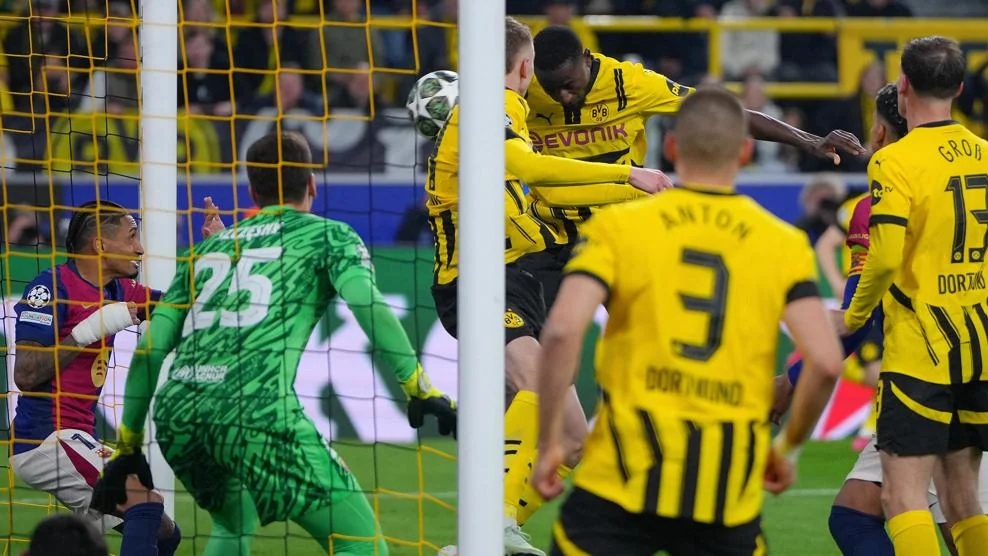
The defining knockout example came on 15 April 2025. Guirassy scored a hat-trick as Dortmund beat Barcelona 3-1 at home in the quarter-final second leg. He opened with an 11th-minute penalty, headed in his second after the interval and completed the treble with a finish following a loose clearance. The goals again involved different skills and different kinds of opportunity.
Yet Dortmund went out 5-3 on aggregate after losing the first leg 4-0. That detail is essential to the match's meaning. A striker can produce an outstanding individual performance while his team still falls short across a two-leg tie. The second-leg score describes the evening; the aggregate describes qualification.
For supporters, the match offers a useful bridge between statistics and role analysis. Guirassy's penalty composure, close-range positioning and reaction to a loose ball all contributed to the treble. The wider tie also shows why finishing cannot solve every team problem: the striker's goals operate within what Dortmund create and concede across the whole contest.
See UEFA's final scoring ranking and its quarter-final report for the competition and match context.
Pressing, service and the limits of the No. 9 role
Guirassy's effectiveness depends partly on what Dortmund do around him. A centre-forward can make a good run without receiving the ball, or offer a useful lay-off without a teammate arriving to collect it. His individual actions matter, but their value is realised through the team's spacing, passing and timing.
Defensive pressure works in the same collective way. The first forward can influence the direction of an opponent's pass, but he cannot close every exit alone. The players behind him must be close enough to contest the next ball. For viewers, the relevant question is whether Dortmund's pressure produces a less comfortable next action for the opponent, rather than whether one striker appears to chase constantly.
A January 2026 example makes the connection between team pressure and finishing concrete. Dortmund's post-match account of the 3-0 home win over Werder Bremen explains that Jobe Bellingham's pressure helped create the error from which Guirassy scored the third goal. Guirassy supplied the finish, while a teammate's work helped create the opportunity. Both contributions belong to the same sequence.
The account also describes a change from 3-4-3 to 3-5-2 after Guirassy and Bellingham entered in the 66th minute. That is a specific historical adjustment, not a promise about Dortmund's next lineup. It demonstrates that the striker's role can be supported through a different midfield balance and a second forward, depending on what the match requires.
When Dortmund face a deep defensive block, watch the preparation of the service. A hurried cross from a poor angle may ask Guirassy to win a difficult duel against a settled defence. Moving the ball to a teammate with time to look up can create a more usable delivery. The striker's run and the passer's preparation need to meet at the same moment.
When the team have space to counter, a different question becomes useful: does the first pass allow him to keep the attack moving? He may receive centrally and release a runner, or attack a channel while someone else carries the ball. The same player can be a receiver in one phase and the final target in the next.
For upcoming games, use the Bundesliga fixture schedule to identify the match, then follow three linked actions: his starting position, the quality of the service, and his movement after the first contact. That gives a fuller explanation of his contribution than judging every appearance solely by whether he scores.
The Bremen post-match report and the coach's August 2025 discussion of attacking options provide concrete team context. Guirassy's central scoring threat remains the starting point; combinations, service and coordinated pressure explain how Dortmund can bring that threat into the game.
JOIN THE DISCUSSION
Comments
Sign in with Google to comment. Keep the discussion focused on Bundesliga football and respectful to other supporters. New comments are reviewed before publication.
Loading comments…