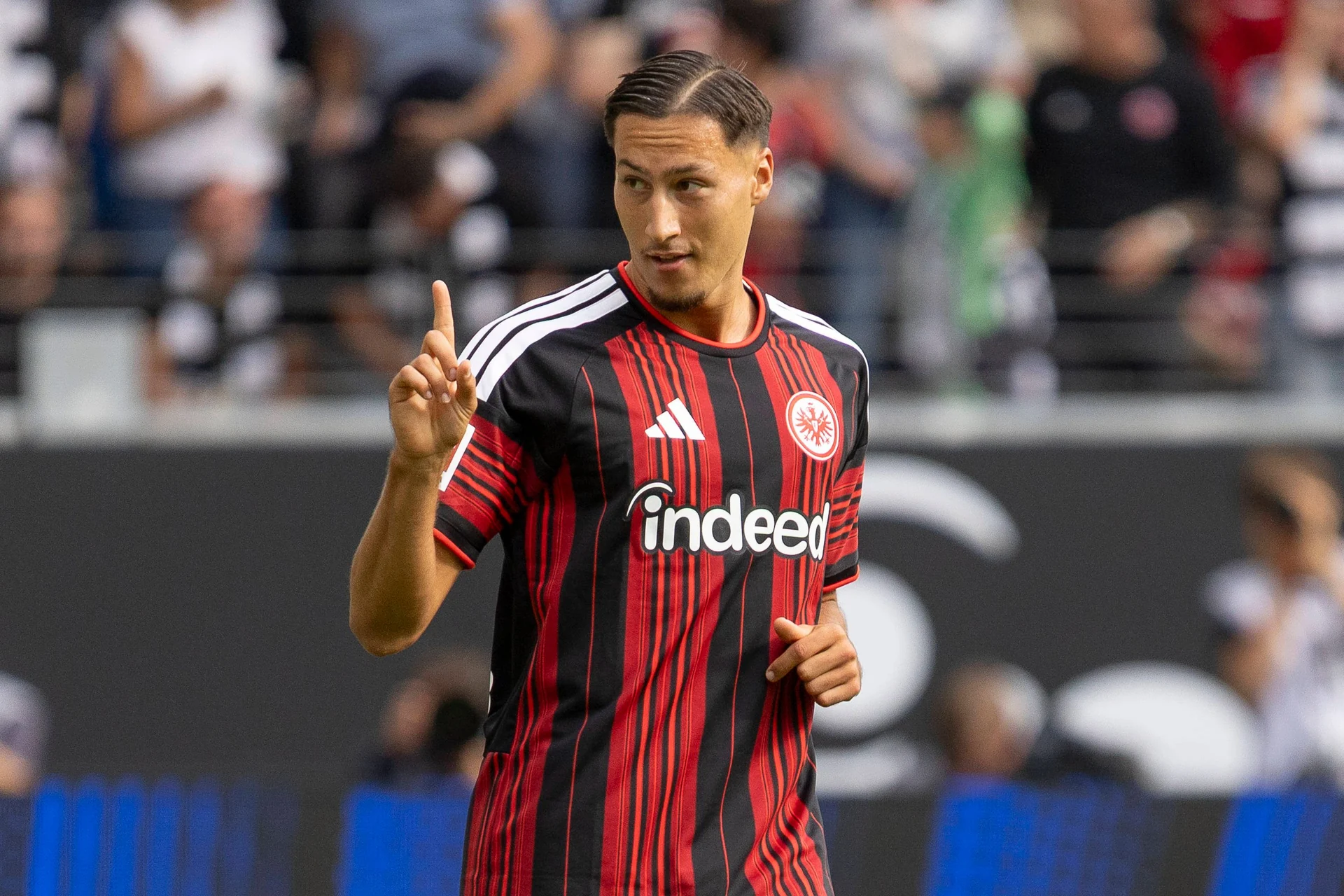
Younes Ebnoutalib is Eintracht Frankfurt's German centre-forward, born in the city on 13 September 2003. His route to the Bundesliga passed through Italy, Gießen and a breakthrough at Elversberg before he joined his hometown club in January 2026. His rapid rise is compelling, but understanding it requires separating the career story, his penalty-area strengths and the evidence from a still-developing top-flight sample.
Who is Younes Ebnoutalib?
Ebnoutalib is a centre-forward for Eintracht Frankfurt, wearing number 11. He turned 23 on 13 September 2026. Frankfurt is both his birthplace and the club where his progress has become most visible, making his return more personal than a routine step between teams. His contract, agreed when he moved from Elversberg, runs until 30 June 2031.
The simplest description of his game is a striker who wants to operate close to goal. That does not mean his contribution begins only when a cross arrives. Finding the next receiving space, protecting a first touch and adjusting to a defender's position are all parts of producing the eventual finish. The Bundesliga's account of his rise highlights close control and movement in the box, rather than presenting him solely as a player who wins headers.
His background also differs from the familiar story of a celebrated teenager moving directly from a major academy into the Bundesliga. He played at local clubs, spent time in Italy and returned to German football before gaining a sustained professional opportunity. The wider attention followed his senior performances. A reader discovering the name through Frankfurt or Germany should therefore see a career that developed in stages, not a player who appeared from nowhere.
The local connection matters because it gives supporters an immediate way into the story. Eintracht's own profile describes playing for the club as a childhood ambition. That is meaningful biographical context; it is not evidence that he will score more often at home or automatically cope with every pressure. The football assessment still needs to stand on his movements, choices and output against Bundesliga defenders.
His ascent has also made nationality part of the conversation. The Bundesliga's September 2026 update records his Germany debut after earlier eligibility for Morocco. A national-team breakthrough signals recognition of his club performances, but it should be treated as an event at a particular stage rather than a guarantee of a permanent role. International selections and club starting places remain different questions.
For anyone first encountering him, the useful starting point is therefore clear: a Frankfurt-born German striker who earned a return through goals elsewhere. The Bundesliga team directory places his club within the league. The next step is to understand how a series of less obvious career decisions prepared him for the opportunity that eventually arrived.
The route from Frankfurt to Italy and back
The important sequence in Ebnoutalib's career is local youth football, Perugia, Gießen, Elversberg and Eintracht. It was not a continuous climb in which every move immediately produced more attention. Frankfurt's own portrait describes the return from Italy as a period of rebuilding after a fractured metatarsal and a difficult spell away. That context helps explain why the fourth tier became a valuable step rather than an embarrassment to remove from the story.
Perugia and Gießen came before the breakthrough
Playing abroad brought a different football culture and distance from familiar surroundings. The spell at Perugia preceded his summer 2024 return to Hesse. At Gießen, he had to recover confidence through everyday football before the move into the professional divisions became possible. His interview with Eintracht stressed that progress was not immediate and that belief from those around him mattered during the recovery.
That makes the level of competition relevant. Gießen's fourth-tier setting offered an opportunity to play and demonstrate his qualities, but it did not automatically prove he was ready for Bundesliga defences. Elversberg represented the next test. Moving there on 1 January 2025 placed him in the second division, where the time, physical pressure and consequences of each action changed again.
| Stage | Why it matters |
|---|---|
| Frankfurt-area youth clubs | Local roots and early football development |
| Perugia | Italian experience followed by an interrupted spell |
| Gießen, summer 2024 | Return to Hesse and fourth-tier rebuilding |
| Elversberg, January 2025 | Entry into Bundesliga 2 |
| Eintracht, January 2026 | Top-flight move back to his birthplace |
Why returning to his home city mattered
For a player who had grown up around Frankfurt, joining Eintracht connected professional ambition with an existing attachment. The club's portrait records his emotional response to signing. It also notes his previous acquaintance with Elias Baum at Elversberg, giving him a familiar football connection as well as a familiar city. A move can be a major sporting adjustment even when the destination feels like home.
The supporter appeal is obvious: someone who once watched the club can become part of the team. The useful editorial distinction is that belonging explains the significance of the move, while performance explains the opportunity. Eintracht signed him after evidence in senior football, not merely because he was local. Keeping both ideas in view avoids turning a serious sporting story into a sentimental shortcut.
Our guide to the German league system explains the divisions involved. Ebnoutalib's route shows how those levels can operate as different stages of development. A season outside the spotlight can provide the recovery and match experience needed for a later step; the destination alone does not tell you what happened along the way.
How Elversberg turned opportunity into a Bundesliga move
Joining Elversberg did not immediately make Ebnoutalib a regular scorer. The club's departure announcement records six short appearances across the league and promotion play-off during his first half-year. With Fisnik Asllani occupying an important attacking role, the new arrival had to wait. The opportunity changed after Asllani returned to Hoffenheim in summer 2025, leaving space for a different forward to establish himself.
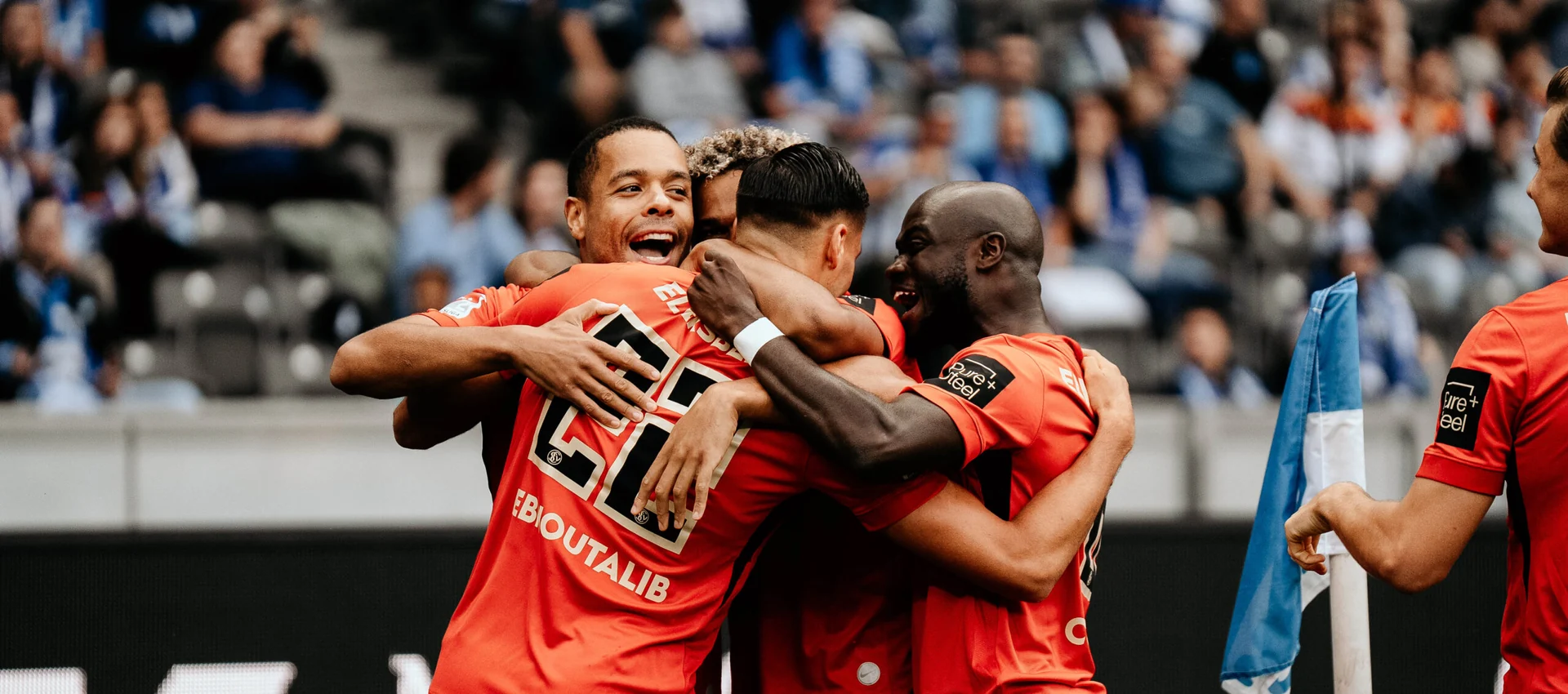
Vincent Wagner gave him his first start on Matchday 4 after three substitute appearances. Elversberg's report of the Berlin victory describes the striker's first two goals for the club, including an opener from a tight angle after work near the byline. That detail is useful because it shows a contribution beyond standing centrally for a routine finish. He had to make the situation dangerous before converting it.
What 12 goals in 17 matches actually tells us
By the winter break of 2025/26, Ebnoutalib had scored 12 goals in 17 Bundesliga 2 appearances. Elversberg's announcement also gives 13 starts. Those numbers describe the first half of the league campaign, not a completed 34-match season. They explain why his name attracted attention quickly: the productivity arrived during a sustained period of selection, rather than as a single memorable cup performance.
Dividing 12 by 17 gives about 0.71 goals per appearance. That is not a per-90 rate, because an appearance can be a short substitute outing or almost a full game. The distinction protects the comparison from false precision. To assess efficiency more closely, minutes and shot quality would also be needed. To explain the transfer, the simpler evidence is already meaningful: a striker given a larger role repeatedly scored at the professional level.
The Bundesliga's profile adds that he scored the opening goal on five occasions during that run. An opener changes the tactical problem facing both teams. The opposition may need to leave a compact structure and attack more aggressively; Elversberg can gain room for subsequent moves. A striker's first goal in a match can therefore matter beyond its place in a personal total, even though every scoreline must still be managed by the team.
Frankfurt moved at the point when that evidence was strong enough to justify a top-flight opportunity, while the broader career remained relatively short. That is different from claiming the second division had become too easy or predicting that the same scoring rate would continue automatically. The Bundesliga move changed the level of defenders, the speed of decisions and the expectations around him. Elversberg supplied the chance to demonstrate his qualities; Eintracht offered the next test.
What kind of striker did Frankfurt sign?
Frankfurt recruited more than a name at the top of a scoring chart. Sporting director Timmo Hardung's description included physical presence, footballing quality, work rate and dynamism. That combination matters because a striker must help the team reach the finishing situation as well as convert it. Ebnoutalib's record provided the headline; the broader assessment concerned how his skills might function within a Bundesliga attack.
Finding space inside the penalty area
The Bundesliga's profile states that all his 2025/26 second-division goals came inside the penalty box. That location does not make the chances effortless. A forward must arrive in the right lane at the right time, often with a defender blocking the direct route. A small adjustment towards the near post can open a gap behind him; briefly moving away from goal can create room to attack the next delivery.
Close control helps when the first contact does not leave a clean shot. A striker may need to protect the ball, shift it out of a defender's reach or finish before the goalkeeper has set. The relevant quality is therefore the connection between movement and touch. Arriving early but losing control can waste a good run. Controlling the ball neatly in a crowded area is less valuable if the player never gains a useful angle.
His physical presence creates another question for opponents: how tightly should a centre-back follow him? Staying close can prevent an easy reception but risk leaving space for a runner. Holding the line can give the forward room to turn. This is a general tactical explanation of the problems his role can create, not a claim that Frankfurt use one fixed pattern or that he wins every duel.
The strengths and limits of the Klose comparison
The league's comparison with Miroslav Klose points towards penalty-area instinct and a less conventional route into elite football. It offers a useful image for a reader unfamiliar with Ebnoutalib: a forward whose value includes locating the scoring space before everyone else recognises it. The comparison should stay at that level. Klose's international record and long top-flight career are achievements, not a forecast attached to a younger striker.
Nor should the analogy make supporters expect only headers. The evidence emphasises close control, physical presence and an eye for goal, so watch the range of situations in which he becomes available. A finish at the far post, a touch under pressure and a run behind the back line test different qualities. Evaluating those actions is more informative than asking whether every goal resembles a famous predecessor's highlight.
The most useful description is a box-oriented striker with enough footballing ability to contribute around the chance. His next stage depends on repeating those decisions against better-prepared opposition. A scouting comparison can introduce the player, but it cannot replace assessment of his own developing body of work.
From an interrupted debut season to Germany recognition
Ebnoutalib's first Frankfurt months and his opening to 2026/27 should be read as different chapters. On 9 January 2026, he scored on his Bundesliga debut in a 3-3 draw with Borussia Dortmund. It was an immediate introduction to the top flight, but it did not become an uninterrupted run of games. A knee ligament injury suffered at Stuttgart disrupted the opportunity to build on that first appearance.
The club's diagnosis described a medial ligament injury and an absence in the following weeks. That report explains an interruption at the time; it is not a medical forecast for his future career. When evaluating a new signing, missing football changes the sample available to judge. Training, match rhythm and relationships with teammates all need repetition, and an early goal cannot supply those experiences on its own.
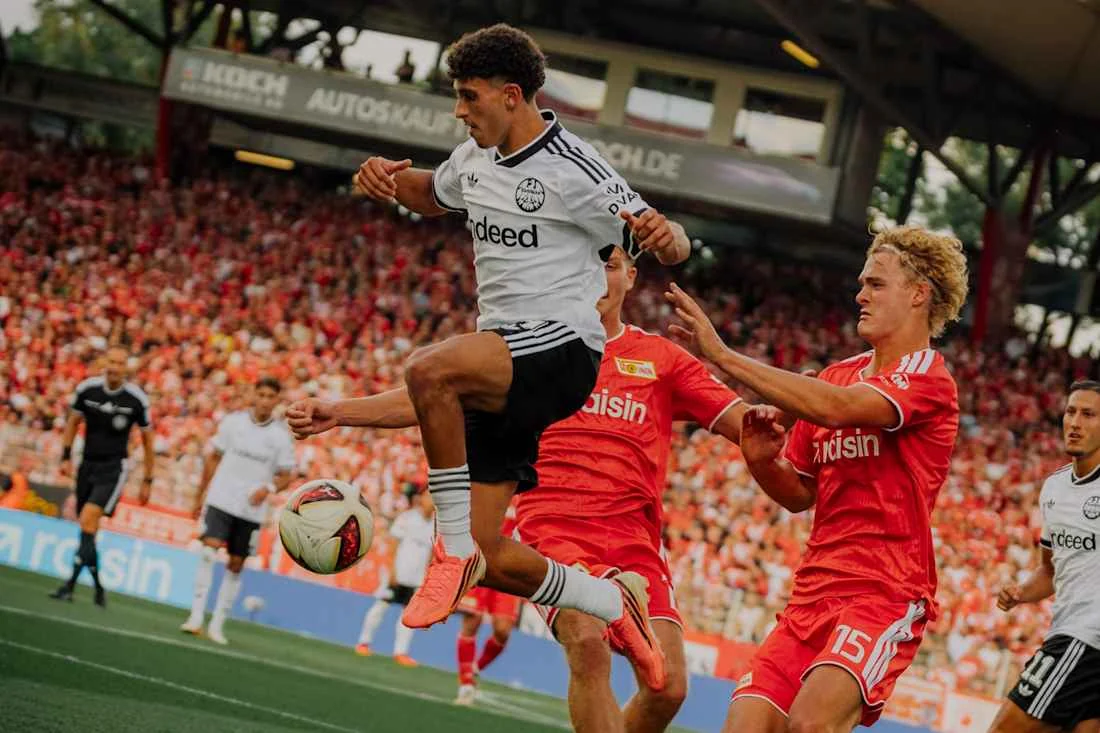
The opening league match of 2026/27 brought a striking response. Ebnoutalib scored all three Frankfurt goals in a 3-3 draw at Union Berlin on 29 August. The hat-trick confirmed his ability to produce at Bundesliga level, while the scoreline also preserved an important distinction: an outstanding individual afternoon did not deliver a team victory. Frankfurt still had to manage the game around his goals.
That distinction helps supporters judge the performance without flattening it. The striker can do his immediate finishing job exceptionally well, yet the side may concede enough to lose points. Conversely, a match with no goal can still include useful work from the forward. The hat-trick is strong evidence of a capability, but the broader assessment needs the surrounding football and the subsequent sequence of appearances.
Germany recognition followed in September. The DFB's report of the 1-1 Nations League draw against the Netherlands on 24 September records Ebnoutalib coming on for his international debut in place of Kai Havertz. That provides a precise milestone, distinct from receiving the call-up or attending national-team training. A debut is the moment the player actually enters a senior international match.
The speed of that progression makes the story compelling: a second-division breakthrough, a top-flight move, an injury interruption and then international football. It also argues for careful expectations. Different stages ask different questions of the player, and each recognition adds pressure as well as opportunity. The useful conclusion is that his performances earned a larger platform; the next period will determine how consistently he can use it.
How to judge his next stage at Frankfurt
Ebnoutalib's next challenge is to make his useful actions repeatable when opponents know more about him. After a breakthrough, defenders can prepare for a striker's preferred movements and teammates can develop more ambitious expectations. The question becomes how he adapts when the first route to goal is closed. That is a more productive assessment than demanding a fresh headline in every match.
In his first Eintracht press conference, he discussed learning, work on his game and the physical flexibility associated with his taekwondo background. Those comments describe his approach; the matches must demonstrate the outcome. Frankfurt's October report of his September player award, with 49 percent of the fan vote, shows the response to his performances. A vote recognises a period, not an entitlement to the next starting place.
Watch the whole attacking sequence, not only the finish
Begin by watching where he positions himself before the ball enters the box. Is he close enough to occupy a centre-back but far enough away to change direction? Does he attack the delivery immediately or wait for the defender to commit? The finish makes the highlight, but these choices determine whether a cross reaches a player with room to use it. A run that helps someone else score can still be valuable.
Next, examine his first contact when Frankfurt play into his feet. Can he keep the ball available to the next teammate, or does the attack end under pressure? A striker does not need to turn every reception into a personal attempt. Sometimes the best action is a short lay-off that lets a midfielder face goal. The quality of that connection helps explain whether the team can sustain pressure around him.
Then consider his work when the opposition have possession. Does his movement direct the ball towards the area Frankfurt want to contest? Does he respond after a turnover, or remain detached from the next phase? Recruitment comments about work rate become meaningful through those situations. Avoid assigning an invented pressing score; the useful observation is whether his action fits the response of nearby teammates.
Finally, judge a sequence of games instead of a single afternoon. Minutes, opponents and the team's supply all affect a striker's opportunities. An appearance from the bench asks a different question from a start against a deep defence. Use the Bundesliga results to place performances in order and the fixture list to find the next test. His rise has earned attention; the football that follows will show how far those developing strengths can take him.
JOIN THE DISCUSSION
Comments
Sign in with Google to comment. Keep the discussion focused on Bundesliga football and respectful to other supporters. New comments are reviewed before publication.
Loading comments…